

Even though hospitals are becoming increasingly overwhelmed due to the rising number of COVID-19 patients to care for, staff members at Mercy Hospital Jefferson in Crystal City say the news that vaccinations soon will be available gives them hope.
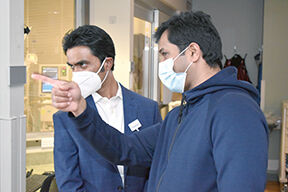
Dr. Karthik Iyer, Mercy Jefferson chief medical officer and intensive care unit medical director, said the vaccines are a welcome development in the fight to control the virus.
“I feel the morale is better than what we would have seen a couple of months ago, and I think the news about the vac
cine has a lot to do with it,” he said.
Iyer, 40, of Frontenac, who has worked at Mercy Jefferson for seven years, said the vaccine news is good for everyone, but especially for the medical community.
“The health care community basically put themselves in the line of fire almost every day,” he said. “I think it (the vaccine) gives them a certain sigh of relief that, if it is as effective as claimed, we have more tools to feel protected so we can take care of the patients who need to be taken care of.
“It’s been a challenging time. We keep going with the understanding that we are going to emerge victorious, eventually.”
Respiratory therapist Kimberli Taylor, 51, of Jackson who worked in the field for 29 years and has been at Mercy Jefferson for 17 years also has a sense of hope because of the vaccine.
“I just feel like it’s on the horizon for us,” she said. “In the meantime, we just have to do the best we can to get through this and prevent the spread.”
Missouri Department of Health and Senior Services Director Dr. Randall Williams said Dec. 4 that Missouri is expected to receive its initial 339,775 vaccine doses by the end of December. He said long-term care residents and staff members, as well as health care providers, are expected to be among the first people who receive the vaccinations.
Williams said he believes those initial doses will be enough for all the long-term care facilities to receive the vaccinations they need.
He said Missouri will receive both Pfizer and Moderna vaccines, but only after the federal Food and Drug Administration (FDA) approves them.
Williams said the vaccines are expected to be available by early summer for anyone who wants it. He also said the vaccines will be free, but health care providers could charge up to $25 to administer each one.
Mercy Jefferson staff members say the vaccines can’t come soon enough because hospital systems and health care workers are overtaxed.
On Dec. 2, there were 36 COVID-19 patients hospitalized at Mercy Jefferson, hospital spokesman Joe Poelker said.
Since the start of the pandemic, the hospital had treated 1,237 COVID-19 patients, and 494 of those had been hospitalized, Poelker said.
Both Taylor and Iyer said it’s unusually time-consuming to care for
COVID-19 patients.
Iyer said one thing that makes treating COVID-19 patients difficult is the time it takes to “don” personal protective equipment before entering a room and to “doff,” or remove, the PPE after leaving a room.
“You just can’t walk into a room like in a normal situation, have a conversation and walk out,” he said.
Iyer said communicating with a mask on can be difficult, so he often must repeat himself, which takes more time.
Also, he said a patient on a ventilator requires extra care, requiring several nurses’ time.
Taylor said the biggest struggle she has faced is the lack of positive outcomes for so many patients.
“For the most part, if we do certain things, we have a certain outcome,” she said. “Now, it’s just kind of bleak to see so many people who still, despite our best efforts, cannot survive the virus.”
Taylor said it is also emotionally draining to care for patients who are isolated from family members.
“Their family members are literally standing on the other side of a glass wall watching their loved ones die because they can’t go in, or we’ve seen people FaceTiming their loved ones who are on ventilators,” she said.
Registered nurse Steven McKenzie, 31, of Festus, who has been a nurse for nine years and has been at Mercy Jefferson for two and a half years, said the ICU has been at full capacity several times, which poses a lot of challenges, including staffing the unit.
“That’s pretty stressful,” he said. “A lot of these patients are a lot sicker than the normal.
“We had patients in the hospital for the flu in the past years who were very sick and required a lot of support, especially in the intensive care unit, but the COVID patients are so much sicker and require more support than we’re used to.”
ICU nurse manager Tyson Davis, 33, formerly of De Soto, said once a bed in the unit becomes empty two or three people are waiting to fill it.
Davis, who now lives in Sunset Hills, said before the pandemic, the daily average number of patients in the ICU was eight with 12 beds.
“Since COVID, we have been running 11 patients,” he said. “We like to keep one bed available in case of emergencies, and many times we are unable to do that at this time.”
Davis said COVID-19 patients often have long stays in the ICU, which adds to the problem.
Typically, the average ICU stay is three to four days, but COVID-19 patients stay in the unit longer, Davis said.
“These (COVID) patients are staying in the ICU for 14, 20 days, and all 20 of those days not getting much better,” he said. “As health care workers, we want to be fixers, and we take pride in fixing people and helping them improve and get back to their healthy life. So, when it’s 14 days in, and we’re not seeing much improvement in some of the individuals we take care of, it’s very draining emotionally, because you want to help them get better.”
Taylor urges residents who want to help health care workers to do two simple things. “I would suggest they wear their masks and they stay at home,” she said. “That’s the best thing they can do for us.”