

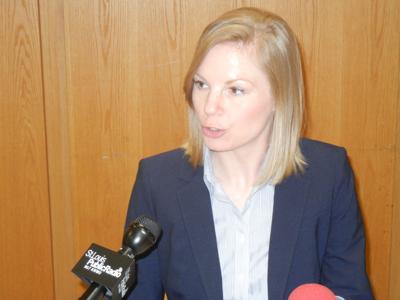
The Fox C-6 School District has made “major improvements” since last year’s audit of the district, which reportedly “found inappropriate spending and severe mismanagement by the former district superintendent,” Missouri State Auditor Nicole Galloway said last week when she released results of a follow-up report.
As part of the 2016 audit, Galloway recommended the district adopt new policies to prevent future abuses.
In the follow-up report, Galloway said the district has made changes based on her advice.
“The Fox School District administration has made great improvements since the last report was issued (in May 2016), and I’m pleased to see so many of my recommendations have been put into place to better serve students, families and taxpayers,” Galloway said in an April 19 written statement.
The current Fox superintendent, Jim Wipke, said he was happy with the recent findings of the Auditor’s Office.
“We were pleased with the state auditor’s review of what we’ve accomplished in a very short amount of time,” he said. “We’ve made great strides as a district and we’re always going to utilize resources in the best interest of our students, and that follow-up report is showing us doing that.”
Dianne Critchlow, the superintendent Galloway referred to in her report, retired in 2014, following allegations that derogatory online comments about district residents were traced to computers at her home.
Later, the Jefferson County Prosecuting Attorney’s Office, a special prosecutor from St. Charles and the U.S. Attorney’s Office looked into allegations the Auditor’s Office made that Critchlow had misspent taxpayer money to benefit herself and her husband, Jamie Critchlow, another district administrator who was fired in 2014.
All three agencies decided against filing criminal charges.
At the time, Critchlow’s attorney, Brandy B. Barth, said the decision not to file charges showed there was no evidence of misspending.
“These allegations have been found to be baseless and Dr. Critchlow has been cleared of any criminal wrongdoing,” Barth said.
But, according to the audit report, which was released in May 2016, the district’s “former administration racked up nearly $100,000 in questionable expenses with little oversight by the board.”
Changes in credit card,
purchasing policies
According to the audit completed last year, “credit card records showed hundreds of purchases that appeared to be personal in nature or otherwise inappropriate, without adequate board review and in violation of the district’s credit card policy,” Galloway said. “Purchases ranged from common items, like coffee, batteries and shampoo, to more extravagant ones, like digital cameras, smartphones and logging equipment. Thousands of dollars were spent on gift cards for places ranging from Buffalo Wild Wings to Macy’s. The lack of oversight that allowed these issues to occur has been addressed through new policies and procedures, implemented at the district level.”
The follow-up report said the audit “identified concerns with 36 percent (or $96,745 of $268,935) of the expenditures reviewed on three credit cards assigned to (Critchlow) or her administrative assistant. In addition, we identified concerns with 77 percent (or $3,394 of $4,383) of the expenditures reviewed on an assistant superintendent’s credit card.”
Among the credit card charges were “$56,702 that did not seem reasonable and/or provide a benefit to the school district,” the Auditor’s Office report said.
In addition, $8,877 in credit card purchases had no “adequate supporting documentation, and in some cases no documentation beyond the credit card statement,” according to the report.
Galloway said that problem occurred partly because “the superintendent reviewed and reconciled her own credit card statement” instead of the district’s accounts payable department, which reviewed the other credit card statements.
Over the past couple of years, the district has revised its “purchasing policy,” limiting the number of employees who may have credit cards and the amounts that may be charged on them, as well as requiring documentation for all purchases. In addition, the district’s accounts payable department examines all the documenta tion to make sure they don’t violate law or district purchasing policies, the follow-up report says.
As part of the follow up, the Auditor’s Office reviewed recent purchases made on several district credit cards and “identified no problems with the statements and supporting documentation,” the report said.
Galloway said the district still buys some gift cards, but chief financial officer John Brazeal, who was hired in 2014, has implemented a “gift card policy” that limits their purchase to a few instances, like for a prize for a student contest or fundraising activity. Also, records must be kept about gift card purchases.
Salary oversight
Another problem the Auditor’s Office identified in its audit report was “salary manipulation” that led to “adjusted contracts and administrator raises based on incorrect and inconsistent use of salary schedules.”
As a result, Galloway said, “a number of administrators, including the former superintendent, received inappropriate salary increases that were not approved by the board.”
The Auditor’s Office claims that Critchlow “was paid $12,456 more than the amount approved in her contract for the 2012-2013 (school year). The superintendent was also issued four contracts for the 2013-2014 school year and there was no documentation that the board discussed and approved the three contracts established after approval of the initial contract. The superintendent was paid based on the second, third and fourth contract salary amounts, receiving a salary increase mid-year that was applied retroactively to the full school year. Also, the salary provided for in the third and fourth contracts was used for the superintendent’s settlement agreement with the district.”
Since the audit, the district has implemented a policy that calls for the superintendent’s pay to be “set by the signed contract and is not based on a salary schedule,” the follow-up report said.
The Auditor’s Office reviewed Wipke’s contract and pay for the past two school years and found that “each contract was approved by the board and documented in the board’s meeting minutes. Also, his pay “agreed with the approved contract amount,” according to the report.
Other former administrators also were overpaid in the past, Galloway said, and between 2009 and 2012, that additional unauthorized pay “ranged from $42,958 to $175,028.”
In both the 2012-2013 and 2013-2014 school years, administrator pay was increased without board approval, and that additional pay cost between $115,983 and $417,088 for the first of those two school years and $98,000 to $294,000 for the second one, the report said.
The district has since “replaced multiple previous (salary) schedules in order to avoid confusion regarding the compensation paid to employees” and “procedures have been implemented to ensure no salaries are paid unless supported by either a signed contract or a board approved salary schedule,” the auditor’s follow-up report says.
The auditors reviewed three administrators’ contracts and pay for the 2016-2017 year and “noted no problems,” according to the report.
Travel, scholarships
The district has also implemented recommendations from the Auditor’s Office regarding reimbursement to district staff for travel expenses after the Auditor’s Office reportedly found that between 2011 and 2014, the district paid Critchlow and her husband $4,214 for travel expenses that were “questionable and improper.”
In addition, the criteria for how the district awards scholarships has been changed following the Auditor’s Office reported finding that Critchlow authorized scholarships to be paid to two of her children, including scholarships that were awarded only in 2010 and 2013, the years her children graduated.
The district also has changed its policies regarding student workers after the Auditor’s Office reportedly discovered that pay for student workers varied, with some being paid more than the “standard student rates.” As a result, the district paid $91,580 more than the standard rate over a five-year period, the report said.
Now, the district pays students $8 an hour, according to the Auditor’s Office.
District officials also have implemented other accounting controls and procedures regarding the way funds are received and deposited, the way contracts for professional services are handled, the way the district keeps track of students’ daily attendance and the way the district handles internal audits.
The district is still working on implementing changes regarding the way petty cash is handled, the way the district handles its bidding process and the way it inventories assets and the way it deals with conflicts or interest related to hiring people who had worked for district vendors, the Auditor’s Office reported.