


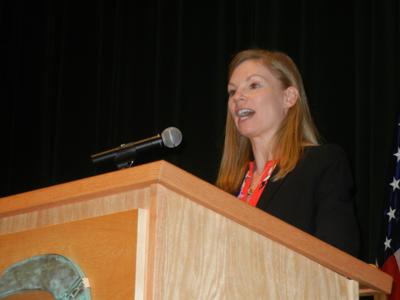

About 25 people, much fewer than expected, showed up June 12 to hear State Auditor Nicole Galloway present findings from an audit of the De Soto School District’s financial practices and policies.
The audit, performed after a petition drive, found 12 areas of deficiency, but district officials already have taken steps to correct the problems, Galloway said.
“They are moving forward,” she said. “They are on the right path.”
De Soto School residents held a petition drive to force the state audit, so the district must cover the approximately $75,000 cost, Galloway said.
She said her office gave the district a “fair” rating following the audit. The rating system ranges from “excellent,” which indicates the entity is “very well managed,” to “good,” indicating the entity is “well managed,” followed by “fair,” which means the entity “needs to improve operations in several areas,” to the lowest grade of “poor,” indicating the entity “needs to significantly improve operations,” she said.
She said no improprieties were found regarding the management of district funds. However, her office identified deficiencies in internal controls, noncompliance with legal provisions, and the need for improvement in management practices and procedures.
“We did not find loss or theft,” Galloway said. “I want to be clear about it.”
Nevertheless, she said the district needed to improve oversight to avoid potential financial abuse.
In response to an audience member’s question, Galloway said oversight deficiencies could provide “an opportunity for fraud.”
Galloway told the sparse crowd gathered at the De Soto High School auditorium that the audit took more than a year to complete and covered the district’s financial records and procedures during the 2016-2017 and 2017-2018 school years.
In addition, the office looked into a report that money was missing from some Athena Elementary School students’ lunch accounts.
Galloway began her presentation by apologizing for the timing of the report.
“When we planned this weeks ago, in no way did we think we would be during Game 7,” she said.
Irregularities
Then, Galloway spent about 20 minutes talking about each of the 12 areas of deficiency, including:
■ District Compensation: The State Auditor’s Office “identified problems with the documentation, approval and reasonableness of the compensation for various district employees,” the report said.
The Auditor’s Office recommended that the district provide “additional oversight and approval regarding compensation decisions and ensure all payments to employees are accurate and have adequate supporting documentation.”
The Auditor’s Office also criticized the district for “no documented basis for the superintendent’s $500 monthly vehicle allowance.” In addition, the superintendent “did not report the extra compensation on his W-2 form.”
The recommendation was to “ensure the superintendent’s vehicle allowance is subject to payroll taxes and properly reported on W-2 forms.”
In their response, district officials said the superintendent’s contract was renegotiated in January 2019 and the car allowance was removed.
■ Personnel Procedures, Records and Policies: “Several of the district’s personnel procedures are not performed in accordance with board policy,” according to the report.
The district responded that it “will continue to comply with its board policies.” It said the problems had been resolved “per the adoption of the time clock system, modification of administrator’s contracts and the previous revision of the mileage reimbursement rate.”
■ Cash Handling and Accounting Controls and Procedures: The Auditor’s Office called for the district to improve its handling of student and athletic fees and concession monies, recommending that money is properly receipted and deposited in a timely manner and that “receipts are reconciled to the composition of deposits.”
The district responded that it has taken steps to rectify those problems, the report said.
■ Procurement Procedures, Contracts and Disbursements: “District procurement, contracting, vendor monitoring and disbursement procedures and practices need improvement,” according to the report.
District officials responded that they are adhering to proper procedures but will ensure that such procedures are documented properly.
■ Budgets: The report said the board did not amend the district’s budget when actual disbursements exceeded budget amounts.
The district responded that the problem occurred because of “unique circumstances in the district’s Self Fund Health Insurance expense” and that “any future similar circumstances will result in an amended budget.”
■ Closed Meeting Minutes: The board did not document its discussion of all topics listed as reasons for going into closed session, the report said.
The district responded that it “will ensure minutes from closed meetings comply with the Sunshine Law and are consistent with the matters recorded.”
■ Vineland Elementary Booster Organization: The Vineland Elementary Booster Organization did not always comply with board regulations, according to the report.
The district responded by saying the booster club bank account is closed and all funds are aligned with board policies. Also, the booster club meetings are appropriately documented with an agenda and minutes, the report said.
■ Homebound Attendance: The Auditor’s Office said the district incorrectly reported the attendance for homebound students for the 2017-2018 school year and records maintained to document homebound instruction provided “were not sufficient.” As a result, “the overstated student attendance hours would have resulted in approximately $30,000 in excess state funding,” the report said.
“The district is working with DESE (the Department of Elementary and Secondary Education) to ensure accurate reporting of homebound attendance,” the district responded.
■ Emergency Drills: The district did not have sufficient documentation to demonstrate that all required emergency drills were performed in accordance with policy, according to the report.
The district responded that it would comply with the recommendation to correct the situation.
■ Capital Assets and Fuel Use: The report said controls and procedures over district property and fuel use need improvement.
The district responded it would make the necessary adjustments to its capital assets records.
■ Cafeteria Meal Charges: The district had not updated board policies to agree with current procedures and did not always monitor collection activity on student cafeteria meal charges, according to the report.
In its response, the district said it will “ensure the board is aware of outstanding student cafeteria balances at the end of each school year to determine the need of addressing specific situations or revision of board policy.”
■ Subsequent Event: The report said that in April 2019, “subsequent to our exit conference, the district was notified of irregularities in the handling of student meal monies at one school (Athena Elementary).”
The report notes that district officials “took immediate action to investigate the issue.” The matter remains under investigation, Superintendent Josh Isaacson said June 12.
Galloway said her office does not always get such a quick response to its recommendations following an audit, especially after a petition drive.
“In some other audits, they’ve said they’re not going to implement our recommendations and they have not,” Galloway said after giving the report.
After the presentation, board members seemed satisfied with Galloway’s report. “I think (the report) speaks for itself,” board member Mark Ferrell said.
Isaacson said he looks at the audit recommendations as tools for improvement.
“I would say anything that makes us better helps us move forward,” he said.
Petition drive
leader responds
Christina Kennedy, a district mother and one of the leaders for the audit petition drive, said she feels the state audit was justified, despite the financial cost to the district.
“Absolutely, I feel vindicated by the audit,” she said. “I do believe the $75,000 was worthwhile: If for nothing else, it showed the school district that they work for the taxpayers.”
Kennedy, who said she did not attend Galloway’s presentation because of work obligations, said the deficiencies enumerated in the report, particularly those involving “transparency,” needed to be addressed.
“The Board of Education was going into closed session for things they should not have gone into closed session for,” she said “There were violations of the Sunshine Law.
“The superintendent was getting a $500 stipend for a car that was not in his contract. It was not being reported as income. What all of these things boil down to is anything but transparent.”
Kennedy and other district residents formed a group in 2017 to fight for former Vineland Elementary School Principal Adam Grindstaff to be reinstated.
District officials said Grindstaff resigned in April 2017, while Grindstaff’s attorney said he was fired.
The group members said they became concerned about the district’s financial practices while questioning the district over Grindstaff’s departure, which spurred them to start the audit petition drive.
“When we went to them about Mr. Grindstaff, they were not being very transparent with us,” Kennedy said. “Taxpayers have a right to know what’s being done with their money.”
For the petition drive, Grindstaff’s supporters gathered 990 signatures, and 792 were verified as registered voters in the district. The state required 770 signatures, or 10 percent of the number of district residents who voted in the November 2016 gubernatorial election.
Grindstaff filed a lawsuit in 2017 against the district, asking for his job back, compensation from the district or both.
A motion hearing in the case is scheduled for 9 a.m. Friday, July 26, in front of Jefferson County Div. 5 Circuit Judge Victor Melenbrink.