


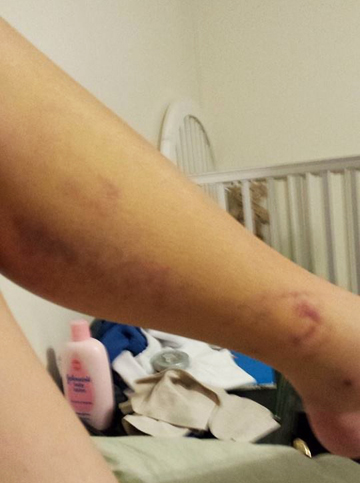
A young mother from Festus is home recovering after a snakebite on July 10 that landed her in St. Anthony’s intensive care unit for two days.
Hope Cull, 20, formerly of High Ridge, was walking in eastern De Soto when a baby copperhead bit her on the ankle.
“I was walking up an alley by Fountain City (Road) and Hwy. 110 in De Soto,” she said, “when I stepped on a patch of weeds in the middle of the concrete.”
Curled up inside the weeds was a snake that she did not see either before or after the bite.
Cull said she was not expecting to be bitten by a snake.
“I probably shouldn’t have been wearing flip-flops,” she said laughing. “It bit me two times on the ankle, right next to the bone.”
The incident occurred at 8:30 p.m. July 10.
After the bite, Cull returned to her home in Festus, but the bite was painful, and her ankle began to swell. So, she ended up at St. Anthony’s Medical Center in St. Louis County.
“I was in the ICU for two days,” Cull said. “They gave me (anti-venom and pain pills) and did multiple ultrasounds on my leg.”
The ultrasounds were used to determine if there was tissue damage from the venom as it worked its way into the bloodstream.
“I’m surprised I still have my leg,” she said. “A lot of times the venom eats away at the tissue, then causes organs to shut down.”
Cull was released from the hospital at 3:30 p.m. on July 12, with a pair of crutches to use.
“The doctor said that I won’t be able to walk on it for a month,” she said.
Cull said the ordeal made her worry about the possibility of her 11-month-old son, Brayden, getting bitten and recommends that parents be more aware of where their children play.
The copperhead, a type of pit viper, is one of five species of venomous snakes in Missouri.
Its venom is the least potent of all pit vipers, slightly less than the cottonmouth (also known as a water moccasin), which is also native to Missouri.
“Snakebites are not common,” said Jeff Breuer, an agent with the Missouri Department of Conservation. “The most important thing is to be careful, because it’s warm and they are more active now because they are cold-blooded.”
There have only been three recorded deaths from a copperhead bite in Missouri, including a St. Charles man who was bitten at Sam A. Baker State Park, in Northern Wayne County, earlier this month.
Breuer advises people to avoid places like log piles, brush, rocky crevices and cracked foundations – places snakes like to hide.
“Places where they find food is where you’ll find them,” Breuer stressed. “And they are protected, so you can’t just kill a snake if you see one.”
For more information on snakes and snakebites, visit the Missouri Department of Conservation website mdc.mo.gov.