




Five people are running for a pair of open seats on the Rockwood School District’s Board of Education in the April 5 election.
Neither incumbent filed for re-election. Loralee Mondl is stepping down after her third term and Thomas Dunn chose not to seek a second term.
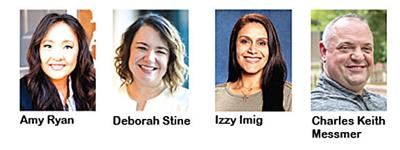
Seeking to supplant them are Amy Ryan, Deborah Stine, Izzy Imig, Jessica Clark and Charles Keith Messmer.
Clark did not return a Leader candidate questionnaire.
RYAN, 44, lives in Wildwood. She and her husband, Jeremy, have two children. She is a healthcare consultant. She received a bachelor's degree in health science from Purdue University in 1999 and a master’s degree in health management and informatics from the University of Missouri in Columbia in 2013.
STINE, 49, lives in Wildwood. She and her husband, Greg, have three children. She is a senior director of advancement for the Arts and Sciences at Washington University. She received a bachelor’s degree in 1995 from Vanderbilt University and a master’s degree of public policy from Georgetown University in 2000.
IMIG, 38, lives in Wildwood. She and her husband, Jason, have three daughters. She is a full-time volunteer. She took post-secondary linguistics courses in Iraq.
MESSMER, 41, lives in Eureka. He and his wife, Karin, have three children. He is a police officer. He received a bachelor's degree in criminal justice from the University of Missouri-St. Louis.
What experience do you have (elected office, civic organizations, volunteer work, etc.) that might serve you well in this position?
Ryan: I have been in the healthcare business for more than 20 years. My clinical, analytical and financial skills will be an asset for the board to achieve academic performance with physical and mental well-being. My qualifications apply to the business and healthcare world. This includes communicating and collaborating with various stakeholders. My most important qualification is being a parent invested in our community.
Stine: I bring 30 years of experience in philanthropy, including six years of fundraising for health and human services, 10 years as vice president of a national organization focused on school dropout prevention and intervention, 12 years managing advancement in higher education, as a grant writing consultant for a program for youth at risk, volunteering with the Coca-Cola Scholars Alumni Advisory Board and supporting my children in theater, choir, band, quiz bowl and Scouting.
Imig: I have volunteered through PTO at my children’s schools for countless hours. It has allowed me to develop relationships with teachers and administrators. Through these relationships, I have heard and understand their concerns. My prior occupation was as an Arabic translator. The primary skill I had to use was to listen. Listening to the concerns and feedback of the various stakeholders in the district is of vital importance.
Messmer: I’ve worked in the St. Louis community as a police officer for 15 years.
What are the biggest problems facing the district and how would you address them?
Ryan: Our reputation to recruit and retain high quality teachers. There is a teacher shortage crisis nationally, and Rockwood is no different. We need teachers for our children to achieve their full academic potential. I want to focus on our kids with special needs, kids who are gifted and kids who are passionate about trade or technical skills. But focus does not mean micromanage. I trust our teachers to be the education experts. We need teachers, assistants and interventionists to reach that goal.
Stine: The learning loss during the pandemic, broken community relationships and a need to build students’ empathy and resilience. I will support teachers so they will provide special attention to students who are struggling after the pandemic. I will approach conversations humbly and listen with the goal of understanding and finding solutions. I will support school-based mental health programs and social-emotional learning. Students who are healthy emotionally and physically are better learners, kinder friends and more engaged classmates.
Imig: The biggest problem is a breakdown in trust and transparency between the district and the parents and taxpayers. I will work to listen and respond to parental concerns and provide more avenues for them to express their concerns while also providing a feedback channel so that parents know their voices are being heard. I also will work to provide better transparency regarding district decisions.
Messmer: We have allowed politics to get involved in our children’s education and we have lost the ability to focus on students. We have allowed political groups to come in and tear us apart and have lost the ability to compromise to make our district better. We need to stop yelling at each other and start working together and we need to keep the children focused on school and not the issues that parents and teachers should be handling.
Why should voters elect you to this position? List your goals, if elected.
Ryan: My priorities are making sure our children reach their maximum academic achievement while enhancing their physical and mental well-being. I will focus on groups of children who need additional services or programs, including those with special needs, who are gifted and who are passionate about trade or technical skills. For them to be engaged and achieve academic success, they must feel seen, heard and accepted.
Stine: My goals are to:
■ Promote safe, welcoming, nurturing and affirming schools for all.
■ Ensure fiscal responsibility and transparency to preserve the district’s AAA bond rating.
■ Improve student outcomes while meeting each student’s learning needs.
■ Attract, hire, support, develop and retain the best and brightest educators while creating an environment that respects and trusts them as professionals.
■ Support and encourage Curtis Cain, the new superintendent.
■ Advocate for an excellent education for all students so they can pursue whatever path they choose after high school.
■ Model civility, kindness, responsibility and transparency.
Imig: I will strive for positive change. All voices should be heard and respected. We have work to do to repair the divide within the district and community and start with building trust and transparency. I will also work to improve MAP scores and refocus education by giving teachers the resources they need to teach core educational functions. This also includes looking at requirements that do not add to the role of educating our children in core educational subjects.
Messmer: Voters should elect me because as a police officer I have been involved in conflict mediation for the past 15 years and in the current toxic climate, that’s exactly what is needed. My goals are to help parents, teachers, administrators and board members learn how to work together again for the sake of the students and to end the arguments that have gotten Rockwood featured on national news networks and embarrassed us. We have to get back to working together again.
Do you support Proposition P, a shift of 54 cents from the district’s debt service levy to its operating fund, on the April ballot? Why or why not?
Ryan: I do support Proposition P. The Federal Reserve already announced interest rates increases throughout the year. The rate of our debt is decreasing significantly. It is reasonable to shift money from one bucket to another for our schools to be safe and secure. Annual maintenance, upgrades and technology enhancements are crucial. No one wants to pay more on interests over loans. Prop P is an effective way to avoid additional payments and still provide the upgrades our schools need.
Imig: Voters should do their own research and come to their own conclusions. I was not involved in the discussion about Prop P, so I know what the voter knows. My research has led me to the decision that I would be in favor of Prop P based on my understanding that it will not increase debt service costs and no new debt will be issued.
Stine: I support Prop P. This authorizes the district to reduce the amount of money it spends on debt service and create a dedicated annual funding source for recurring maintenance projects, including roofing, flooring, HVAC, technology, security systems, cybersecurity, data protection and athletic facilities. Funds will not be used for daily operating expenses like salaries, utilities and supplies. The result will not increase your taxes. This is part of our long-term strategic financial plan and is a common-sense, responsible way to address maintenance needs without incurring interest.
Messmer: Yes, the district needs to maintain and upgrade many things and this is the best way to acquire the funds to maintain and upgrade our schools.
Should the school board be responsible for restricting or banning reading material from school libraries? Why or why not?
Ryan: The board should not micromanage what 22,000 students read or what teachers assign for them to read. Parents have the right to challenge a book. There is a process that comprises of a committee to review and discuss. That process decides if there should be no limitations, limitations or age-appropriate restrictions. The board must consider the perspectives of all parents and students and what is best to fuel critical thinking and debate.
Stine: The board approves policy, and Rockwood already has a policy to categorize and contest books. Board members should trust the process and encourage parents, students, librarian, and educators to serve on review panels. Removing a book from the library should rarely, if ever, happen. Book banning hinders discourse, hampers building of a broad worldview and also may violate the First Amendment. Parents already can control what their children read, but in general, they should not be able to restrict what books are available to others.
Imig: The district and the board should be responsible for ensuring books and educational materials are age-appropriate. I am not in favor of banning books, I am, however, in favor of ensuring a better system is in place to review new material and enact a more transparent opt-in system for books that may be objectionable to some parents. We have ratings on everything, from movies to TV shows to video games. If an excerpt from a book is not allowed to be posted to YouTube or Instagram, shouldn’t we also have a rating system for our books?
Messmer: Yes, the responsibility of the board is to make these decisions. However, there needs to be some way to compromise on this issue. Institute a restricted section in the library and require students to have a signed permission slip to access the books in that section. We don’t need to have an all-or-nothing approach to this issue.
What letter grade would you give your school board on its policies regarding the COVID-19 pandemic? Why?
Ryan: B. The board and administration did the best with the information it had at that time in a no-win situation. No one could communicate effectively what is best for a large group of people. No parent, teacher or student will agree 100 percent. Parents have the right to decide what is needed for their children medically, but public health officials are required to look at every person who is impacted within the community. The balance between individual vs. community is hard to manage. I believe Rockwood did its best.
Stine: A-. Rockwood made the best decisions it could with the information available at the time. It collaborated with neighboring districts and consulted health experts to react quickly and responsibly when pivoting to online instruction. Rockwood went the extra mile to make sure students had internet, computers, instruments and meals. Seeing that most students would benefit from returning to school, it was one of the first local districts to resume in-school learning and maintained science-informed mitigation policies in the face of threats. The board could have given parents more frequent and meaningful two-way communication about critical decisions.
Imig: COVID brought us unprecedented times, therefore I will give the existing board grace. I would give them an A for effort, but a C in execution. As parents brought their concerns about the impact of masking on their kids, it felt as if the board was less than willing to hear their concerns and was not willing to change policies based on new data. Data being used to support mask mandates seemed to be cherry-picked, rather than including all studies on masks done throughout the world. Communication with parents behind their decisions could have been better as well.
Messmer: D-, I was very vocal that the first year of the pandemic was a complete failure. The second year has been better, but there were too many questionable decisions made without reasonable explanation. Transparency was terrible and common sense was not used as often as it should have been.