


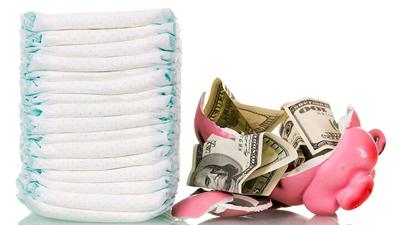
Food pantries are always grateful for donations, but some items are welcomed more enthusiastically.
Diapers are one of those items
“We would love to get them,” said Gary Davidson of the Ozark Food Pantry in Festus. “We get calls all the time asking about them.”
The National Diaper Bank Network will observe National Diaper Need Awareness Week from Sept. 27-Oct. 3, to help draw attention to the need across the country for diapers and other hygiene supplies.
According to the Children’s Defense Fund, nearly 15 percent of American children lived in poverty in 2019 (the most recent year for which U.S. Census poverty data is available). In Missouri the number is closer to 20 percent.
For the families of those children, the cost of diapers is an enormous burden. Diapers must be provided to most child care facilities, and if parents can’t afford that, they can’t go to work. Lack of adequate diapers also can prevent children from taking part in early education programs such as Head Start.
The American Academy of Pediatrics reports that families spend about $936 a year for disposable diapers and the high cost can lead to less frequent changing, which can cause diaper rashes and other health issues.
That’s where diaper banks come in.
There are more than 200 member banks in the NDBN, distributing more than 64 million diapers annually. Countless other local food banks also collect and distribute them, but the need remains.
Food programs
don’t cover diapers
There are three common assistance programs available to low-income families.
The largest is the Supplemental Nutrition Assistance Program (SNAP), which provides benefits via an Electronic Benefits Transfer card that can be used to purchase food in most retail stores.
The Missouri Women, Infant and Children program (WIC) provides food vouchers or electronic cards to pregnant women and families with children younger than 5. Temporary Assistance for Needy Families (TANF) uses grant funds to provide families with financial assistance and support.
Of the three, TANF is the only one whose funds may be used to purchase diapers. But even those funds are precious few.
“Nationwide, only 23 percent of families living below the federal poverty level receive cash assistance through TANF,” the National Diaper Bank Network website says.
“In 13 states, fewer than 10 of every 100 poor families receive cash assistance, and the funds they do receive commonly go for rent, utility bills, clothing, etc., and often do not stretch to cover buying diapers as well.”
Local sources for help
H.E.R.O.E.S. Care in Fenton is the only Jefferson County organization listed as a member of the National Diaper Bank Network, but many pantries and programs around the county offer help.
The Peace Pantry in Cedar Hill is part of the St. Louis Diaper Bank, which receives funding from the Jefferson Memorial Foundation to help families in Jefferson County, said Linda Schroeder, pantry president. “We pay a minimal fee to be part of it, and we collect and distribute diapers for them.”
Schroeder said the St. Louis bank’s program allots 25 diapers per month for pregnant women, and 50 per month for each baby or toddler. The Peace Pantry relies on donations to fill the need.
“In August we served 682 people in 307 families,” Schroeder said. “Of those, 67 were children under age 6. Obviously, 50 diapers is not enough for a month, so we are lucky we have some people who bring them in on a weekly basis. Unfortunately, we rarely get the larger sizes, and that’s what people really need.”
Louise Sardo, director of the Jefferson County Rescue Mission in Pevely, said even families without babies have a need.
“Adult diapers are even more expensive than baby diapers.” she said. “People are embarrassed to ask for them.”
Local groups work together to get diapers to the families who need them.
“We share any extra we have with Disability Resource Association,” Sardo said. “The very small ones we get, we usually give to Hand ’n Hand Pregnancy Help Center.”
Schroeder said the St. Louis bank joins forces to streamline collection and distribution. “I take a van to downtown St. Louis and pick up the supply for us and several other organizations,” she said. “Then they come here to get theirs.
It’s all about networking.”
Every local food pantry and assistance agency will gladly accept donations of diapers or the cash to buy them.
Davidson said people are generous with other donations; maybe they just need to be informed about this particular need. “I don’t think people realize that diapers would be a good donation,” he said. “But, like I said, they would be a godsend to the families we serve.”
The National Diaper Bank Network encourages local agencies to explore membership, which includes advocacy tools to help raise awareness; resources to help with collection and distribution; access to grant funding; and bulk diaper purchasing programs.
To learn more, visit the network online: