
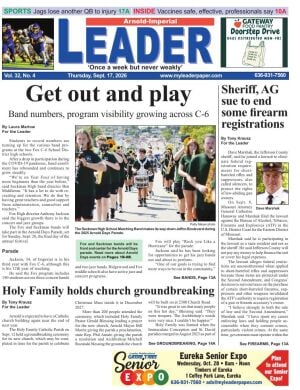

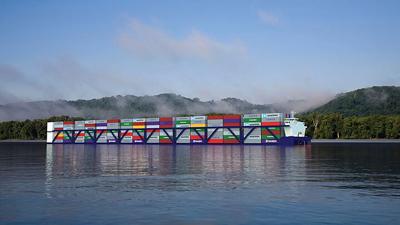
The planned container-on-vessel port in Herculaneum is in line to receive a $25 million infusion of state money.
The Missouri General Assembly recently approved 19 bills that make up the state’s $49 billion budget for 2023, and among them is the sizable chunk of money set aside for the Jefferson County Port Authority to help develop the project.
The budget bills await the signature of Gov. Mike Parson to become official.
In December, Port Authority officials announced plans to develop the port at which containers of cargo from around the world will be unloaded at Herculaneum.
Hawtex Development Corp., which is based in Texas and Hawaii, will be the lead developer for the project.
The development company has been working with American Patriot Holdings (APH) and has identified Herculaneum as a prime site for a port for APH’s specialized barges that will carry large metal shipping containers from Plaquemines, La., up the Mississippi River.
The port of Plaquemines, near the mouth of the Mississippi River, is being developed as the destination for ocean-going ships going through the Panama Canal to unload their cargo onto APH’s vessels, which at 13 mph travel rivers faster than traditional barges.
At that press conference, officials said the port may be in operation by the fourth quarter of 2024.
“It’s very optimistic, but that’s what they’re shooting for,” said Jim McNichols, executive director of the Port Authority.
APM Terminals, an international company, will operate the ports at Herculaneum and Plaquemines.
“The partnership between Herculaneum and the Plaquemines Port will reduce the transit time going up the river very significantly,” said Brian Harold, managing director of APM’s existing facility at Mobile, Ala.
“What shippers are finding now is that transit time is important, but consistency is even more important. In Plaquemines and Herculaneum, we’re going to have to service these vessels as they arrive and keep them on schedule and jointly show, between our two ports, that when someone’s cargo arrives in Plaquemines, we can have it in Herculaneum rather consistently within a certain transit time. And if the shippers can depend upon that week after week and day after day, then that’s something they’re going to continue to grow.”
Harold said developing an inland waterway transit system will take pressure off ports on the East and West coasts and alleviate supply chain issues.
The $25 million included in the state budget will help get the Herculaneum port up and running, McNichols said.
The state budget includes another $30 million for port activities, but that money will require local matches and will be awarded on a competitive basis among the state’s 17 port authorities, McNichols said.
Jefferson County’s was the only port authority to be granted money in the budget without requiring a local match.
“This is without question the largest amount of money the state has budgeted for the Jefferson County Port Authority,” said Cory Schuh, deputy director of the Port Authority.
What it will be used for
Derrick Good, executive director of the Port Authority’s Board of Directors, said some of the $25 million will be used to purchase equipment needed for the Herculaneum port.
“We’ll buy that equipment and lease it back to APH,” Good said. “We’ll also use some of the money to buy an equity stake in the port so that the Port Authority has, maybe for the first time, income to be self-sustaining, rather than rely on the county government, or before that, the Economic Development Corp. for some of our funding.”
Good said APH officials have always wanted a public-private partnership.
An example of equipment the Port Authority can supply to the port, Good said, are cranes that lift the containers from the vessels. He said an estimated cost for one crane is $1 million.
“Also, by us purchasing some of this equipment, this will allow us to close the project in less time,” McNichols said. “APH is busy right now with plans to build these vessels that will go up and down the Mississippi. They’ve got bids to build four of them, and I understand they’re going to award the contract soon.”
Other equipment that the Port Authority can supply include conveyor belts, lifts and a device called a dolphin, which is a mooring point in the river.
Good said because the port is still in the design phase, plans remain fluid.
“There are a lot of players in this project,” he said.
What the money will not be used for is land acquisition.
“I want to make this clear, that the Doe Run Co. has no intention of selling property (from its decommissioned lead smelter site) to this project,” Good said. “They have said all along that they will enter into a lease.”
He said Doe Run owns about 600 acres in the Herculaneum area, but the container port project ultimately will need about 350 acres. He said more than 200 acres are ready for development, with Doe Run in the process of remediating the rest.
Action in Jefferson City
McNichols said it was a “team effort” to land so much money in one state budget.
“We owe a lot to our local legislative team in Jefferson City, both in the House and the Senate,” he said. “They did a lot of heavy lifting to make this happen.”
McNichols and Schuh said a trip to the state capital on March 1 to meet with key legislators was a catalyst.
“We had scheduled 17 meetings in one day,” Schuh said. “That just doesn’t happen.”
A team that included County Executive Dennis Gannon, Director of Administration David Courtway, chief executive officer of APH Sal Litrico, and Hawtex president Jim Hurley in addition to Good, McNichols and Schuh, met with House and Senate leaders, including those who lead the appropriations committees that control the budget.
“In addition, Sen. Paul Wieland (R-Imperial) was gracious enough to offer us his outer office so we could set up a presentation board and have literature available to those who we could not meet with so that they also had access to our information,” McNichols said.
“It was a long day,” Schuh said, “but everyone we met was receptive to our message. Several of them leaned in and said, ‘What can I do to help?’ We got compliments on the packet of information we had prepared and distributed.”
In a press release announcing the passage of the budget, Wieland said he had hoped to see $50 million to $75 million allocated for the Port Authority, but “after members of the Port Authority and the County Executive visited with members of the General Assembly, I was pleased to salvage the $25 million.”
Wieland is challenging Gannon for the Republican nomination for the county’s top elected office in the August primary.
Wieland said he attended only one of the meetings on March 1, the final one with Sen. Dan Hegeman (R-Cosby), who chairs the Senate Appropriations Committee, and Wieland said that the local delegation was caught off guard when Hegeman asked whether Doe Run property could be used as a part of a local match for money.
“They seemed confused, and not sure of the questions they were going to be asked,” Wieland said. “If they had come to me first, it would have been beneficial.”
Good said Wieland and his staff were apprised of the project in the weeks and months leading up to the March 1 marathon session.
The other Jefferson County representative in the Senate, Elaine Freeman Gannon
(R-De Soto), said Hageman seemed enthusiastic about the project.
“I spent quite a bit of time visiting with the chairman about the port project, and he saw the value of it, not just for Jefferson County, but for the entire state,” she said. “Our delegation in the House also did a lot of work there.”
Gannon said before the budget came up for a vote in the Senate, Hageman approached her.
“He asked me whether I wanted it (the $25 million) to be a line item in the budget (rather than part of an overall port package), and I said, ‘Most definitely.’ The budget chairman in the House, Cody Smith (R-Carthage) was also supportive of having that money be a line item. I’m proud to have helped make that happen.”
Schuh said he was confused when he heard that Wieland criticized their efforts.
“Everyone we talked with showed a great deal of support,” he said. “I don’t think the heavy hitters from APH and Hawtex would have stayed with us if we would have been disorganized. And in the end, we got $25 million – more than we’ve ever gotten.”