
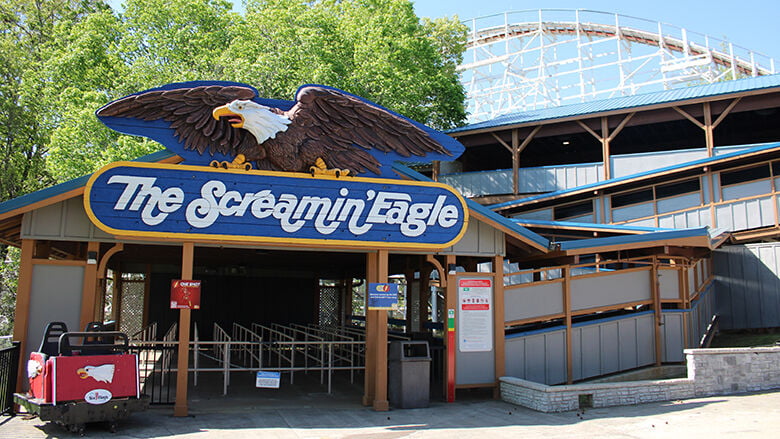
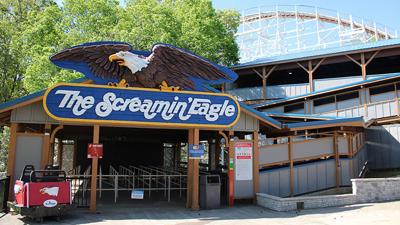
The Screamin’ Eagle, built to celebrate the country’s bicentennial, has been a staple in the Six Flags St. Louis amusement park for 50 years.
Opening on April 10, 1976, the Screamin’ Eagle held the title of longest, tallest and fastest roller coaster in The Guinness Book of World Records for two years. The 3,872-foot course sends riders speeding at more than 60 mph on the wooden track, first over an 87-foot precipice and then over the ride’s highest point, a 92-foot straight-down dive.
Park spokeswoman Elizabeth Gotway, who has worked with Six Flags for more than 40 years, said the silhouette of “the Eagle,” as most park employees call it, contributes to the park’s iconic vista.
“When you drive down I-44 and look at the park, you notice it, and you notice Colossus (the Ferris wheel),” she said. “That’s what really stands out. When we think of our park and that vista, you think of the Screamin’ Eagle back up there on the hill. For people who have worked here a while – I don’t want to sound sappy or corny, but it’s like an old, familiar friend.”
Kansas City real estate company EPR Properties announced April 6 it closed on a deal with Six Flags Entertainment Corporation for six parks, including Six Flags St. Louis, in a deal worth about $342 million.
Enchanted Parks, based in Orlando, was selected to operate the St. Louis park and will change its name to Mid-America by Enchanted Parks next year. The Eureka park’s name in 2027 will hearken back to the park’s original name, Six Flags Over Mid-America, when it opened in 1971.
Enchanted Parks CEO James Harhi said roller coasters like the Screamin’ Eagle can connect generations of families.
“Generations have ridden that ride, and now they have the opportunity to ride it with their kids or their grandkids,” he said. “I think that’s such a unique part of the theme park world that we lose sight of sometimes.”
Six Flags brought the late John Allen, known as the “dean of American Coaster design,” out of retirement to craft the Great American Scream Machine at Six Flags Over Georgia in 1974. An instant success, Six Flags then commissioned Allen to design the Screamin’ Eagle, his last creation. Allen died in 1979 at the age of 72.
Steve Read, a former Six Flags St. Louis employee, carved the massive wooden sign at the ride’s entrance and exit.
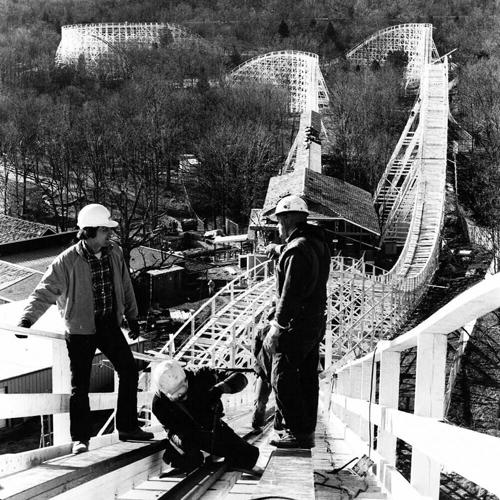
The expansive ride was built with 1,278 footings, 886 cubic yards of concrete and 550,000 board feet of lumber. The ride is painted with 10,000 gallons of white paint and held together with 50,000 pounds of bolts and 15,400 pounds of nails.
It took workers from the Frontier Construction Company 130,000 hours to finish the ride.

Workers on the Screamin’ Eagle lay down track in 1976.
In 2016, the American Coaster Enthusiasts club declared the Screamin’ Eagle an American landmark for its 40th anniversary.
When the ride was built in 1976, Gotway said it was only the second coaster in the park. Only three other rides in the park are still here from when the park opened in 1971: the Steam Train, Log Flume and Mine Train.
Chris Dwyer of Wildwood retired in 2021 after 46 years working in the park. He was hired as a ride operator in 1976, the same year the Screamin’ Eagle opened. When he retired, he was director of park operations.
Dwyer recalled that the Screamin’ Eagle was the ride every employee wanted to work at, since it was such a unique coaster at the park. Every morning, Dwyer would walk the track with other operators to check for any debris or damage.
“It was our baby,” Dwyer said. “At the time, there was nothing like it. It was like the Mine Train on steroids.”
As the driver, Dwyer said he manually operated three sets of brakes for the two trains on the Screamin’ Eagle. Over time, the brakes moved to a computerized system.
“If you got to be trained as a driver, you were braking it, bringing it into the station. That was all on you as a driver,” he said. “I loved that type of responsibility.”
Gotway said the Screamin’ Eagle was on the cover of Better Homes and Gardens in the late 1980s. Sears, who advertised in the magazine, paid to repaint the coaster and filmed a commercial.
“I remember that was one of the first things I did as PR, and I was like, ‘Oh, this is cool,’” Gotway said. “They chose it because of how pretty the ride was. I guess that was the thing; when they would choose homes or buildings for (the cover), they would go and paint it. They took a picture of all the paint cans stacked up, and we were like, ‘Don’t anyone knock those over, that’s a lot of paint.’
“(The Screamin’ Eagle) has had a lot of recognition over the years. I think we take that for granted. I think probably people in St. Louis are just like, ‘Eh.’ It’s really iconic, but that’s the way it goes.”
Gotway said she’s not a daredevil when it comes to roller coasters. She recalls riding the Screamin’ Eagle a few years after it opened.
“When I got brave enough to ride it, I rode it with my eyes closed the whole time,” Gotway said. “Somebody later said, ‘Don’t ever close your eyes on a ride like that, all it does is make it worse.’ If you keep your eyes open, believe it or not, your brain is registering what you’re doing and where you’re getting ready to go. When you close your eyes, it’s like closing your eyes and trying to walk. You have no perception of anything. Next time I rode it, I kept my eyes open and thought, ‘Ah, this is better.’”
David Ray of Imperial worked in the park’s operations department from 1985-1987.
Growing up in Fenton, Ray called Six Flags a “home away from home,” usually bumming a ride from a groundskeeper to make his 7 a.m. shift start time and not making it back home until around 1 a.m. the next day, whenever he could scrounge up another ride.
He graduated from Eureka High in 1987 and said many of his friends and peers worked at the amusement park.
Ray recalls riding the Screamin’ Eagle for the first time about a year after it opened.
Ray said he and his friends would make a game of standing up in the back row of the ride, taking advantage of a loophole that has since been fixed.
“Back then, you could slip out of the lap bar. I would stand up in the back seat and hold on to the headrest in front of me,” he said. “We always had to wait until we got past that first hill, because the drivers and workers were required to watch that hill. I was 16 or 17 years old; I didn’t have fear.”
On the park’s opening day on April 25, the first 1,000 riders received a pin that said, “I’m no chicken, I flew the Screamin’ Eagle,” similar to the pins park attendees were given after first riding it in 1976.
Tim Schulte, 60, lead pastor at The River at Eureka, received his pin on opening day after riding the coaster. He recalls riding the Screamin’ Eagle for the first time with his friend, Quentin, when they were 10 years old in 1976.
Schulte joked that, while the coaster hasn’t changed much in 50 years, the ride feels a bit rougher for him now than as an adolescent.
“I have noticed the forest has grown around that ride,” he said. “There’s a canopy of trees, and it’s a beautiful setting. It’s a neat place, and to be out there 50 years later to ride that ride, it was just awesome.”
Schulte said his eight grandchildren live in Eureka, making Six Flags a convenient hangout place for his family.
“It’s easy for us to pick up one, two, three or all of them and hop over to Six Flags for two hours,” he said. “Sometimes we make more of a day of it, but it’s so close that we have that flexibility to just pop in whenever we want. It’s just one of those great aspects of the Eureka area, an opportunity for families to experience fun together, whether it’s at the theme park or Hurricane Harbor. It’s just such a gift to have something like that so close.”
For more on the topic, see Reporter Abby Stetina’s column here.