


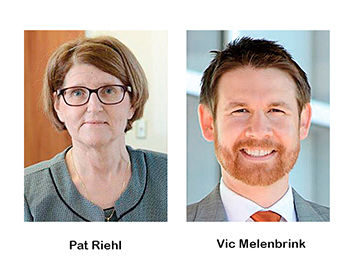

Patricia A. Riehl barely had enough time to get used to the view in her Div. 5 courtroom before she needed to file for election to keep the seat.
Riehl was appointed on Feb. 17 by Gov. Jay Nixon to fill a vacancy created after he appointed Div. 5 Circuit Judge Lisa Page to the bench of the Eastern District of the Missouri Court of Appeals.
She was formerly the Div. 13 associate circuit judge.
Filings for the August primary election opened four days later.
Riehl, a Democrat, ran unopposed in her party’s primary but will face a challenge in the Nov. 8 general election from Republican Vic Melenbrink, the county’s Municipal Court prosecuting attorney.
Circuit judges serve six-year terms and are paid $146,803 per year.
RIEHL, 59, lives in Fenton. She has a daughter.
Before she was appointed to the Div. 5 bench, she had been associate circuit judge in Div. 13 since 2007 and before that was the county’s drug court commissioner from 2003-2006. She also has served as the municipal judge in De Soto from 1987 to 2003 and in Crystal City from 1995 to 2003.
She received a bachelor’s degree in education and graduated with summa cum laude honors from Southeast Missouri State University and a law degree from the University of Missouri-Kansas City, graduating with distinction. She has implemented truancy courts in the Fox C-6 and De Soto school districts and was a founding member of the Veterans and Alternative Courts Foundation. She was a member of Experience Jefferson County, is an annual lecturer at the Jefferson County Law Enforcement Academy for Crisis Intervention Training and the Jefferson County’s Women’s Bar Association and is an associate member of Vietnam Veterans of America.
Social media: Website: voteforriehljustice.com
MELENBRINK, 35, lives in Arnold. He and his wife, Andrea, have three children. In addition to working as the county’s Municipal Court prosecutor, he is an adjunct professor of political science and constitutional law at the Jefferson College Law Enforcement Academy. He received a bachelor’s degree in political science and a law degree from University of Missouri in Columbia. He has been a board member and officer for Habitat for Humanity of Jefferson County since 2015 and the Jefferson College Law Enforcement Academy Advisory Board since 2016.
Social media: Website: votevic.org Facebook: Vic for Judge
What training and experiences have equipped you for this position?
Riehl: I started as municipal judge almost 30 years ago and have devoted the better part of my life to public service. I will never forget advice given to me years ago by a non-attorney municipal judge: Give any person your absolute attention and kindness matters. In private practice I have handled criminal, civil (jury and nonjury), probate and family matters. I have been on both sides of the bench for over half my career and that has prepared me to be fair, firm and proven. I have been federally and state trained to implement and operate alternative courts. I view each day as an opportunity to learn and apply that experience to life.
Melenbrink: As prosecutor I’ve handled a wide variety of cases, from trials all the way up to Supreme Court arguments, from shoplifting to first-degree murder. During my service as an assistant attorney general my job was to thoroughly analyze whether judges made mistakes during trials, and if necessary defend their rulings to keep criminals in jail. As a trial court prosecutor, I’ve had the responsibility of handling a high volume of cases with limited prosecution resources, while continuing to ensure that the safety of residents, as well as their families and property, are protected. I also practiced civil law with a local firm, including family law and property law. Based on my extensive experience, handling the duties of the judiciary should be no problem.
What is your assessment of the workload for circuit judges in Jefferson County? What changes, if any, are needed to improve the efficiency of the office and the circuit?
Riehl: I am responsible for veterans treatment court, adult treatment court, all adoptions, 20 percent of all civil cases and 11 percent of all family law. Before a recent change, I had no civil docket and more than 30 percent of all family law. I look forward to my case assignment change. If there was one thing I could change, I would have one judge for all treatment courts. Currently we have three different judges who are tasked with treatment court assignments. To be more consistent in our approach to treatment, it would be better to have one judge assigned all treatment courts but because those courts are so time-intensive it is difficult for one judge to be assigned to treatment court duty.
Melenbrink: While the current workload is acceptable, Jefferson County is growing quickly, which means we need to continue to improve our court operations to ensure that all residents are treated fairly. One of my strengths is a high level of skill with computers and technology. While the electronic filing system was a good start, I would encourage and help to implement other measures, such as videoconferencing and electronic document exchanges, to improve the court’s efficiency and effectiveness. These types of innovations would make things easier for attorneys, which would lead to less expensive legal services for their clients. Representing yourself is usually a bad idea, so making it cheaper and easier for people to hire a lawyer is critical.
Should Jefferson County’s circuit and associate circuit judges continue to be elected in partisan elections? Why or why not?
Riehl: There is nothing more sacred to our democracy than an independent judiciary. That means that our judges should not continue to be elected in partisan elections. Judges are sworn to protect and defend the Constitution. Party designations should not play a role in who you choose as a judge. Experience, education, professionalism and dedication to the public should. Judicial interdependence allows judges to do their job with an open mind, not influenced by personal interest or political pressure.
Melenbrink: Given the current options, yes. The only alternative under Missouri law is the “nonpartisan court plan,’ which would take the power to select judges away from voters and give it to lawyers and the governor. The Missouri Bar says the plan “gets politics out of judge selection.” That is complete nonsense. I know attorneys and judges who have been involved in that process, and between the favors, lobbying and backroom dealing, it is just as dirty and political as the ugliest election. Jefferson County residents should resist giving up the power to choose their judges over to politically connected attorneys who feel entitled to a judgeship. If people want changes, they should work toward new legislation allowing nonpartisan elections where voters still have control.
Why should voters elect you to this position? List your goals, if elected.
Riehl: I have served in the judiciary for nearly 30 years, in all positions ranging from municipal to circuit judge. I have with a group of caring community partners dealt with the issue of substance abuse in our community by implementing a host of treatment courts. I am proud to have implemented a veterans treatment court to those who have served us. I am humbled to have saved lives and families; there is no better feeling. I realize there is a movement to “vote them all out”. By doing so in judicial races, we as a community lose years of institutional knowledge, education and understanding. My goal is to continue to serve in a fair, firm and proven manner for all of our residents.
Melenbrink: Based on my legal experience, I am well-prepared to be a judge, and my technological skills will assist me in improving the overall effectiveness of the court. Additionally, I have significant experience in the municipal court system. While some might dismiss these as “minor” cases, two-thirds of the cases filed in Missouri are in municipal courts. For many Missourians, the only contact they will ever have with the court system is in municipal court. The circuit court is responsible for oversight and ensuring that municipal courts protect the rights of citizens by operating lawfully and efficiently. No other current judge or candidate can match my knowledge and experience in this important, but underappreciated, area of law.
Do you support your party’s nominee for president? Explain why or why not.
Riehl: The Code of Judicial Conduct prohibits a response to this.
Melenbrink: As a candidate for judge, ethics rules prohibit me from endorsing specific candidates for political office.