


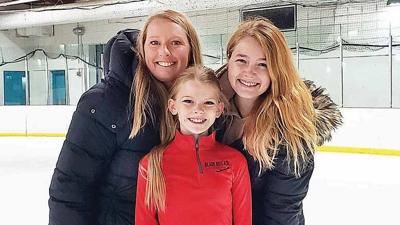

When ice dancer Rebekah Stockwell, 13, of Byrnes Mill finished her routine at the 2023 Dallas Classic in Plano, Texas, she thought the judges wouldn’t like it.
Her fierce eye contact during the tango routine probably scared them off, she thought. Or, maybe her edges weren’t “flowy” enough during the blues routine.
All those fears evaporated when she got her final score.
“When I got off the ice, I felt shaky, and I said (to my coach), ‘That was not my best skate.’ But (the score) was 31.95. For comparison, the first time I skated in this program, I got an 18.
“I was like, ‘Oh my gosh.’ I was so shocked.”
Rebekah will start eighth grade at Valley Middle School on Aug. 22.
A few weeks later she will head to the 2023 U.S. Figure Skating National Solo Dance Final in Chicago, Ill., which will be held Sept. 14-17.
Rebekah will be one of six skaters representing the Midwest in the preliminary solo pattern dance category.
According to U.S Figure Skating, solo dance is open to skaters of all ages and ice dance levels, from “preliminary to gold and international.”
Creve Coeur Figure Skating Club coach Brianne Arnaiz said the dance competition provides opportunities for skaters who struggle with jumps and spins.
“(The national competition) has opened up a lot of avenues for a lot of girls because the jumps and the spins are definitely the hardest part,” she said. “When you take those out, it makes it a little bit lighter and more fun. We’ve seen a lot of growth in the St. Louis area from that.”
Rebekah finished in first place in the Dallas Classic in mid-July, skating a tango and a blues number for a final score of 62.90 in the solo pattern dance category.
“Tango is a pattern you have to learn that is very sharp and direct,” Rebekah said. “You have to be on time. If you don’t stay on time, it will knock you off the whole program.”
Ice dancing is scored by a panel of judges on technical skating skill, the collection of various movements put in a meaningful pattern and the overall presentation showing engagement on the ice.
Fiery eyes
For Rebekah, the challenging part of the routine is not just the dancing, but the fierce and determined expression the dancer must display.
“(The judges) look so mad and intimidating,” she said. “You’re supposed to stare them down. It scares me more than it scares them.”
“With ice dance specifically, expression shines through,” said Rebekah’s ice dancing coach, Ashley Klotz. “It can be really intimidating to stare down the judges, but they’re doing the scoring, so you want to be including them during your performance. She’s worked very hard to improve that.”
Rebekah said her favorite dance is the blues, especially her routine set to Taylor Swift’s “False God.”
“The blues in contrast (to the tango) is more laidback and lazy. It requires softer extensions,” Klotz said. “(Rebekah) was able to bring that relaxed touch.”
Klotz, a coach with the Creve Coeur Skating Club who has worked with Rebekah since April to perfect her ice dance routines, said her student has come a long way over the past several years.
How it began
Rebekah’s mother, Roxanna Stockwell, said her daughter’s figure skating craze started at age 3 with a free, learn-to-skate event at Kirkwood Ice Arena.
“It was really cute because the smallest pair of skates they had was still two sizes too big,” Roxanna said. “(Rink employees) gave her a 5-gallon bucket to lean on. Her little feet just went to town.
“I was hesitant at first (to let her skate). The rink wasn’t very close. But she kept telling me over and over she wanted to do figure skating.”
Rebekah first joined a figure skating class at the Kirkwood ice rink in January 2019, at age 9, where she began to “fly through the levels,” as her mother put it.
In 2020, Rebekah was connected with Arnaiz, who works with her one-on-one on general skating skills, plus spins and jumps. “She’s a very light skater,” Arnaiz said. “And she’s very good at presentation on the ice.”
After taking about a yearlong hiatus from competing because of the COVID-19 pandemic, Rebekah began competing again in 2021, traveling across the Midwest for regional competitions. While ice dancing is an individual sport, Roxanna said her daughter found camaraderie and friendship with other figure skaters during her travels.
“The girls cheer each other on,” Roxanna said. “Sometimes you’re competing against those same friends, which can be a delicate situation at times. You learn to cheer everybody on even when you don’t do as well as you hope.”
Looking for more friends to share figure skating with, Rebekah joined the Blade Brigade at Kennedy Recreation Complex in St. Louis County, a synchronized skating team of 12 to 20 girls that practices lifts and tricks and links arms to skate in unison. Their season begins in October and concludes in March.
Skating circles around the competition
Even with support from her friends, Rebekah isn’t immune from the pressures of competition, Klotz said.
She said mentally preparing to step on the ice is a big part of training for figure skaters.
“The first competition we did this season, (Rebekah) was a nervous Nellie,” Klotz said. “I knew we needed to work on her getting her nerves under control.”
Roxanna said Klotz is great at boosting Rebekah’s confidence and Rebekah said Klotz teaches her to keep calm and “not freak out” during competitions.
Klotz said she plays out scenarios that might throw a figure skater off her game during competition, like if music cuts out mid-routine.
“A lot of training can be negative, but I focus on what’s going well and bringing in more of a positive aspect,” Klotz said. “I think if she can keep a level head, she has a chance of doing really well (at the U.S. Figure Skating National Solo Dance Final).
“As long as she stays determined, there’s nothing she can’t do.”