


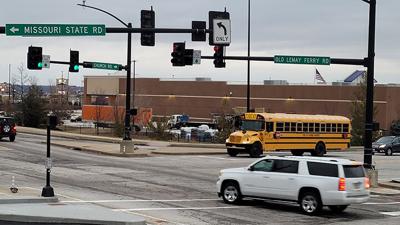
Misfortune turned to fortune for the city of Arnold after an odd turn of events involving two of the city’s intersections.
Gerstner Electric of Fenton charged a reduced price to replace non-working traffic signal video detection systems at the intersections of Church Road and Stardust Road and Church Road and Old Lemay Ferry Road.
Gerstner, which is under contract with Arnold to handle the city’s traffic signal maintenance, fixed the systems for $29,000. City Council members voted unanimously in January to approve the contract.
Public Works Director Judy Wagner said the devices were installed over two days early last month.
Odd twists
The city learned that the video detection systems, which allow the signal timing at the intersections to be overridden when there is limited traffic, were not working following a lighting strike on July 15, 2020.
Wagner said a Gerstner representative told her about the broken detection systems in August.
In September 2020, Gerstner told Wagner it would cost $40,000 to replace the two systems, and she decided not to get them replaced at least until the 2021-2022 budget cycle.
In January, however, Gerstner contacted Wagner again and told her another job requiring the installation of the detection systems had fallen through and the company had the systems available for the city.
Gerstner offered to install the systems at a significant discount of $14,500 per systems at each intersection for a total cost of $29,000, Wagner said.
She said Missouri Department of Transportation records show that in 2019, similar work cost an average of $24,000 per system. The deal was only available until the end of January because the company offered the systems to other clients, too.
“That is why I didn’t wait for the (next) budget,” Wagner said.
With this deal, Arnold is having the systems installed for about $9,500 below the average cost compared to 39 projects done in 2019, she said.
“Gerstner is very loyal to the city of Arnold,” Wagner said. “They keep their eyes open for things for us.”
Subtle change
Because the systems only take control of the signals at the intersection when there is limited traffic, most people will not notice the change, city officials said.
Now that the new video detection systems are in place, when a vehicle is stopped at a red light but there is no other traffic detected on the road, the red light turns green quicker, City Administrator Bryan Richison said.
“It is just more convenient when those cameras are working because the timing can be overridden when it makes sense and keep people moving faster,” he said. “The lights function without the cameras, and the timings are done as well as possible to help move the traffic. But, there are times the timings do not work well for the traffic situation, and that is when the detection cameras come in.”
Richison said the city had not received any complaints about motorists waiting for long periods at the intersections before the systems were replaced because most of the time, they are not needed.
Wagner said the intersections’ normal timing predominantly controls the traffic signals during the peak driving hours of 7 a.m. to 8:30 a.m. and 2:30 p.m. to 7 p.m. on weekdays. Outside of those periods, when there is less traffic flow, the detection systems may kick in and reduce a motorist wait time at a red light.
“If you are there during heavy traffic, you will not notice a difference,” Richison said. “There is too much traffic to override the timing, and you won’t notice anything.”
However, now that the systems are fixed, motorists likely gain a few seconds during their commutes, even if they do not notice it, he said.
“Without the cameras working, the lights follow their default timing. Most of the time, that works well, but during off peak hours, you could have somebody with a red light when there is no traffic, and they would wait longer than they should. When the cameras are working, they can detect a car is waiting with no oncoming traffic, and then the timing can be overridden to switch to green. You are talking 30 or 45 seconds someone may be stopped at the most at a red light. It is not much, but it does add up over time.”