
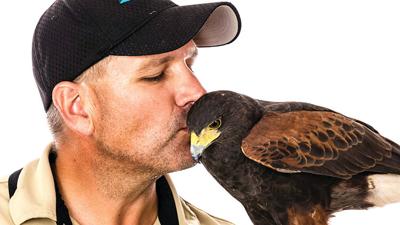
Jefferson County resident Michael Beran has an unusual, and dangerous, occupation.
He catches wild animals, usually with his bare hands.
Beran, 56, of the Arnold area owns the Wildlife Command Center, 4080 Country Club Drive, in Imperial.
“Our saying is that we rescue people from wild animals, but our catchphrase is, ‘We can catch it. When nobody else can do it, we do.’”
Beran’s exploits have captured the fancy of the folks at the Animal Planet cable channel, which has ordered an initial run of four episodes for a series titled “Bare Hands Rescue.”
“It’s called that because I’m known as Bare Hands Beran,” he said. “They show us rescuing people from wild animals, mostly bare-handed.”
The first episode was shown on Animal Planet on Aug. 22.
“But if you missed it, it’s streaming on Discovery Plus. Please check it out,” Beran said. “If Animal Planet sees enough interest, they will order more episodes.”
Beran said he prefers to capture the critters sans gloves because it’s easier on the animals.
“It’s really an effective way to catch snakes,” he said. “Typically, a pair of tongs is the way to approach a snake, but you don’t know how much pressure you’re putting on the snake and their ribs break very easily. If you put that snake in distress, it’s going to start struggling because it’s distraught.
“If you put your hand on it, it’s thinking, ‘Hey, what’s going on?’ but it doesn’t squirm and doesn’t feel the need to bite. But I do warn people not to do this at home. Save that for a trained expert.”
Swampy start
Beran came by his love of wildlife at a young age. The oldest of four boys, he grew up in a military family that eventually settled on a farm near Deville, La.
“Our farm was next to a swamp, and we boys went out and played in it all the time,” he said. “We’d try to catch every creature we could. I think we caught every kind of snake, including venomous snakes. All the water creatures, really.”
After graduating from high school, Beran enlisted in the Navy, where he worked on nuclear missiles.
“When I turned 19, I was the youngest Launcher Operations Supervisor the Navy had at the time,” he said. “I oversaw 16 nuclear missiles with 160 warheads.”
He spent 20 years in the service, including time in the Navy Reserves.
After that, Beran worked in the cell phone and construction industries, but after the company he was working for went bankrupt, he concluded that the corporate life was not for him.
“I told my wife (Bonnie) I wanted to do something I wanted to do for a change, and that I wanted to be an animal trapper. I think she threw a shoe at me,” he said.
He already had some experience in the trade.
“In 2003, I had become a master falconer. Falcons are known to hunt squirrels, and because of that, people would ask me if I could get squirrels out of their attics. I formed a company called Tenacious Avian Predators, but I couldn’t get it off the ground – at least not enough to keep me gainfully employed.”
In 2010, he bought a franchise in an animal control company, but parted ways after a falling out with management.
Then, Beran decided to pull up roots from Shreveport, La., and his family toured much of the country.
“One day we were driving through St. Louis and my wife really fell in love with the area. She really was taken by the limestone outcroppings along the highway,” he said. “You have to remember, we were from Louisiana, which is flat and swampy.”
A calling in Jefferson County
Before committing to a move to the Midwest, he tried to gauge whether there was interest in the area for an animal rescue business.
“We set up a test phone line for an animal control company and we got a lot of calls about problems with bats, so we picked up everything in Shreveport and moved on Aug. 14, 2014, to a great house in the Arnold area that was very affordable. We turned on our internet on Aug. 15 and got slammed with business.”
Since then, the company has expanded, first to Kansas City and now to nine offices, stretching from California to Florida and 25 employees nationwide, 12 in the Imperial headquarters.
Beran’s son, Chance, heads the Kansas City office; his other son, Michael, continues the family tradition of Naval service.
The business has five divisions, including one that trains animals for movies, events and parties. That’s led to some on-screen roles for Beran, who has 22 acting credits and he also does some modeling.
“I’m over 50 and have gray hair, so I get jobs that call for what’s called a silver fox. The older I get, the more modeling jobs I get,” he said. “It turns out younger models want to pose with older guys, not people of their generation. But really, I do the modeling mainly for attention.
“I got into acting because of the training of the animals on movie sets. Sometimes people don’t show up, and they have a problem. I’m a problem solver.”
Most of Beran’s acting appearances, he said, are in movies that have yet to be released.
“I’d say 2020 was my best year as an actor,” he said, and said his role in “The Night of the Tommyknockers,” which is in post-production, is his best.
“It’s kind of a Western horror movie,” he said.
Bats, zebras and lizards
… oh my!
But, he said, he doesn’t plan to stray far from being Bare Hands Beran.
Beran said in this area, eradicating brown bats makes up about 75 percent of his business.
“Typically, people have bats in their attic, and they won’t know it because no one goes in their attic. The bats are quiet. They only hunt at night,” he said. “But for some reason, maybe a temperature change, one bat gets lost and finds its way into your living space. We get the call and do an inspection, and sometimes find 300 bats in the attic.”
Sometimes a call comes in involving an uncommon critter, he said.
“One man in Barnhart called about a lizard on his roof. I was expecting something little, but when I showed up, there was a 4 1/2-foot green iguana sunning itself,” he said. “I ended up keeping him and calling him Mr. Snuggles. That’s meant to be an ironic name, as he’s not very snuggly.
“One animal we deal with that you wouldn’t think of is zebras. Anyone with $1,500 burning a hole in their pocket can buy a baby zebra. They’re super cute. Unfortunately, they grow up to be adult zebras, and zebras live on the Serengeti with lions. They know how to fight. So they bite – very hard – and tear stuff up. People really don’t think that all the way through when they’re buying that baby zebra. We find homes for those grown-up zebras, but picking them up can be tough. Usually, someone’s going to get bit.”
Still, he said, injuries don’t come as often as you’d expect.
“But you have to remember that anything that has a mouth can and will bite,” he said. “We come prepared with a lot of first aid, mostly things that stop bleeding.”
Beran said Bonnie, his wife of 21 years, has grudgingly accepted his profession.
“She’s learned to put up with my nonsense over the years. When something really crazy happens, she remains calm, cool and collected on the outside. Later, when nobody’s watching, she tries to kill me, though.”
Despite the ups and downs, he said, what drives him is simple.
“What keeps me doing this is every day, I’m someone’s hero,” he said. “My customers are so grateful.”