







(Photo by Beyzaa Yurtkuran via Pexels)
Cravings hit hardest at 3:42 p.m., according to new research.
A survey of 5,000 Americans, split evenly by state, looked at what cravings look like across the country, finding that the average person gets two cravings a day, with one in four experiencing cravings more often than this (24%).
Regardless of the time, six in 10 respondents can’t hold out on their cravings for more than an hour (57%) — and one in five give in in 15 minutes or less (21%).
Respondents from New Mexico are the champions when it comes to withstanding their cravings the longest, but Maine-dwellers and West Virginia residents give in earlier.
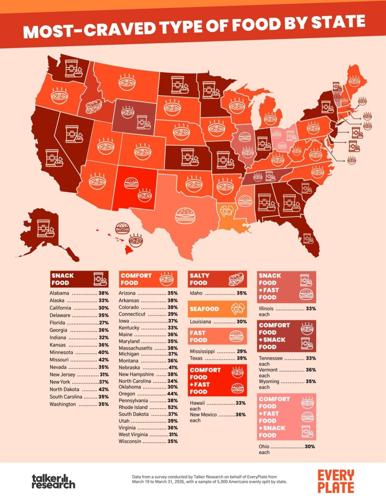
Conducted by Talker Research for EveryPlate, results found that when the hankering hits, those surveyed yearn for comfort food (33%), fried foods (22%) and salty foods (22%).
Comfort food is especially crave-worthy in Michigan (23%) and Arizona (20%), while soul food is well-loved in Mississippi (12%), Georgia (10%) and South Carolina (8%).
Spicy food gets love from those who live in North Dakota (16%), Arizona (15%), Texas (12%) and seafood is a particular favorite among respondents from Louisiana (13%) and Mississippi (12%).
Besides sweets and snacks, some of the most-craved dishes include pizza (30%), burgers (22%), french fries (19%), tacos (18%) and fried chicken (15%).
No matter what they like to eat, nearly two-thirds of Americans would rather satisfy their cravings at home rather than turn to takeout.

(Talker Research)
This carries over to their grocery habits, too — 35% percent said that their cravings from the previous week regularly affect their grocery list for the following week.
“In an era of convenience, it’s refreshing to learn that two-thirds of Americans would prefer to satisfy their cravings at home rather than turn to takeout,” said Benjamin Grebel, senior culinary development manager at EveryPlate. “It proves that people know their own tastes better than anyone; all it takes is a little extra confidence in the kitchen to bring those favorite flavors to life.”
On average, those surveyed follow up on cooking a meal based on a craving more than half the time (56%).
Those from Maine, Colorado, Louisiana, Maryland and Mississippi cook meals based on their cravings the most.
Satisfying a craving knows no bounds, as nearly half of Americans have spent more than an hour cooking a complex recipe just to satisfy a specific craving (49%).
Forty-three percent have even attempted to cook a professional-level dish at home after seeing it online and feeling the need to have it.
However, not all respondents are feeling their skills. Respondents of Arizona (24%), Massachusetts (24%) and South Carolina (24%) are admittedly least confident in being able to come up with a new dish that hits their desired flavor profile.
For many, it’s about resetting expectations. A third of Americans admit that more of the meals they see online are unrealistic for the average person to cook.
Yet, 43% of those surveyed who are parents feel guilty at least once a week about not cooking meals that look “influencer-worthy.”
When cooking meals inspired by recipes they see online, the average person estimates that they come about 60% close to their vision, although 29% admittedly don’t get to a full 50% accuracy.
“You don't need to spend an hour in the kitchen to make something worth craving," continues Grebel. "For most people, the barrier isn't cooking itself, but it's the mental load of planning, deciding and executing a meal from scratch. Remove that, and suddenly dinner isn't something to dread. It's just good food, made easy."
Research methodology:
Talker Research surveyed 5,000 Americans evenly split by state who have access to the internet; the survey was commissioned by EveryPlate and administered and conducted online by Talker Research between March 19 and March 31, 2026. A link to the questionnaire can be found here.
To view the complete methodology as part of AAPOR’s Transparency Initiative, please visit the Talker Research Process and Methodology page.