


If Theodore Kimm had a crystal ball to see his town of Kimmswick today, he surely would have been pleased with the festivals, shops and sidewalks full of tourists. He hoped for a bustling community for the town when he first envisioned it in the mid 1800s.
On Oct. 4, 1850, Theodore Kimm, an immigrant from Brunswick, Germany, purchased the large tract of ground along the banks of the Mississippi River where the town would be built from Mrs. Cordelia (Waters) Hassenger, according to a Jan. 1, 1899, article in the “Jefferson Democrat.”
Hassenger was the daughter of Capt. George Washington Waters, a West Point graduate who was stationed at Jefferson Barracks and later became the Jefferson County surveyor. Waters, himself, had purchased the tract of property for $20 on the courthouse steps, according to the History of Kimmswick section on the “Visit Kimmswick” website. Waters died in 1846 and left the property to his family.
Kimm, a successful dry goods merchant from St. Louis, wanted to take advantage of the opportunities that arose when the St. Louis and Iron Mountain Railroads came to the area. The railroad from St. Louis to Pilot Knob was completed in 1858, the same year the Kimmswick Post Office opened with Kimm as the postmaster, according to the “U.S. Appointments of U.S. Postmasters 1832-1971, Jefferson County, MO.”
Kimm welcomed tradesmen of all kinds to the town. He named his town Kimmswick.
“Mr. Kimm laid out his town in a grid pattern of blocks subdivided by lots and alleyways. He sold vacant lots and also built some houses and sold them on the trust deeds to encourage tradesmen to settle,” according to the article on the website.
But all was not peachy, especially during the Civil War. Members of the Missouri Volunteers 5th Infantry were raiding his orchards, and although he asked for help from the nearby post, he received none, according to letters he wrote to military officials, recounted in Missouri’s Union Provost Papers in Sept. 9, 1862.
The letters must have attracted attention because a search of Kimm’s home the following year resulted in charges against him when stores of ammunition were found.
Kimm was charged with “secreting 38,000 U.S. gun caps and two sacks of buckshot” and was further charged as a Southern sympathizer and he was transported to St. Louis to be imprisoned until the charges were investigated, according to the papers in May of 1863.
Whether he was tried or served time in prison for the offenses was not mentioned in the records.
Not long after the end of the war, however, Kimm was certainly in business and Kimmswick was booming.
“By 1867, the town had a steam flour mill, brewery, brickyard, copper shop, wagon maker, blacksmith shop, and stores,” according to the website.
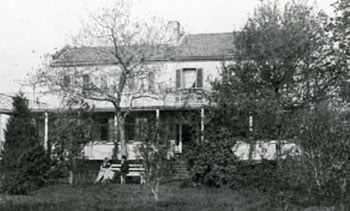
Not long after that Kimm decided to enjoy the good life he had made for himself. He retired in 1872 at the age of 61, sold all his unsold lots and the family home and began to travel abroad with his wife. Wilhemine.
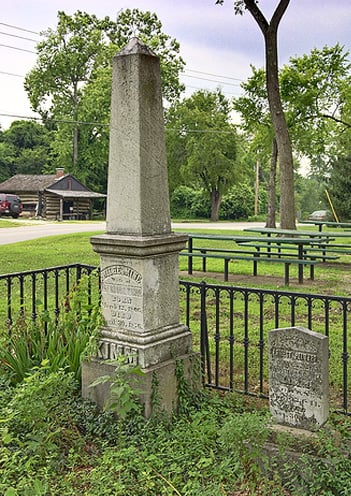
Before he left, though, he set aside an entire block for a public park. There, at Jefferson Square Park, his only son, Ernest, who died at the age of 9, had been buried. When his wife died in St. Louis in 1876, Kimm buried her there too. Kimm continued to travel and died in Switzerland pm Feb. 5, in 1886, according to the website.
Send submissions to LOOKING BACK to nvrweakly@aol.com or bring or mail them to the Leader office, 503 N. Second St., Festus (P.O. Box 159, 63028). Please include your name, phone number, a brief description of what’s in the photo and tell us how you came by it. Please also include when it was taken, where and by whom (if known). A new LOOKING BACK photo will be posted each week.