


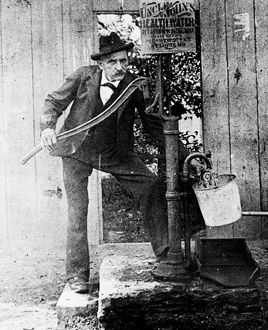
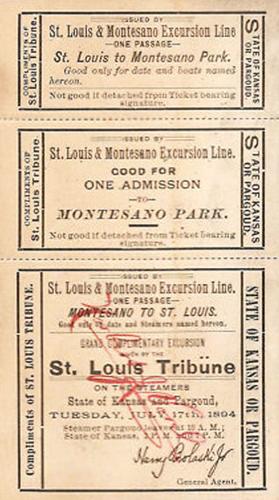
If Juan Ponce de Leon had made his way up the Mississippi River to Montesano Springs, he would have found medicinal waters that may have helped him on his legendary quest for the Fountain of Youth – at least according to John O’Heim.
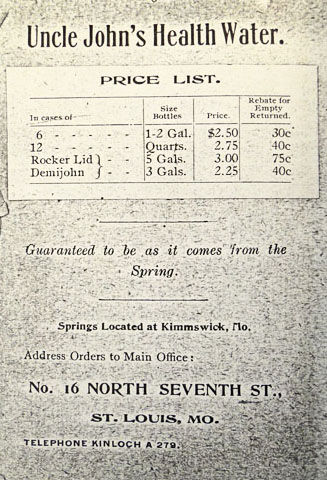
O’Heim, a German immigrant and Kimmswick merchant, said he discovered water with amazing curative properties after drilling for a well 130 feet through a formation of solid rock. He said he did not know the water had special qualities until, during a dry summer, residents began to drink it and “to the astonishment of all, those afflicted with stomache and kidney ailments began to improve so in health Mr. O’Heim was induced to have the water analysed and tested,” according to a pamphlet extolling the qualities of “Uncle John’s Health Water.”
The area known as Montesano Springs is on the north side of what is Kimmswick today.
“Montesano means mountain of health,” said Nadine Garland a member of the Kimmswick and Herculaneum historical societies.
O’Heim, however, was not the first to discover the “healthful waters” around Montesano Springs.
Several sources claim it possibly was the saline and mineral springs that brought the mastodons to the area’s marshy lands near the Mississippi River thousands of years ago. The remains of dozens of mastodons and other prehistoric animals have been found buried in the Kimmswick Bone Bed, now cordoned off for posterity, in the Mastodon State Historic Site.
Native Americans, too, settled there in great numbers, according to an 1896 article in Midland Magazine.
“Even prior to the days of Laclede, the Indian chieftains had camped around the fifteen springs that bubbled from a small area in a cove between two great hills,” the article says.
Native Americans used the spring water in the area to make salt, boiling off the water and leaving the mineral behind, Garland said.
“There were so many springs in that valley; they were everywhere,” she said.
When white settlers arrived, the importance of the minerals in the water was not lost on them. One man, Thomas Jones, had a salt manufacturing operation there in 1770 in what was then known as Crystal Springs, according to Walter Eschbach’s Historic Sites of Jefferson County. Later, the name of the settlement was changed to Montesano Springs.
In 1850, Theodore Kimm purchased a large parcel of land and laid it out on a grid. He called it Kimmswick and opened a post office in 1858, the same year the Iron Mountain and Southern railroads came through, bringing settlers and tradesmen with them, according to the History of Kimmswick on the Visit Kimmswick website.
On the north side of Kimmswick, visionary entrepreneurs recognized the value and service they could provide by making the medicinal waters from the springs available, so in 1881, a summer resort was laid out and a four-story hotel was built. Visitors took the trains or steamboats from St. Louis to the springs to escape the city heat and drink the mineral waters from the springs. The hotel burned five years later, in 1886. But the Columbia Excursion Co. purchased the property and built a large amusement park there that attracted visitors by the thousands, according to the Kimmswick Historical Society’s Walking Tour Guide.
“Arriving by steamboats such as the Providence or the J&S and by trains (a 21-mile ride from St. Louis) the people came to partake of the mineral waters from the fourteen springs within the park. The water was bottled and shipped as far away as New York.
In the park were a hotel and restaurant, a dance pavilion, a boating lake, a merry-go-round, a gallery, ‘Herr Bismarck’s Tent Show,’ and other attractions,” the guide says.
O’Heim’s discovery was right in step with the times. He began bottling the waters as a recommended cure for “dyspepsia, stomach troubles in all their aggravated forms, biliousness, constipation, rheumatism, backache, sleeplessness and kidney complaints rising from defective action of the liver, kidneys and stomach,” according to its advertisement.
Uncle John’s Health Water was also “recommended for nervousness, no matter from what cause, young or old, it will give quietude, refreshing sleep, gain in flesh and healthy color cheeks,” the advertisement said.
O’Heim was adamant that his health water was a cut above the rest.
“…it is not a ‘quack’ or ‘cure all’ and should not be classed or confounded with virtueless, so called medical waters, that are so generally on the market,” according to his pamphlet.
Eventually, the automobile became the favored mode of transportation. Roads were built that passed by Kimmswick. The steamboats stopped coming. The trains brought fewer passengers.
The last records show Montesano Springs Park closed in 1918, according to the Walking Tour Guide. A subdivision now stands where the long lost attractions once stood. And the springs, although in many places development has covered them over, still bubble up from time to time in unexpected places, Garland said.
Send submissions to LOOKING BACK to nvrweakly@aol.com or bring or mail them to the Leader office, 503 N. Second St., Festus (P.O. Box 159, 63028). Please include your name, phone number, a brief description of what’s in the photo and tell us how you came by it. Please also include when it was taken, where and by whom (if known). A new LOOKING BACK photo will be posted each week.