
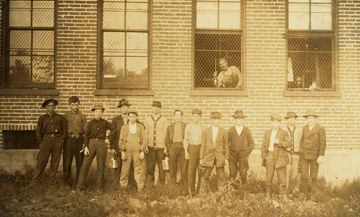
Whether they worked for International, Hamilton, Penaljo or Norwood, hundreds of De Soto families share the memory of a shift at the shoe factory and the smell of leather and cement.
Former employees of the De Soto “Penaljo” Shoe Factory will gather the company “family” at the De Soto Community Center for a May 16 reunion.
There, at the center at 400 Boyd St. in De Soto beginning at 1 p.m., former employees will sit down to share their pictures and their stories, enjoy appetizers and remember years gone by. Tickets for the event are $10 and may be reserved by calling 636-209-7080.
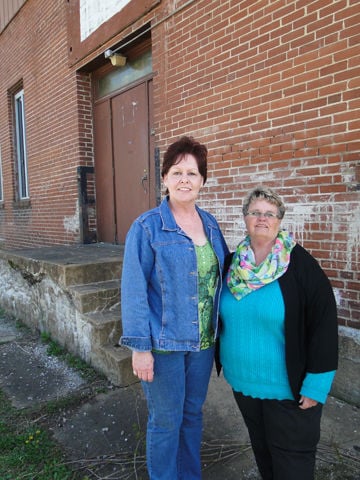
“We were a family,” said event organizer Kathy Ingram Smith, whose final days at the Norwood Shoe factory were spent as a supervisor in the pre-fit department. “Everyone helped each other. If anyone had troubles, we passed around a bucket and everyone contributed.”
“There were wedding showers, baby showers, parties,” said organizer Silvia Blake, who did piece work at the factory.
“Some people spent their whole lives working there,” Smith said.
Families often worked there from one generation to the next, a fact that Smith and Blake can personally attest to.
The beginning of shoe manufacturing in De Soto was in 1907, when the Peters Shoe Co. had a factory built at 201 E. Clement St. The company, headquartered in St. Louis, then merged with Roberts, Johnson and Rand to form the International Shoe Co. in 1911.
The factory belonged to the International Shoe Co. when Alice Secrets of De Soto, now 96 years old, began to work there in 1938, Smith said.
“She started working for 35 cents an hour. She was a splitter and a tracer on the third floor,” her daughter Blake said.
A splitter split thick pieces of leather into thinner pieces and a tracer traced the pattern of the “vamp,” the top part of the shoe, onto the leather.
“She loved her job and loved working there,” Blake said. “She came from a family of 10 and five of her sisters – Virginia Boyer, Goldie Butler, Florence Woolsey, Stella Johnston and Bertha Rogers – worked there and one brother, Lawrence Johnston. Alice is the only one left of the 10.”
International Shoe was known for brands like Red Goose, Poll Parrot and Weather-bird shoes.
In 1958, Charles D. P. Hamilton III, who was known as Penn, purchased the International Shoe Co. building, and the company was renamed the Hamilton Shoe Co. The brand name of the shoes made there was Penaljo, a combination of three men’s names – owner Penn Hamilton, and his associates, Al Shoy and Johnnie Walsh, Smith said.
Penaljo was a well-known brand featured in advertising in Mademoiselle and Glamour magazines.
Blake began working at the factory in 1971 right after high school.
“I worked on the second floor in the lasting department. We were all on piece work, which was the harder you worked the more you got paid,” Blake said.
“Sylvia made her machine smoke,” Smith said.
Smith came to De Soto with her family in 1962. Her grandfather worked at the International Shoe factory in St. Louis, a building which once housed the Lemp brewery. Her father and mother, Harold and Molly Ingram, went to work for International Shoe in De Soto. Smith remembers the scent that permeated her parents clothing each night when they came home, but didn’t know it was leather and cement until she went to work in the factory.
In 1981, a new factory was built east of De Soto on Hwy. E and the old factory closed, said Smith, who began her career at Hamilton Shoe Co. in 1983 and worked there for 11 years.
Blake worked 23 years for the shoe factory in De Soto, and then went to work in Potosi at Red Wing Shoe until she retired in 2012, after spending a total of 41 years making shoes.
In its heyday, the shoe factory in De Soto employed about 300 people, half of them women, Smith said.
Besides the railroad, the shoe factory was the largest industry in the city, the women said.
They both have cherished memories of the people who worked there, like Harlan Love, who headed the maintenance department, “built machines and kept them all humming,” Smith said.
Laura Maness liked to play tricks on fellow employees, Blake added.
“If you stepped away from your machine, she would take the light bulb out or turn the belt around backwards (which caused the machine to sew backwards),” she said.
They also remember the toughest thing about working in a shoe factory.
“Patent leather,” they both said simultaneously.
“It was stiff, hard and slippery,” Blake said.
In 1985, Penn Hamilton sold the Hamilton Shoe Co. to Pacific Brand Footwear, Dunlop, an Australian firm. Smith remembers how employees took on management when they noticed that the company flew the Australian flag outside the building higher than the American flag. They brought in their own flags for their work stations.
“There was a sea of American flags. It was the prettiest thing you’ve ever seen,” Smith said.
Pacific Dunlop closed its doors in 1989.
The following year, James Norwood, Phil Knapp and Tom Capps purchased the factory and the Penaljo brand name and began production under the name of Norwood Shoe Corp., Smith said.
Three years later, on Oct. 12, 1993, workers received notice that Norwood would close. On Nov. 1 of that year, three supervisors – Marge Lorenz from the cutting department, Smith from the pre-fit department and Lila Medley from the fitting department – each wrote a note about their experience making shoes and how they felt about the plant closing. They each took an object from their department – a cutting die, a tuf-sta and a needle – and placed them along with the notes in a Ziploc bag and then dropped the bag into a concrete block in the wall of the building. The factory closed its doors Jan. 7, 1994.
Marge Lorenz has since passed on. Lila Medley, who shared Smith’s enthusiasm for a reunion this spring, unfortunately died March 8.
“She was so excited about the reunion,” Smith said.
Smith recently retrieved the items from the wall of the former factory that has now been remodeled and serves Sheet Metal Contractors Inc.
“The bag was grungy, but there. It was the only wall of the original factory left standing,” Smith said.
Smith swears she could still smell the leather and cement in the building.
“It was still there,” she said.
A new LOOKING BACK story is posted regularly. To submit one, send it to LOOKING BACK to nvrweakly@aol.com or bring or mail it to the Leader office, 503 N. Second St. (P.O. Box 159), Festus, 63028. Please include your name, phone number, a brief description of what’s in the photo and tell us how you came by it. Please also include when it was taken, where and by whom (if known).