




Sometimes when perusing the annals of history, it’s worth taking a pig in a poke to see if you can get a nice ham anyway. A humorous article in the Jefferson Democrat in 1890 was a tasty enough tidbit to lead right into the tales of one fine family from Ware – the Wileys.
The article mentioned "Long Tom of Dry Creek" visiting Hillsboro.
Apparently, he was in good spirits after some political news because the paper said he was “brimful and running over, not with Bourbon county barreled lightening, nor with Green Tree elixir of life, but the good Democratic news from all over the country.”
As soon as he heard the news, according the Jefferson Democrat, Nov. 27, 1890, “…he began to fatten like the porkers in his pen.”
“The fact is, he came out to the county seat for the purpose of trading pants with Elkins or Sheible, but the trade was a failure,” the paper said. “While their clothes fitted snugly about his waist, they lacked a foot or more in length.”
Well he may have been Long Tom of Dry Creek, but he also was known as Thomas J. Wiley or by his full name Thomas Jefferson Wiley. He was the grandson of one of the first pioneers who arrived in Dry Creek in 1818, John Wiley. It was the same year Jefferson County was formed, even though Missouri was not yet a state.
John was made a commissioner of schools and did well for himself, as did his son Eli, as noted in the elaborate obituary spun in the Jefferson Democrat in Dec. of 1878, when he died. Born in 1799, and originally from North Carolina, Eli had come to Dry Creek with his father from Tennessee.
“They hired a flat-boat, in which they pulled from the mouth of the Tennessee River to the mouth of Isle Au Bois, in St. Genevieve County. From this place he started to Jefferson County, in an ox-cart, and settled on Dry Creek, at what is known as the "Stone house place."
Eli was “a well to do farmer,” a member of the Presbyterian Church, a justice of the peace and an associate judge for the county court for a short time, according to the “History of Franklin, Jefferson, Washington, Crawford and Gasconade Counties.”
Thomas was born in Ware on July 13, 1849, to Eli and Lucinda (Johnston), one of 13 children four girls and nine boys. He was a pig farmer.
Apparently he was well liked, enough to be made sport of in the paper, but he did get into a little trouble when a deal he had with a neighbor went sour, according to the Jefferson Democrat.
It seems Thomas had a deed of trust on Calvin McMullin’s farm, but McMullin wasn’t paying the interest or the taxes. So Wiley gave legal notice and sold it. Despite the sale, Wiley didn’t bring in enough to pay the debt, so he began proceedings to attach the wheat that was then growing in the field. He went to McMullin’s farm with papers and a sheriff, and the parties came to a compromise – Wiley would only take a portion of the wheat.
McMullin, however, was slow about threshing and Wiley went to visit him.
“He and McMullin had a quarrel about it, and as McMullen made a demonstration, Wiley drew a pistol and presented it,” the paper reported.
Wiley later pleaded guilty to the charge of presenting a weapon and paid a $1 fine and court costs.
McMullin then threshed the field at night and hauled the wheat to De Soto. Wiley, when he heard about it, had him arrested for larceny and taken to jail. After several days McMullen was released on bond, but the grand jury failed to find a bill against him, according to the Jefferson Democrat in Sept. of 1891.
Whether he got his money or not, Thomas Jefferson Wiley lived a long life. He died March 18, 1947, at the age of 97.
There are still Wileys around Hillsboro. One in particular is the descendent of Thomas Jefferson’s brother, George Washington Wiley. George “Wayne” Wiley, 75, of the Hillsboro area is his great-grandson.
“My mother didn't like the name Washington,” he said.
Wiley said he remembers his relatives sitting and talking about the old days, but “it went in one ear and out the other. I wish I had been listening.”
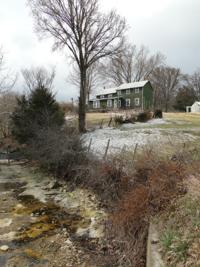
Wiley remembers his mother talking about “Uncle Tom” and he knows that he last lived down by the Big River although he was only a small boy when he died. His great-grandfather’s farmhouse still exists and looks just like it did when he was a boy. The Wiley family cemetery is still there too, he said.
Wayne did remember one thing that was passed down – how to lead a pig, he said.
“You tie a rope around his back leg and you nudge him forward with a stick. If they try to run away, they fall over,” Wiley said.
Send submissions to LOOKING BACK to nvrweakly@aol.com or bring or mail them to the Leader office, 503 N. Second St., Festus (P.O. Box 159, 63028). Please include your name, phone number, a brief description of what’s in the photo and tell us how you came by it. Please also include when it was taken, where and by whom (if known). A new LOOKING BACK photo will be posted each week.