


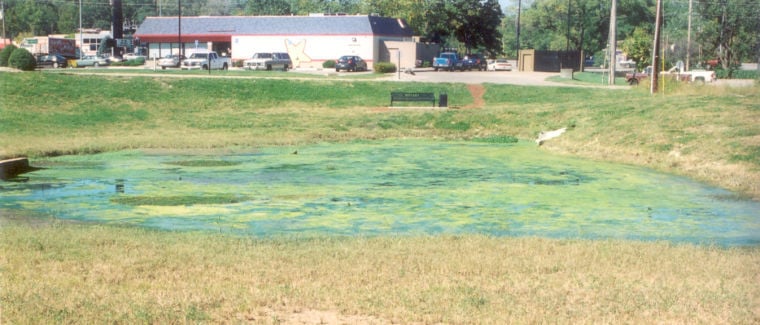
In the middle of the House Springs business district, there’s a small green pool close to the roadway on the north side of Hwy. MM. It is the remnant of the springs that flowed across the plain into Head’s Creek, the springs that are an integral part of the town’s history and gave House Springs its name.
The springs, as they are now, resulted from development of the property that began about 1990. Paul Taylor, who owned the ground, brought the fast food restaurants and strip mall to town, and in 2008 offered the county 1.5 acres where the spring was located. The area included the springs, a retention pond and a common ground area designed by the Army Corps of Engineers. The county accepted the offer and placed the property under the authority of the Parks Department, which maintains it.
Historically, the location is significant. There, only yards from the spring, near where Gravois Road (as Hwy. MM was once called) and the intersection of new Hwy. 30 meet, an ancient Native American burial ground was found. The “cist” burials were unearthed in 1940. Cist graves, where a single body is placed in a hole covered with slabs of stone, are characteristic of Woodland Indians, says historian Della Lang, in her book “Along Old Gravois.”
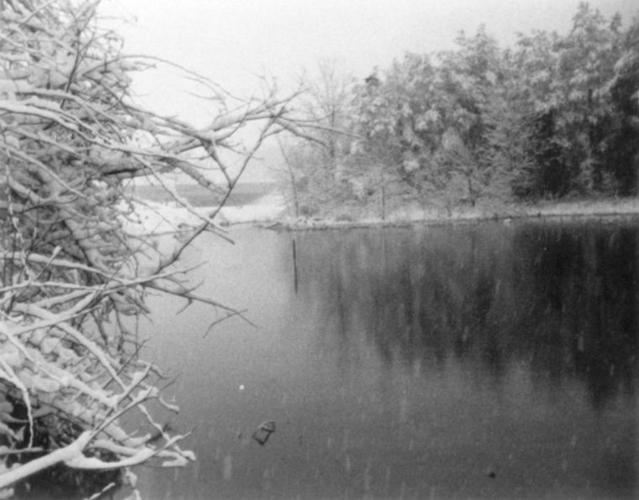
In the late 18th century, James Head, for whom the creek is named, was one of the first settlers of European descent known to live in the immediate area. He settled near the location of a spring which had a current strong enough to turn a mill wheel, according to history books.
Some accounts say Head was chased out by Indians. In any case, when he left that place about 1796, even before the Louisiana Purchase, Adam House settled on the property. His tale is the most famous, of course. House, along with his son Jacob, was killed by Osage Indians. This report came from the commandant of Carondelet who was sent in pursuit of the Indians:
“On reaching the place, I found an old man dead, head cut off and laid at his side, scalp taken and a body full of wounds from musket shots; and a few paces off, a boy of 8 or 9 years old, head cut off and lying near him, face smeared with blood with a small piece of maple sugar in his mouth…” It was March 1800.
The town eventually was named for the House family and the springs near where they lived.
Once the years of conflict with the Indians subsided, the Burgess family built a home on the property near the springs in 1868. Four generations of the family lived in that house, and several families since. Although members of the Northwest Historical and Preservation Society of Jefferson County tried to save the house, it fell to development in 1988.
The spring still flows on, but with the establishment of businesses along MM, its course was rerouted through pipes underground.
Although Taylor handed the property over to the county, very little can be done with the grounds because it is a mitigated wetland, preserved in a federal program in exchange for changes made to another wetland during development of the property, said Mike Ginger, director of Jefferson County’s Parks Department.
He said that the spring area is not the type of property the Parks Department usually works with, but they are doing the best that they can.
“They told us, ‘It’s a wetland. Just let it grow. It’s planted with wetland flora and it’s not supposed to be mowed,’” Ginger said.
But soon, complaints came in, and park personnel were instructed to mow the property, he said.
A bench and birdhouse from the High Ridge Rotary Club adorn the lawn, and now and again ducks light on the water paddling around, even amidst the passing of countless cars on the three sides of the small pond.
Donnie Bruce, a resident in the area since 1965, says the springs are not even a shadow of their former beauty. He worries about the run-off from the road and parking lot into the algae-covered spring and wishes something could be done to restore the spring to a portion of its past glory or at least create a place that is worthy of its significance to the area.
“They used to put trout in that spring. They couldn’t reproduce but you could see them swimming there,” Bruce said. “The spring was a beautiful thing until man got a hold of it.”
Ginger said people in the neighborhood have contacted him about the springs, and the Parks Department has done what it can
“I understand where they’re coming from. This is not what we want, but it is where we are—the reality. If we could go back in time, it might be different,” he said.
Leroy Luck, who has lived in the area since 1969, said the spring used to flow into Heads creek about the same location where a bridge crosses the creek on Hwy. 30. Luck, who has two great-grandmothers who were Native American, said that a large camp of Indians lived along the Big River nearby. The area along the Big River is rich in artifacts. The county allowed him to change the name of the road that runs along Head’s Creek north of the spring to Indian Springs in 2012.
“I thought the Indians deserved a little credit for that place,” he said.
Send submissions to LOOKING BACK to nvrweakly@aol.com or bring or mail them to the Leader office, 503 N. Second St., Festus (P.O. Box 159, 63028). Please include your name, phone number, a brief description of what’s in the photo and tell us how you came by it. Please also include when it was taken, where and by whom (if known). A new LOOKING BACK photo will be posted each week.