

By Peggy Koch
Fort Sumter was attacked on April 12, 1861, and began the Civil War 150 years ago.
Chapter 1
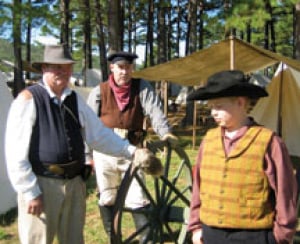
This story was inspired by a suggestion made by made by Trina Rasmussen and other re-enactors of Robinson’s Light Artillery, Confederate States of America. They played parts in the Civil War re-enactment event that was held at Fort Davidson in Pilot Knob on Sept. 25, 2010. All photos that run with this series were taken at that event except when noted.
“It’s time for bed,” Dad called as he passed Adam’s room. “Turn off that video game.”
“But Dad, I’ve got to win this battle!” Adam protested.
“What battle?” Dad questioned. “You’re not playing a war video, are you?”
Adam ignored him and continued playing. His father crossed the room and leaned over him.
“Adam,” Dad demanded, “show me what you are playing.”
Reluctantly, Adam handed the controls over to his father.
“I thought we warned that your racing car games were O.K. but not war games. No killing games, Adam!”
“No, you just said you wouldn’t buy me any war games, Dad. My friend Kenny loaned me this one.”
Adam could see that his father was trying to stifle his anger. His face was turning red. But after a moment of silence, his father said, “I guess it is time we had a talk about war and killing. It’s easy to pretend to hurt or kill. You see it on television all the time. Son, you have no idea what war is really like.
“Your great-great-grandfather did. Late in life, he wrote a story about what had happened to him during the Civil War. His story began when he was 12 years old, the same age you are now. I want you to read it sometime. Now go to sleep.”
The following morning, at breakfast, Adam’s father announced, “You’re going with me to a Civil War re-enactment this weekend.”
“Do I have to?”
“If you want to play any more video games in this house, you do.”
The following Saturday morning, the two of them drove into the still-green Ozark hills. The site of Fort Davidson in Iron County was already crowded when they arrived. Tents dotted the valley. Men dressed in dark blue uniforms could be seen everywhere. A few men were riding horses while one man curried his mount as visitors watched. A practice cannon volley shattered the air.
“Why don’t we see as many Confederate soldiers?” Adam asked. “I thought you said the Federals were outnumbered 9 to 1.”
“That’s because so many of them didn’t have uniforms by 1864. See that line of Confederates practicing over there? Some have on gray shirts, some have civilian clothes, some even have on dark blue. They had to wear whatever they could scrounge.
“That’s confusing, Dad! How did the Federals know who to shoot?”
“They didn’t always.”
Adam studied the scene for a while longer, then asked, “Why are there so many women around here? War is for men.”
“Let’s ask one,” Adam’s father suggested.
“You ask,” Adam insisted.
A smiling woman in a calico dress explained: “Southern officers were allowed to take their wives along. See, the enlisted men slept in the pup tents. The officers and their wives had the larger tents and were allowed to bring some creature comforts. Like these.” She proudly showed them a portable writing desk, a small cooking stove and a store of preserved food.
“What did the women do while the shooting was going on?” Adam asked her.
“Most camps were set up far away from the shooting. But we knew how to shoot if we had to. Battlegrounds can change quickly.”
“That’s not right,” Adam told his father as they walked on. “Women don’t belong in battles. Look – I don’t see any women among the Federal troops.”
“That’s because they weren’t allowed to bring them. Another difference was that while the officers in the Confederate army slept in a separate area from their enlisted men, the Federal officers were right by their men.
“Now look here, Adam. These are the tools used by a field surgeon. See, there are forceps for removing bullets and a saw for amputating.”
“Look at all that stuff on his apron, Dad. Is that blood?”
“Yes, it is. You see, in war soldiers didn’t always die right away. Sometimes they would get shot in an arm or leg. Many soldiers died later from infections.
“Why didn’t they just give them some penicillin?”
“Penicillin and the other antibiotics hadn’t been discovered yet. The doctors in field hospitals often were usually short on even the most basic supplies like clean bandages.”
Adam looked a little green.
“Not a very glorious picture is it, son? And now we had better find a place to stand to watch the battle.”
LOOK IT UP
The battle of Pilot Knob actually involved entire Arcadia Valley, including the town of Ironton. It took place in late September 1864. (The next re-enactment will be held in September 2014, exactly 150 years from the date this battle was originally fought.)
Penicillin became widely known after 1928, when Sir Alexander Fleming noticed that a colony of staphylococcus bacteria was being dissolved and replaced by a blue-green mold. He isolated and grew that mold in a pure culture. With experiments, he discovered that the substance could kill a number of different bacteria. He named the substance penicillin.
Chapter 2
The morning after the Civil War re-enactment, Adam’s father handed him a thin stack of pages. “This story was written by Will Kerns, your great-great-grandfather. In 1864, his family lived in Reynolds County, about 20 miles from Fort Davidson. Many years later, after Will retired from his medical practice, he wrote his experiences so his children and grandchildren would remember what war is really about.”
Reluctantly, Adam picked up the faded pages and began to read.
“When is this fool war going to get over?” Martha sobbed to her mother. “We can’t eat or sleep without being afraid.”
“At least you still have Will here to help with the garden and what little stock you have left. Where is he anyhow?”
“He’s back in the woods feeding the hogs, Mother. Got ’em penned up down in the hollow by the spring branch. I just hope no one comes by who wants ’em. We almost lost everything when that Yankee general and his soldiers came through last year. Glad they left us a few chickens and didn’t find the hogs. Good thing we live so far back in the woods. Hear they cleaned folks out near Patterson. What kind of war is this anyhow when women and children are burned out of their homes or starved to death on purpose?”
“I wish you’d come back to St. Louis with me, Martha. At least there’s food up there.”
“I’m not going to live with a bunch of murdering Yankees, Mother.”
“Well, I’m still one of those Yankees, daughter. You were too until you fell in love with Jess. I’m going to be heading back in the wagon tomorrow morning, with or without you. I can’t wait any longer. Bushwhackers would be happy to steal my horse and wagon.”
“I really appreciate that you risked your life to try to save us, Mother.”
“What else could I do when I heard how much danger there is down here?”
“But I can’t just leave now. What if Jess comes back and I’m not here?”
“I’m sure your husband would rather have you and Will safe in St. Louis...”
“Hush! I hear horses,” Martha interrupted, then looked out the window. “I can see at least a dozen men riding up.”
“Can you tell by their uniforms who they are?”
“Well, glory be, it looks like they’re Confederate soldiers. I think we’ll be safe with them, Mother, just as long as you don’t let on that you’re a Yankee sympathizer.”
“Don’t worry. I’ll let you do the talking.”
Two weary-looking men in officers’ uniforms knocked at the door, then strode in, not waiting for Martha to open it.
“Evenin’, ladies,” one said politely while taking off his hat. “Ya’all have any food for the good of the Confederate Army?”
Martha knew they could smell the beans cooking and see the cornbread laid out on the table for supper.
“I guess you can have our supper,” she volunteered reluctantly.
“Looks like there’s enough here for three people. Somebody else live here?” the officer questioned suspiciously.
“No, it’s just my ma and me,” Martha lied.
What’s your name?”
“Martha”
“Well, here’s the thing, Martha, I’ve got a squad of a dozen hungry men out there. Are you sure you don’t have more food around? Some potatoes, maybe? I expect you don’t need all those chickens, either.”
“We only have six left, sir.”
“I’d like to see you get to fixin’ those chickens for my men’s supper. It’s good for the cause, you know.”
“Please don’t take our chickens,” Martha begged. “We’ve been livin’ off the eggs. That’s all we’ll have this winter. My husband is fighting for the cause in Tennessee. Isn’t that enough?”
“Sorry, Ma’am, but that’s not my problem. Feedin’ my boys is.” the corporal insisted.
Seeing they had no choice, Martha’s mother reluctantly headed toward the chicken coop. Martha joined her and together they wrung the chickens’ necks and plucked the feathers.
As the chickens cooked, they gathered the last of the corn from the corn crib, ground and cooked it.
“How can they do this to us?” Martha whispered, tears rolling down her cheeks.
“Let’s just hope this is the worst,” her mother whispered back. “You know we have to get back to St. Louis now – somehow.”
LOOK IT UP
In the late summer of 1864, the situation was looking desperate for the Confederacy. Although their military leaders had won many battles, the Confederate States had begun the war with fewer potential soldiers, fewer industries for manufacturing weapons and fewer miles of railroad for getting supplies where they were needed.
On Sept. 2, 1864, Gen. William Tecumseh Sherman had captured Atlanta, dividing the South and giving the North cause to hope for an end to the war.
On Sept. 19, 1864, troops commanded by Confederate Maj. Gen. Sterling Price crossed into Missouri. His three divisions were led by Joseph O. Shelby, John S. Marmaduke and James Fagan.
His intention seems to have been to take either the arsenal at St. Louis or the State Capitol at Jefferson City. Price expected to accumulate more recruits from among the Southern sympathizers in Missouri, as well as gathering arms and other military supplies along the way.
He hoped that a surprise victory would demoralize the North into ending the war with the Confederacy still intact. Although his army included 12,000 men, as many as 3,000 of his recently enlisted troops had no weapons. Few enlisted soldiers had complete uniforms. Some of them wore pieces of federal uniforms taken after battles. It is estimated that 6,000 of them had never seen combat.
Chapter 3
“You sure are hungry,” Martha noted as she spooned out the last of the chicken and corncakes to the Confederate soldiers as the sun set.
“I thank you ladies for the good food,” one private volunteered. ‘We ain’t had a hot meal for weeks.
“We’re Pap Price’s men,” he continued. “Goin’ to ride all the way to St. Louie, too. Gonna get us some more fighters and guns.”
“Shut up,” warned the soldier behind him. “You know we ain’t supposed to tell that.”
“Aw, that’s just a couple of ladies. They cain’t hurt no one.”
“Well, just don’t tell ‘em no more.”
“You sure you haven’t got more food?” the sergeant asked Martha as the soldiers prepared to leave.
“No sir,” she repeated for the dozenth time.
Both women sighed in relief after the officers mounted their horses and their men followed them out of the yard and down the trail.
“Are they gone?” 12-year-old Will whispered through the back window.
“I think they are, son. But I’m sorry to tell you that you won’t get any supper. They ate everything we had.”
Will crawled in through the window. Quickly the women put out the oil lamp, secured the door and all three went to bed.
At dawn, the door to the cabin flew open to the sound of splintering wood. Martha awoke in fright. As her eyes focused, she could see the sergeant dragging Will from his bed.
“I knew there was someone else living here,” he shouted.
Martha and her mother jumped out of bed, threw blankets around themselves, then went to face the invading Confederates.
“He’s just a boy,” Martha cried.
“Well, we just happen to be needin’ a boy right now,” the sergeant told her.
“Son, wouldn’t you like to be like your father, a brave soldier in the Confederate Army?”
Will gulped. “Suppose I would, sir.”
“Well then, we’ll take you along right now.
“First thing is to tell us if you have any more food hidden around here. Remember it’s your duty now.”
Will looked a question at his mother. He could see the fear in her eyes.
“We’ve got three hogs down in the hollow.” Will spoke reluctantly.
“Take this boy and go fetch those hogs.”
Waiting until after Will had left, the sergeant threatened: “Ladies, we’ll be goin’ soon. But don’t give us any trouble or we’ll burn down this cabin – maybe with you in it. Oh, and we’ll be takin’ that fine horse and the wagon, too. I have no idea how you’ve managed to keep that horse here in such good condition. You’re lucky I’m not going to ask.”
“Am I really going to be a soldier?” Will questioned as he marched north along with the squad.
“Son, better than that. You’re going to be a powder monkey.”
“What’s a powder monkey?”
“You’ll see when you help us shoot off our big cannon. But we aren’t always shootin’ so you will have other jobs, too. Know how to play a drum?”
“No sir.”
“You may get to learn. There’s more to it than just settin’ the pace when we march. That’s how we communicate out in the field. The particular drumbeats tell units how to stay together when smoke gets thick. Or when to charge.
“And when to retreat,” a nearby soldier added with a snicker.
“We don’t never retreat!” another shouted.
“Got any shoes, boy?” the sergeant asked Will.
“No sir. I haven’t had a new pair since the war started and I outgrew the old ones.”
“Get this boy a pair of marching boots, Corporal. By the way, you are to call me Sgt. Dill.”
By midday, the soldiers had arrived back at the main camp. Will sat down wearily and removed one too-large boot to see why his foot was hurting. An angry blister had formed on his heel.
“Don’t you just sit there, boy. Water those horses,” the sergeant ordered.
Will winced in pain as he eased on his boot and headed toward the creek with two buckets.
“Why can’t the horses just drink out of the creek?” he asked.
“Do what you’re told and don’t ask questions,” the sergeant snarled.
LOOK IT UP
As the Confederate troops marched toward Fort Davidson, Union Brig. Gen. Thomas Ewing was desperately requesting reinforcements. Enough troops were sent to bring the total number of soldiers to approximately 1,400, a larger force of Federal troops than Price had expected to meet in combat. Still, the Federal troops were outnumbered nearly 9 to 1. (Fort Davidson is approximately 60 miles south of the southern Jefferson County line).
Powder monkey: More than 250,000 young boys may have fought in the Civil War. Many served on warships. Others joined the army.
Although the official enlistment age was 18, most recruiting officers were more interested in filling quotas and did not worry about keeping accurate records.
There was a need for young boys. Their services included being drummers or playing a bugle, caring for the horses, cooking, cleaning and chopping wood. And if they were particularly daring, they were used as powder monkeys.
Chapter 4
The encampment was much larger than Will had expected. Hundreds of soldiers milled about, talking and swearing. A few platoons marched in time, forming wide circles. A blacksmith was shoeing horses. A few soldiers were lounging around playing cards.
“There’s a lot of men here,” Will noted as a soldier passed him by.
“Yeah, old man Price is really gonna give it to the Yankees,” the man replied. “We’ve marched up from Arkansas and Tennessee. Gonna grab us some railroad trains and go all the way to St. Louis. Surprise them feds. Show ‘em the South still has some fight left.
“Have you fought in Tennessee?” Will asked eagerly.
“Sure have.”
“Do you know a man named Andy Kerns? He’s my father.”
“Can’t say as I do. Tennessee is a big state. Lots of fighting goin’ on there. Lots of dying, too.”
Will looked alarmed.
“Oh, your Pa’s probably doin’ just fine.”
From far away, Will could hear some pigs squealing in fear. He recognized the sound of Petunia, his favorite pig among them. Then there was silence. Will stifled a sob, knowing what that silence meant.
Just then Sgt. Dill approached.
“This here is Cpl. Long. He’s gonna teach you a little bit about how to help with the cannon loadin’.”
Long smiled.
“So ya want to be a powder monkey, do ya? Well, follow me and we’ll show you.
“Here’s the way it works. Takes four of us to get it ready.”
He pointed. “One of the men uses this claw-shaped worm to clean out any bits of debris in the bore of the cannon.” He picked up the claw.
“Another man plunges in this wet sponge to finish the job and put out any live embers left.” He demonstrated.
“You bring us a measure of black powder in this cotton sack. The third man sets the charge. Then he puts in a ball and shoves it into position with this prod. The first man fixes the firing wire. Someone pulls it and… ka-boom!
“Always be careful, boy. The cannon gets real hot as it is fired. And I promise you this, son, it’s gonna bet hotter ’n a firecracker pretty soon. Probably tomorrow.”
“What’s gonna happen tomorrow?” Will asked.
“We’re gonna take that Yankee molehill fort down by Pilot Knob. It’s mostly made of dirt and wood. Shouldn’t take us long. Word is they only got a couple hundred men defending it.”
“That sounds like it should be easy, sir.”
“Yeah, we’ll overrun them like a Biblical plague of locusts. Once we do, we’ll have more rifles for our men. Some of ’em don’t have any. And some of ’em ain’t never been in a battle before. New recruits like you.”
“So they don’t know how to fight?”
“They’ll learn in a hurry, boy.”
Just then, a squad of soldiers came by.
“We caught us some men on the farms outside of town, Sergeant.”
“Any of you brave men want to join the victorious Confederate army?” Sgt. Dill asked the sullen-looking captives.
One teenager stepped forward. “My pa says I’m too young to fight but he’s wrong.”
“Good for you! Go with the corporal. He’ll get ya settled. Now what about the rest of you?”
“This one was makin’ sorghum when he should be fightin’ with us.” One of the captors shoved the man forward. The captive fell to the ground.
Will wondered if the man had been sick, he looked so pale. He appeared to be past 40 years old. When he struggled to his feet and walked back toward where the other captives stood, he limped.
“His foot’s crooked,” one of the soldiers whispered.
“He’ll be no good to us,” the captain spat. “But we can’t turn him loose. We’ll march him up with the other prisoners.”
“I thought there was supposed to be a flood of volunteers,” one soldier whispered to another. One out of seven ain’t no flood!”
LOOK IT UP
Gen. Price’s regiments began engaging Union pickets just after noon on Sept. 26. As the Confederate forces pushed their way across to the Arcadia Valley, the Union pickets were driven back toward Fort Davidson. The Ironton County Courthouse was attacked before the Confederates reached Fort Davidson. That courthouse still shows evidence of where cannonballs struck during the battle.
Highly explosive black powder was needed for each firing of a cannon. Younger boys were short and agile, therefore more able to keep low. And they were considered to be as expendable as the enlisted men.
Pickets: Both sides would have set up guards and scouts to watch for evidence that another army was coming near.
Cannonballs or shells? Civil War cannonballs were solid. Shells were hollow. They were filled with an explosive charge and possibly shrapnel.
Chapter 5
Will spent an uncomfortable night trying to sleep on the damp ground amid the enlisted men. Though he felt exhausted, still he lay awake worrying about what had happened to his mother and grandmother. And he wondered what the morning would bring.
“Hope he don’t end up like our last powder monkey,” he overheard one soldier whisper. “Yankees shot him in the head.”
At daybreak, Will was rudely awakened by the cook’s curses.
“Go get me some water right now, you good-for-nothin’ boy,” the cook ordered, giving him a not-so-gentle kick.
Later, Will watched as the cook placed flour in a large crock, then kneaded it into dough. The cook showed Will how to wrap some dough around a stick. Then the enlisted men lined up, each bringing a stick. Will wrapped one stick for each of the men and they cooked the dough on the open fire, turning it constantly so it would bake but not burn. This was their only breakfast although they could smell the aroma of bacon cooking somewhere nearby in the officers’ section. Will gagged at the smell.
All morning, Will was too busy doing chores to think about the ongoing attack. He could see companies of men moving out, heading for a break between two tall mountain ridgelines. Beyond them, he had been told, lay the hexagon-shaped earthen fort with a wide dry moat, overshadowed by tall mountains rising up to the east and west.
Not long after noon, Will began to hear gunfire. A few moments later, his unit was ordered to move out.
Below him, he could see waves of Confederate soldiers spilling across the lower hill. Beyond them, a few soldiers dressed in blue were firing rifles and then retreating through the town of Ironton.
Someone let out a rebel yell, and then sang out, “We’ve got ’em on the run.”
“The sergeant-major says we’re to march our cannon up to the other side of Shepherd Mountain,” Sgt. Dill told the men.
“Why didn’t he tell us to do it yesterday when we weren’t doin’ nothin’ but playin’ cards?” one soldier protested under his breath.
“Get moving!” the sergeant ordered.
The soldiers had just placed the cannon on a high rise when one of the siege guns from Fort Davidson opened fire on them.
“Hurry,” a corporal ordered. “Boy, go get us some black powder and keep it coming.”
Will dashed to the rear where a large box of black powder had been set. Quickly he filled a cotton bag with powder. Then he stooped and nearly crawled back to where the three soldiers had prepared the cannon.
“Hold your ears, boy,” one of them shouted as another lit the charge. The metal frame recoiled as the shell flew through the air. It fell far short of its goal and exploded, spewing dirt and grass into the air.
“We’ve got to set this cannon up higher in front,” the sergeant ordered. “Help us, boy.”
“Ouch,” Will shouted as he grabbed a spot too close to the barrel and felt the searing heat. He spit on his hand to ease the pain.
A gentle rain began to fall, soaking and chilling the gunners as they worked the cannon. “Don’t get the powder wet,” Will was warned over and over again as he made his rounds.
Below them, they could see company after company charging toward the fort from the side of the mountain.
“Look, them boys in blue are retreating. Runnin’ like rabbits, they are, right into the fort. Won’t be no time ’till our men overrun them.”
But it didn’t look quite that way to Will. From the distance, he could see more and more men falling onto the sodden ground of the treeless fields around the fort. Each time he heard a distant kaboom coming from the fort, the ground shook and more soldiers fell.
It’s hard to tell, Will thought, just how many of those men are ours. A lot of them were wearing dark blue shirts or trousers.
Will could hear the cheers of the men behind him as one brigade finally reached the fort’s dry moat. Then they all watched in dismay as Federal soldiers began lobbing hand grenades at the closest fighters. Soon, the Confederates began to pull back.
“It’s gettin’ too close to dark,” the sergeant noted. “Don’t know if we’re gonna finish this off today or not.”
LOOK IT UP
The Confederates began attacking on the morning of Sept. 27, assuming that a quick assault would win the day. Federal pickets from Ironton quickly began retreating toward Fort Davidson to warn of the attack.
Price’s forces attacked from Shepherd Mountain to the west and the slopes of Pilot Knob to the east. Ewing’s men kept up a steady fire from the 11 cannons mounted inside the fort. As ordnance exploded, waves of Confederate soldiers would fall, then be overrun by successive waves.
In 1864, Thomas Fletcher, who was born in Herculaneum, organized the 47th and 50th Missouri Infantry Regiments. He commanded a regiment at Fort Davidson during the battle.
He was later elected governor of Missouri and served from 1865 to 1869.
Chapter 6
Night had fallen on the battlefield at Pilot Knob. All was deadly quiet inside the fort. Other squads had been ordered to moved up and away from the fort and set up camp. Word was passed that the Confederate leaders were confident they could capture the fort the following day and secure the area.
Sgt. Dill’s men were ordered to help find the wounded among the dead. Will was so weary, he could hardly make himself move among the shadowy bodies. The crescent light of a new moon gave him little aid. Yet the constant cries of, “Help me” kept him combing through the piles of gory bodies scattered across the Arcadia Valley.
He supported those who could still stagger off the battleground. Later, he pointed out to the stronger soldiers those whose bodies seemed to have some life left in them. Up in the hills, he could see light coming from the tents of the surgeons who were treating the wounded.
“Sergeant says we only lost a couple hundred men,” one of the soldiers whispered, “but it looks more like a thousand to me.”
“What did you expect?” another one asked. “I don’t know why Pap’s officers didn’t start ordering us to use our cannons sooner.”
“Our men didn’t have much choice either but to get themselves shot with the ones behind them shoving them forward over that open field. With those big guns inside the fort mowing them down, what could they do?”
“Makes me sick.”
“Don’t our officers notice? All these raw recruits were armed with dozens of different kinds of firearms. How could we keep them supplied with the right kind of ammunition? Half of them had nothing to shoot back with after the first few volleys.”
Well past midnight, the exhausted rescuers fell asleep in whatever shelter they could find. Shortly before dawn, an explosion rocked the air.
“Something must have blown up down at the fort,” one of the men grumbled. Will opened his eyes briefly, then fell asleep again. Whatever it was, it could wait until daylight.
The protests of exhausted Confederates could be heard throughout the encampment as the sound of bugles broke the quiet morning air, calling them to another day of battle. Soldiers stretched and cursed their still-wet clothing or huddled near smoky fires to take away the morning’s chill.
Across the valley, Will could see the smoke rising from Confederate camps on Pilot Knob, where he judged that the same scenes were being repeated.
Orders were being given through the chain of command. Then suddenly word began to spread. “They’re gone.”
“Gone? Gone where?”
Will’s joined hundreds of eyes in looking down on the fort. All was quiet. One large cloud of smoke was rising but not the usual signs of many campfires. No guards were visible along the walls. No horses were neighing.
A few of the Confederates began working their way along the margin of the battleground. When no one shot at them, they broke into the fortress.
All that moved was smoke coming from a giant hole in the center.
“They must’ve blown up their extra munitions,” Will heard one soldier shout.
Will headed to the battleground. The scene had been bearable in the dark. In the light of day, the boy could see heads blown off, arms without bodies, dead and dying horses. A weak cry came from one body. Will stooped down and touched the man’s face.
The man’s eye s opened. “Would you reach in my pocket, boy? I writ a note to my wife night before last. Would you see that she gits it? I know I’m dyin’, son. Nothin’ you can do. Just let my Rosie know I love her.”
Will reached into the man’s breast pocket and found a folded note.
“I’ll try, sir. And God bless you.”
The man gave a great sigh and closed his eyes.
Will wanted to cry. The man looked like his father. He wanted to run away.
Around him, more Confederates had joined him in checking for wounded. But some were concentrating on taking clothing or shoes from their fallen comrades.
From behind him, Sgt. Dill called out. “Run up to the infirmary, boy. The sawbones need all the help they can git.”
LOOK IT UP
To the great disappointment of the Confederate leaders, the walls of the fort could not be breached the first day. The order was given to reorganize and prepare plans for the next day’s attack.
Realizing that he was nearly surrounded and low on ammunition after the first assault, Ewing ordered his men to evacuate. The soldiers slipped past the sleeping Confederate pickets in the early hours of the morning. The last squad blew up the powder magazine at the center of the earthen fort as they left. Confederate leaders who heard the blast assumed the explosion was an accident.
During the Civil War, doctors had few choices in treating bullet wounds, burns and shrapnel. Though surgeons carried a wide range of instruments for treating such wounds, amputation was often the only treatment available. The damaged limb would be removed and “cuffed” with sutures and a bandage. Some used leaches to bleed out the infectious matter. Later, fly larva (maggots) might be added to eat the dead tissue away. (Both treatments have recently come back into use in much more limited ways.)
Some not-so-effective antiseptics have been recognized for centuries. Alcohol, salt and bicarbonate of soda (baking soda) for example have been available throughout most of history. Still surgeons rarely had the quantities they needed during the Civil War when they were trying to treat hundreds or even thousands of casualties within a few hours.
Joseph Lister did not publish his paper on the use of carbolic acid (phenol) as a method of cleansing wounds before surgery until 1867. Before this, general knowledge of the use of antiseptics was limited to a few experimenters. If available, alcohol was more likely to be used as an anesthetic (although it was dangerous to do so) than as an antiseptic.
Ether had been used by a few doctors to “knock out” surgical patients as early as the 1500s but it was mostly unavailable until decades after the Civil War.
Chapter 7
“You were a brave lad during the fighting,” Sgt. Dill told Will as he thumped him on the back. “Your father would be proud of you. Now, I want you to be even more brave. Go help the surgeons in the infirmary. Off with you now.”
After a day of working in the field infirmary, Will felt he could no longer bear the cries of “Help me” and “Mother!” from the wounded men. The smell of death was terrible in his nostrils. And the image of his own mother filled Will’s head. Where was she now?
On his way back to his tent, he overheard three men talking. “My wife sent me this message: My children are starving. One child has already died. She needs me at home.”
“This war is already lost,” another whispered. “Why risk my life anymore?”
“The next chance I get, I’m taking off. I’ve got to get home,” a third declared.
Won’t they get in a lot of trouble if they do? Will wondered to himself.
He’d seen that officers were on the alert to catch anyone who tried to desert. If caught, a potential deserter could be beaten or even hanged.
The following day, his squad was ordered to move out. Confederate Gen. Shelby had been ordered to follow Ewing’s Federal troops and harass them, while the larger part of the army was to head toward Jefferson City carrying the artillery.
“We’ve lost a lot of men, but we can still attack, once all the brave Confederate sympathizers join us,” Shelby had explained to his officers.
“Will, we won’t need a powder monkey for a while,” Sgt. Dill explained. “You go on with Sgt, Baer’s squad and follow Shelby. You’re old enough to use what you’ve learned about fighting. You’re as experienced now as half the men in this whole platoon. I don’t have a rifle to give you, but take this knife. You can kill enemies who are down on the ground but look like they might want to get up again.
Since Ewing’s men had a head start, it was two days later when Shelby’s forces finally caught up. Scouts came back to report that they were up ahead.
The Confederates attacked near dusk. Their only objective for the time being was to cut off and kill as many Federal troops as they could.
This time Will was at the center of the chaos, with soldiers from both sides taking cover behind trees and shooting at each other.
“Now’s our chance,” one man shouted. “Head for the woods.”
Will recognized him as one of the soldiers who had talked about deserting.
In the confusion and flying bullets, Will dodged from tree to tree. Suddenly a bugle charge rent the air and he saw a line of soldiers wearing dark blue charging forward.
Quickly, he climbed up an oak tree with a split crotch. He pulled himself as high as he could, then waited as the wave of blue uniforms passed below the tree pushing back the Confederates. Slowly, the noise of battle faded further and further away as night slowly fell. Then, just as Will started to climb down, he heard another group of soldiers heading nearer. Will froze, clinging to a limb with hands and crossed knees.
Just as the Federal soldiers were beneath him, the limb began to crack with a sharp report. Several men looked up in the dim light. Knowing the branch would give way any second, Will quietly stuck the knife into the tree trunk and then let himself down to a lower branch. Quickly, several rifle barrels were pointed in his direction.
“What do we have here?” one of the soldiers called out.
Rough hands brought Will down to the ground.
“No weapon on him, sir,” one soldier reported.
“Boy, what are you doing out here in these woods?” another soldier demanded.
Will was glad he was still wearing his own clothes.
“How’d you get so much blood on you?” one soldier asked.
“I was helping deliver a calf a couple of days ago,” Will lied. “I live near here. My mother sent me out to find one of our cow. Then all the fighting began.”
“I don’t believe there’s a cow left anywhere around here,” one soldier commented. “I think we’d better take him prisoner just in case.”
LOOK IT UP
Most of Ewing’s troops were able to force march to a Union stronghold at Rolla. At the same time, other Union forces in the area were closing in on Price’s forces. Price gave up hope of surprising St. Louis and ordered his troops toward Jefferson City instead.
Deserters posed serious problems for both sides. Along with leaving them with a smaller force of fighters, deserters sometimes banded together to get food, horses and arms. Therefore deserters presented a serious threat to the well-being of civilian populations on whom they sometimes preyed.
Although flogging had been abandoned as a punishment, deserters who became thieves could legally be branded on the face or hip.
As the war progressed and more soldiers deserted, it was not uncommon for those caught to be hung or executed by a firing squad with only the most basic “trial.” This provided an example to others who might be tempted to desert.
Chapter 8
The train ride to St. Louis would have been exciting for Will at any other time. Under heavy guard, it was no pleasure to travel.
The train stopped several times along the way. Soldiers got on and off. Men unloaded cargo and loaded other cargo. Will began to understand why having rail transportation was so important to the war effort.
In St. Louis, the captives were divided into groups. The largest group of Confederate soldiers was transferred to a barge on the Mississippi River.
“Where’s it going?” Will asked.
“I think the barge is headed up river. Those men will be kept in the prison at Alton,” someone volunteered.
“What will they do with the rest of us?”
“Oh, since you’re just a kid, they’ll probably send you to Gratiot Street Prison. That’s where they keep the less dangerous military and civilian prisoners who are Confederate sympathizers.”
The streets of St. Louis were crowded. Thin, gaunt, hollow-eyed women seemed to stare through Will as he rode in a wagon with four very sick prisoners.
“Who are all these people?” Will asked the driver.
“Most of them are refugees from the war. A lot of women whose husbands are fighting for the Union have had to escape from southern Missouri or be killed by Confederate sympathizers or Bushwhackers.”
“But there are so many of them!”
“Sure are. Some come from as far as Arkansas and Tennessee, too.”
“Why are they out here on the streets?”
“It’s time to go to work. Most have jobs. They cook or clean houses or sew or whatever to get money for food. The ones too sick to work get taken care of by the Western Sanitary Commission.”
“What’s that?”
“When the refugees began coming in at the start of the war, a group of concerned folks led by a Unitarian minister started collecting money to give them medical care and feed them. This group even treats sick Confederates like the rest of these men in this here wagon. You’ll find out a lot more when you get to Gratiot Street Prison.
“I sure hope this war is over soon,” the driver continued, “because there are more people needing care than there are places for them to go. Women and children are living in tents or shacks, whatever they can find. They’re going to get mighty cold and sick again this winter.”
Will shivered when the driver pointed out a massive rectangular building with a central tower. “That’s Gratiot Street Prison. Used to be where Dr. McDowell had his medical school. He’d steal the bodies of dead people for his students and they’d cut them up to see what was wrong with them. Against the law, you know. One part has burial vaults for his family. Another part used to have all kinds of things in jars – human brains and such.”
Will spent the night in a round room, a tightly-packed area with unwashed men who coughed and spat and cursed.
There must be more than 200 men in here, Will decided.
There was no way to get away from the terrible stench in the room. The food was disgusting. To Will’s great relief, a basket of good bread was finally passed around.
“You can thank the Sisters of Charity for the bread,” someone told him.
“Isn’t there any way out of here?” Will asked.
“Yeah,” one miserable-looking prisoner answered. “They take out at least one body every night. But that’s the only way out. The guards will shoot you if you even try to put your head out the window to get some air.”
The following morning, a guard took Will up to the infirmary.
“The doctors are mostly captured Confederates who would rather work here than do nothing in prison,” the guard explained.
In the infirmary, conditions were cleaner. About six dozen men were lying around on cots. A doctor quickly examined Will.
“You’re a little undernourished, but otherwise healthy,” he pronounced. “Well enough to do some work.”
“Where are you taking me now?” Will asked the guard when the doctor was finished.
“You’re in luck, boy,” the guard replied. “I’m taking you to Myrtle Street Prison. Mrs. Dixon needs another helper in the kitchen down there.”
LOOK IT UP
The “round room” at the Gratiot Street Prison was 60 feet in diameter and usually held about 250 prisoners. The “square room” measuring 70 feet by 15 held another 250.
Federal officers who had charges against them occupied one wing of the prison. Confederate officers were held on the top floor.
The prison hospital had four wards. Captured Confederate surgeons who volunteered for sick duty worked under the direction of a Federal medical officer. Attendants were often detailed from among the prisoners. The medical staff routinely fought smallpox, measles, pneumonia, vermin infestations and chronic diarrhea.
Along with Confederate soldiers, this prison often held civilians – women, children and confiscated slaves along with an assortment of political prisoners.
Western Sanitary Commission: The first major conflict of the war at Wilson’s Creek near Springfield alerted both local and nationally prominent leaders of the need for medical care for the wounded and food and shelter for the many refugees.
Local civic leaders William Elliot. James Yeatman, C.S. Greeley, Dr. J.B. Johnson and George Partridge formed a committee to collect donations. Their early efforts led to the creation of a national effort.
Many new hospitals had been built by the end of the war, including 15 in St. Louis. They helped to focus the efforts of existing groups such as the Sisters of Charity to work without duplication in addressing the immense human needs brought on by the war.
Chapter 9
Will eyed the tall brick building with hope that it would be better than Gratiot Street Prison.
“This used to be a slave pen and market,” the guard told Will. “It’s not big. They mostly keep women here these days. But don’t be deceived. No one escapes from Myrtle. There’s a metal-lined dungeon in the basement. Try anything and you’ll end up there for the rest of the war.”
The keeper’s wife, Mrs. Dixon, escorted Will into the kitchen, where a harried-looking woman immediately handed him a mop and bucket of water. “Get busy!” she ordered.
The floor was littered with waste from preparing potatoes and turnips. Will dutifully began picking up pieces of rotted vegetables and throwing them into a crock. Then he mopped as the ragged woman stirred soup.
“Take this bucket of soup to the prisoners in the dungeon downstairs,” she ordered.
Downstairs, as Will passed the doors to smaller rooms, he heard something that made him stop and listen. A woman was singing a familiar hymn in one of those rooms.
“Move on quickly,” a guard called out. Reluctantly, Will walked to the end of the hall, then handed the pasty looking soup to the guard, who slid it into an opened box at the bottom of a door.
As Will walked back to the stairs, he began to whistle the same hymn. The voice sang louder. Something in Will’s chest rose in hope.
From then on, Will volunteered to carry the food to the basement. He would whistle the first few notes of the song and some days a voice would begin to sing. Some days, he’d hear only a hacking cough. But Will could never find a way to see who lived behind that door.
The building was desperately cold by January. Will slept in the pantry next to the kitchen. The heat from the kitchen stove kept the room warmer and Will could always find a bit to eat to supplement his meager meals. But in exchange, he was often waked by the squeals of rats. He dispatched them quickly and threw the bodies outside each morning.
He awoke stiff with cold early one morning in early February. In the entry he could hear voices, one rising in anger.
“I must see my daughter,” a familiar voice demanded.
Will rose quickly and began to tiptoe toward the voices.
“Special arrangements have to be made to see the prisoners. A donation of $50 would be required,” Mrs. Dixon purred.
“What do you mean, ‘donation’? You mean a bribe, don’t you?”
“Whatever you call it, the sum must be paid,” Mrs. Dixon replied. I assure you she is healthy and well-cared for. Come back this afternoon and I will allow you to see your daughter.”
Without thinking, Will sneaked outside.
“Grandmother,” Will called softly from the alley behind the prison.
The woman looked around puzzled, then turned to see where the voice had come from.
“Over here,” Will whispered.
“Will, Oh, Will I’m so happy to see you alive.” She turned the corner and ran to him.
“I can’t stay out long. I’m only supposed to be throwing out dead rats. I’ve thought I heard Mother’s voice. She’s locked in the basement. Can’t you please get her out?”
Will was watching from the kitchen at 3 o’clock when his grandmother returned. She was met by Mrs. Dixon, who promptly stuck out her hand. Reluctantly, his grandmother handed the woman some money.
“You said I could see her!” he could hear his grandmother shout from the basement a few moments later.
“Yes, and now just kneel down to the floor and you can see her. She’s in there.”
“I thought I could visit her!”
“Too much of a risk!”
“It’s so cold down here,” Will’s grandmother continued. “She looks terrible. And what is she doing lying on that filthy straw mat? For that matter, what are the other women crowded into that tiny room doing in such conditions?”
Just then Will could hear another fit of coughing.
“She needs a doctor!” his grandmother hissed.
“She’s fine,” Mrs. Dixon replied. “They all do that to avoid work.”
Soon, Will could hear the door slamming in the front hall.
Now that Will knew for sure that it was his mother and realized how sick she was, he concluded that he had to do something immediately.
LOOK IT UP
Anyone who was suspected of Confederate sympathies might be fined or confined to protect the general population. Prisoners were usually held at Gratiot Street Prison. Those considered less dangerous were processed there before being sent to smaller prisons.
The women at Gratiot Street Prison were kept the in area formerly used for dissecting cadavers. Water drenched them each time the floors above were washed. They slept on straw. Baskets of bread, baked and donated by the Daughters of Charity, saved them from having only disgusting prison rations.
The home of Margaret McLure was confiscated when she was accused of being a spy. Called Chesnut Street Prison, it was mostly used for socially prominent female prisoners, many of whom were later banished to the South. McLure was deported to Vicksburg, Miss., in 1863. (McLure’s 14-year-old son was also arrested as a spy. He was ultimately sent to prison in Alton.)
The two-and-a-half story brick Myrtle Street Prison had formerly been the Lynch Slave Pen and Market, where slaves were held until they could be sold at auction. Lynch had added bars to the windows and solid bolts and locks on heavy doors to keep slaves from escaping.
Conditions there were poor and overcrowded. Eventually the wife of the keeper faced charges for demanding bribes for favors, for stealing from the prisoners and for forcing them to live in filthy conditions. She also forced them to sew for her.
Chapter 10
Knowing that his mother was very ill, Will no longer cared what happened to him. He sneaked out the kitchen door. Quickly, he ran to the nearest church and rang the bell of the parsonage. The parson who answered the door was brusque and unhelpful.
“Serves her right if she married a Secesh,” he said as he showed Will to the door.
Will plowed through the snow. He was shivering violently and near to crying when a man stopped him.
“What’s the matter, young man?”
Will looked into his kind eyes and then began to tell him the tale.
“You’ve come to the right person,” Mr. Norris exclaimed. “I’ve been trying to prove that Mrs. Dixon is cruel in her treatment of prisoners. Will you tell what you told me to the head of the Western Sanitary Board?”
Through chattering teeth, Will nodded his assent.
“Some pages are missing, Dad. Did Will get his mother out of prison?” Adam asked his father.
“Sorry, I must have left them in my desk. Yes, with Mr. Norris’s help, his grandmother was allowed to post a bond and take her daughter home.”
“What happened to Will?”
“He and Mr. Norris walked back to Myrtle Street and confronted Mrs. Dixon.
“Mr. Norris explained that Will was not trying to escape. He told her that he expected her to take Will back and commented that he planned to visit the boy at least three days a week to make sure he was being treated fairly. Then he added that the head of the sanitary board would be dropping by for an inspection the following day. He suggested that she might want to clean the place up and see to some better food for the prisoners or lose her job.”
Adam grinned.
“The Civil War was about many things. It was about economic competition and unfair tariffs. In the end, it was most about living up to what our forefathers hoped for, a country where all people are treated with respect and valued. We still have a lot of work to do in this country. That’s why I want you to learn about these things instead of imagining that all our problems can be solved by killing an enemy.”
“At least Will lived through it,” Adam observed.
“That’s the saddest part of this story, son. Will did live. But so did the hatred and people like Mrs. Dixon who were willing to profit from it.
“The war was over by April of 1865. Less than a year after Will had arrived in St. Louis, both he and his mother were freed. The two of them walked home. The found their cabin burned to the ground.
“They lived in a tent that summer. Slowly, with the help of some kind neighbors, Will built a tiny new log cabin.
In September 1865, more than four months later, Will’s father stumbled home, sick and undernourished. Jess had been captured and imprisoned in Alton.
“It took him two years to gain back his health. He was just beginning to get the farm working. Then one day someone shot him dead. No one knows who did it or why. What we do know is that Will’s mother couldn’t pay the taxes on the land the following year. They lost the farm and had to live with Will’s grandmother.
“The land was quickly bought by a neighbor who had been trying to force Will’s father to sell it to him before the war.
“Had that neighbor been the one who fired the shot? Will always suspected so.
“So what happened to Will in St. Louis?”
“He went to school and became a doctor.”
“You talked to Will, Dad?”
“Yes, he lived to be 95 years old.”
Adam thought for a moment. “Maybe instead of playing video games I ought to be volunteering somewhere. Maybe at a hospital? I could be a doctor, too.”
“That seems like a good idea to me, son,” his father agreed.
LOOK IT UP
When historians began to study the 1870 Census information, they discovered that many families were no longer listed in a particular Missouri county. One example is the Irish Wilderness.
In the mid-1800s, a Catholic priest helped to establish a settlement of poor Irish immigrants in the Ozarks of southern Missouri around the Eleven Point River. Instead of finding the peace and prosperity Father Hogan envisioned, they found themselves in the midst of the Civil War. The settlers’ small farms were raided by marauders from both sides. By the end of the war, all of the 200 or more people who had lived there were gone. No one can say how many were killed or starved or succumbed to disease.