

Chapter 1—History is boring
As Meg walked home from high school, she wondered if she should stop and visit with her grandfather for a few moments.
I have a lot of homework, she thought, and Mom left several chores for me to do before supper, so maybe not.
But then she remembered that her grandmother had recently died and her Grandpa was feeling lonely.
He is fun to talk with sometimes and maybe he can help me decide how to write a paper for my history teacher.
Grandpa greeted Meg at the door looking sleepy. She could tell she had probably awakened him from a nap.
“Glad to see you. What brings you here today?” he asked as they sat down in the kitchen.
“I was also wondering if you could help me. My history teacher wants us to do a senior essay on the Civil War. She says we can do anything that interests us. But nothing really interests me. I think history is so boring.”
“That depends on how you view history,” Grandpa replied. “History as a collection of facts and figures is boring. But history as a collection of stories about different people can be very interesting. And history using your imagination can make it even more rewarding.”
“I don’t understand.”
“What would have happened if Abraham Lincoln hadn’t been elected or if he if he had decided to let the South secede?”
“I can’t begin to imagine that,” Meg said.
“You can if you find out more about what really happened and then start asking questions,” Grandpa said.
“Like what?” Meg countered.
“Like how many men ran for president that year.”
“Usually only two men run for president,” Meg said with confidence.
“Why don’t you get on your computer and Google it?” Grandpa suggested with a grin.
***
Meg returned a few days later. “Grandpa, did you know that four men ran for president in 1860? Why were there so many?”
“Meg, instead of having me answer that, what would you think about visiting the Lincoln Museum in Springfield, Ill., with me this weekend? It’s only 130 miles from here. If we started early, we could see the museum and still be home by dark.”
“May I bring my friend Jametta?”
“Sure.”
“How about my friend Seth?”
Grandpa slapped his hand against his head dramatically.
“He’s your boyfriend, isn’t he?”
“I wish he were. I really like him. He doesn’t even notice me. Jametta and Seth are both in my history class. If they go along, we can help each other remember what we’ve learned. Please, please, please, Grandpa.”
“As long as you promise to pay attention to the exhibits and not just your friends,” Grandpa grumbled.
***
The following Saturday, Grandpa and the teens headed north. As the car sped along I-55 through miles of farmland, Meg asked, “Grandpa, our teacher said Seth, Jamie and I can work together on the project. Will you please help us too?”
“We want you to know we’ve done extra studying this week,” Seth added. “We just want your opinions.”
“I’ll be glad to,” Grandpa replied.
“Something you need to remember is that Abraham Lincoln was a real human being. He was not always well-liked and praised as it seems these days.”
“He wasn’t the best president ever?” Meg asked.
“Not everyone thinks so,” Seth cut in. “We visit cousins in Alabama and they say terrible things about him to this day. They call the Civil War the War of Northern Aggression.”
“But the war’s been over for 150 years,” Meg said.
“Lincoln’s detractors weren’t just in the South,” Grandpa added. “In 1861, both sides thought the war would last three months and both thought they’d win. After two years, even citizens in the Northern states were tired of fighting and were questioning President Lincoln’s judgment.”
“Our history teacher says that when he issued the Emancipation Proclamation in 1863, it didn’t actually free many slaves.” Jametta said. “It only freed the ones in states the federal government didn’t control at the time. Why was that?”
“This is where the story gets complicated,” Grandpa explained. “As we tour the museum, I want each of you to ask: ‘Was freeing the slaves Lincoln’s top priority?’ ”
The teens became quiet as each one tried to remember what they had already learned. Then Meg whispered to her friends, “I hope this museum isn’t too boring.”
Did you know?
Abraham Lincoln was born on Feb. 12, 1809 in rural Kentucky. His family later moved to Indiana. He had little formal education but loved to read books. Around age 20, he moved to New Salem, Ill. There he studied law books and did odd jobs as he tried unsuccessfully to help run a general store. By age 25, he had become a representative in the Illinois state legislature. In 1837, he moved to Springfield and became the law partner of John T. Stuart. In 1846, he was elected to Congress. After one term, he returned to Springfield and his law practice. In 1858, he was nominated to run for the U.S. Senate. He gave the well-known “House Divided” speech and held debates in seven Illinois towns while running against Democrat Stephen Douglas. Douglas won that election. Lincoln won a four-way race for the presidency in 1860. Even before the family arrived in Washington, the Lincolns were being portrayed by many as uncouth Westerners.
Seven states seceded from the Union between November 1860 and Lincoln’s inauguration in March 1861 – South Carolina, Georgia, Florida, Alabama, Mississippi, Louisiana and Texas.
Chapter 2 – War stories
Inside the Lincoln Museum, Grandpa and the teens were immediately drawn to the realistic replicas of Abraham and Mary Todd Lincoln and their sons Robert, Willie and Tad. The teens got out their cell phones and started shooting photos, laughing later when they saw that Grandpa had slyly inserted himself into the picture of the president’s family.
“Who are those two military men supposed to be?” Jametta asked.
“I think that’s Gen. McClellan and Gen. Grant,” Seth said. “Gen. McClellan was well known for his ability to organize an army but many people criticized him because he rarely won a battle. The Southern generals were thought to be more daring until Gen. Grant began to win battles.”
“Are those other people slaves?” Meg asked.
“I recognize them,” Jametta said. “He’s Frederick Douglass. He was a free man by the time of the war and a strong voice for abolishing slavery.”
“Who’s the woman, then?”
“Sojourner Truth. After she escaped, she worked with abolitionists, but she also spoke often about allowing all women to vote.”
“Why didn’t slaves just escape?” Meg asked.
“Many did, but then many were recaptured,” Jametta replied.
“I thought all slaves were free once they escaped across the Ohio River,” Seth said.
“Not after the Fugitive Slave Law passed in 1850,” Jametta explained. “That allowed slave owners and even bounty hunters to cross into any state and bring slaves back to their owners. Sometimes they cheated and sold free black citizens back into bondage. That made people who lived in free states really angry. Canadians actively opposed bounty hunters, so Canada was the only truly safe place to be.”
“Who’s that man leaning against the post?” Meg asked. “He’s good-looking but somehow sinister.”
“That has to be John Wilkes Booth,” Jametta said. “Looks like he’s trying to spy on the president.”
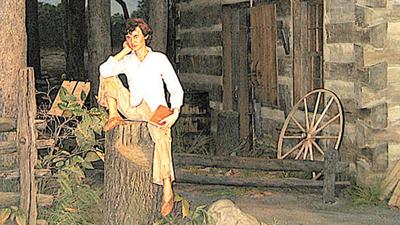
From there, the group moved to a figure of a young Abe Lincoln in front of a small rustic cabin holding a book.
“He didn’t have much formal education, so how did he get to be a lawyer?” Seth asked.
“He loved to read and borrowed books whenever he could,” Grandpa said. “Can you imagine having no books in your home?”
“I can,” Seth quipped, “as long as I have my cell phone and internet service.”
Grandpa laughed. “Yes, you are privileged to have so much information at hand. But don’t forget, we can’t trust everything we read.”
“I’ve read a lot about Lincoln this week,” Jametta said. “As a young adult, he moved to New Salem, Ill. He did any kind of odd job he could get, like splitting logs and hauling wood and corn. He even made one or two trips to New Orleans on a flatboat, taking crops downstream and returning with goods to sell. He saw slaves for the first time on that trip and couldn’t stomach the cruelty.
“After his adventures, he came back and clerked at a store in New Salem and later partnered with another man but wasn’t successful. He did better as the postmaster in New Salem. He studied law in his free time.
“By age 25, he had become a representative in the Illinois legislature, so he moved to Springfield, where he learned more about the law. Eventually he found a partner and practiced law.
“So how did ‘Honest Abe’ get from Springfield to the White House?” Seth asked.
“Let’s find that out by following the museum’s Election 1860s journey,” Grandpa suggested. Grandpa frowned as they walked into a set that looked like a newsroom from recent times.
“Hey, that’s newsman Tim Russert on the monitor. Why is he talking?”
“Look around this room,” Seth said. “Other screens are showing campaign ads. And each of the four candidates are calling out sound bites. Others are doing commercials for them, just like now. Are they trying to tell us that politicians campaigned the same way even then?”
“Human nature hasn’t changed in thousands of years,” Grandpa said. “They had to rely on speeches and newspapers then. But they were just as savvy about getting votes and used as many tricks.”
“Grandpa,” Meg whispered, “I feel so dumb. Jametta and Seth know so much more than I do.”
“Don’t worry about that, dear,” Grandpa whispered back. “The smartest people in the world are the ones who are not afraid to ask the most questions, so keep asking and learning.”
Did you know?
The Abraham Lincoln Presidential Museum occupies a city block in downtown Springfield, Ill. An area of 50,000 square feet is devoted to exhibits, special effects theaters and displays of original artifacts. Instead of static exhibits with flat images and objects in glass boxes, the museum tells Lincoln’s story using advanced technology and entertainment.
In 1860, Lincoln received only 39 percent of the popular vote. He defeated three other candidates: Southern Democrat John C. Breckinridge, Constitutional Union candidate John Bell and Northern Democrat Stephen Douglas, a U.S. senator for Illinois. Lincoln had lost his bid for U.S. Senate in 1858 to Douglas after having engaged with him in angry debates over slavery.
After Lincoln was inaugurated in March 1861, Virginia, North Carolina, Tennessee and Arkansas joined the Confederate States. Maryland, in close proximity to Washington, D.C., was brought under control but continued to be a hotbed of spies and Southern sympathizers. Four of the remaining slave states did not join the Confederacy: Missouri, Kentucky, Delaware and pacified Maryland were called “border states.” In addition, 50 counties in western Virginia chose to remain loyal to the Union despite Virginia’s secession and in 1863 became the state of West Virginia.
Chapter 3 – A quick war
As the teens continued their tour of the Lincoln Museum, they passed through the crooked walls of the Whispering Gallery. Male and female voices hissed out ugly accusations about Lincoln’s political motives, his dress and manners and questioned the loyalty of Mrs. Lincoln, who had been raised in Kentucky and had relatives fighting for the Confederates. Political cartoons on the walls expressed varying degrees of contempt.
“That was awful,” Meg sputtered when they got to the end of the exhibit. “Calling them ‘uncouth Westerners’ was about the nicest thing people said. And the ugly rumors and gossip people passed along without question – how could the Lincolns have endured constantly being called villains?”
Seth cleared his throat: “Outside of Springfield, newspaper editors knew very little about Lincoln as a person. Many of them suspected he was just another corrupt politician, lining his own pockets. Because the generals Lincoln picked wouldn’t fight or lost battles, he was also suspected of not really wanting to win the war.”
“Southern slave owners hated him,” Jametta added. “Those who profited from slavery feared he was going to leave them with no way to make money and a large population of angry unemployed workers.”
“His accusers had no way of knowing he’d be considered a great president, perhaps the greatest,” Grandpa suggested. “Let’s move on to the next part. It’s called, ‘The Civil War in Four Minutes.’”
The three teens watched in fascination as the digitized animated map showed a series of quickly shifting battle lines interrupted by flareups that marked the locations of major battles.
“I want to watch that again,” Meg said. “The changes happened so fast. And it doesn’t seem like there was any fighting in Missouri. But I know we had lots of conflicts here. And what was that counter thing for?”
“It showed the growing number of casualties,” Seth explained. “But no one really knows the exact numbers. When soldiers were fighting and marching, their officers didn’t have the time or methods to keep accurate numbers. Historians agree that the figures are incomplete, particularly for the South. Casualty figures contain statistics that don’t tell how many soldiers were killed, wounded, missing or prisoners of war. No one knows how many died from disease. And no one has been able to count the number of civilians who died from lack of food or disease or from raiders. Confederate fighters in Missouri often had to live off the land and were known to take everything families had to eat.”
“I still want to know why President Lincoln didn’t issue the Emancipation Proclamation as soon as he took office,” Jametta said.
Grandpa pointed the way to the next exhibit. As they entered the Emancipation Proclamation – Illusion Corridor, the teens could see President Lincoln standing over a table, pen in hand, weighing his options. Ghostly faces were shouting conflicting and insulting advice at the president.
“Look, here are a dozen different versions of Lincoln’s Emancipation Proclamation,” Seth said. “He’s trying to decide which version to use after listening to so many conflicting opinions.”
“From what I read,” Meg said in a faint voice, “he was more concerned about keeping the U.S. together than ending slavery. As a compromise to the South, he even looked into raising money to buy the freedom of every slave at $300 a person, then transporting them all to somewhere in Central or South America. He was very aware of the South’s fears that the freed slaves would rise up and kill their masters like in Nat Turner’s rebellion.
“About 30 years before Lincoln took office, in Virginia, a slave named Nat Turner organized fellow slaves to revolt. They killed at least 50 people before they were subdued. Over time, smaller revolts happened as well. Southerners wanted to keep up the image that owners and slaves were all one happy family. But by the end of the war, some plantation owners even killed their slaves rather than letting them have their freedom.”
“I never heard that,” Seth said. “Hey Meg, you find good information sometimes. You’re not as dumb as I thought,” he joked.
“Sometimes people don’t look below the surface. They think they know, so they don’t ask,” Meg said, stifling a sob.
“We have more to see,” Grandpa reminded them, putting his arm around Meg. “Let’s move on.”
I’ve heard guys didn’t like smart girls, Meg thought. But after that remark, I’m going to start talking.
Did you know?
Throughout his term of office, President Lincoln’s reputation was frequently abused in the newspapers. Some called him a Mudsill – defined as “a lower-class person for the upper classes to rest upon.” The term derives from a mudsill, the lowest threshold that supports the foundation for a building.
In one newspaper, it was suggested that he was no more likely to become a statesman than a braying donkey can become a lion. Someone else wrote that he was so wishy-washy and his manners so disgusting that the U.S. would become a laughingstock to the leaders in Europe. Others accused him of being a “pettyfogger” – at best, not a very good lawyer and at worst, a crooked one. Many newspapermen didn’t like the down-home stories he was always telling and someone said that “he indulged in twaddle that would be a disgrace to a well-bred schoolboy.”
Lincoln entered Washington just before his inauguration. Because his life had been threatened so often, his friends insisted he sneak into the capital on a secret midnight train to avoid assassins, disguised in a soft felt hat, a muffler and a short bobtailed coat. He finally gave in to their warnings after they convinced him that his wife and sons would travel more safely without him. For this, he was called a coward and rumors began to circulate that he had been dressed as a woman.
Nat Turner's rebellion took place in Southampton County, Virginia, during August 1831. Led by Nat Turner, rebelling slaves killed as many as 65 people, the highest number of fatalities caused by any slave uprising in the southern United States.
Chapter 4 – An American tragedy
On the ride home from Springfield, the teens continued talking about the museum.
“What impressed you most?” Grandpa asked.
“That re-creation of the theater and presidential box at Ford’s Theater was impressive. Is that what theaters looked like in olden times, Grandpa? Meg asked.
“Are you asking me as an eyewitness or as someone who loves history?” Grandpa teased.
Meg thought. “I guess you are too young to be an eyewitness.”
Grandpa smiled. “I do remember how ornate older theaters in St. Louis were,” he answered, “and the Fox Theater still is.”
“Maybe we should write our paper about what would have happened if Lincoln had decided not to go to the theater that night,” Meg suggested. “He almost didn’t. General and Mrs. Grant were supposed to have gone with the Lincolns. But Mrs. Grant refused to go because Mary Lincoln had said some spiteful things to her earlier in the month.
“Lincoln’s Secretary of War, the speaker of the House and even their son, Robert, had begged off, too. Clara Harris and her fiance, Maj. Henry Rathbone, finally agreed to go with them although they barely knew the Lincolns.
“One of the last things Lincoln did the day he died was really touching. He and Mary came out on the porch of the White House where many people were gathered hoping to see him. A one-armed soldier yelled, ‘I would almost give my other hand if I could shake that of Abraham Lincoln.’ The president strode into the crowd, grabbed the soldier’s remaining hand and said: ‘You shall do that and it shall cost you nothing.’
“Clara Harris later reported the couple’s last moments together before John Wilkes Booth snuck into the presidential box, placed a pistol behind the president's left ear and shot him.
“Mary held his hand and later hugged him and asked, ‘What will Miss Harris think of my hanging on to you so?’ Lincoln turned to her with a tender reply, ‘She won't think anything about it.’ ”
“If Mary had been the awful person so many said she was, would they really have been holding hands while they watched the play?” Jametta asked. “It sounds like they must have loved each other a lot. Why did John Wilkes Booth want to kill him?”
“Booth was a Southern sympathizer,” Grandpa said, “but there’s another suspicion. He wasn’t considered as excellent an actor as his older brother, Edwin Booth, who sympathized with Lincoln. Edwin had saved Robert Lincoln’s life a couple of years before, when he pulled him away from being crushed by a moving train. John may have envied the greater attention his brother received. People often have more than one motive when they act.”
“Lincoln really had aged in the four years he was president,” Seth said. “His pictures showed him old and thin and exhausted. And what’s with you, Meg? First you don’t talk and now you don’t stop.”
Meg cringed.
“Maybe Lincoln was supposed to die at that time,” Grandpa interrupted, changing the subject. “Members of Lincoln’s cabinet recalled that, on the morning of his assassination, the president told them he’d dreamed of sailing across an unknown body of water at great speed. He explained that he’d had the same dream, ‘before nearly every great and important event of the war.’ ”
“Lincoln told his friend and bodyguard Ward Lamon another story just before his death: One night Lincoln dreamed that the White House was filled with people crying. He followed sounds of mourning to the East Room, where he saw a corpse and asked one of the guards who had died. ‘The president,’ was the guard’s answer. Then a loud burst of grief woke Lincoln.”
“That gives me the chills,” Jametta said.
“I had the same feeling at Ghosts of the Library, Meg said. “When the announcer asked why anyone in the audience should care about the dusty mementos on display at the museum and then turned into the ghost of a soldier who had died, I got the shivers. What an awful cost they all paid so we could take our present lives for granted.”
As Seth got out of the car back home, he whispered to Meg, “I’m glad you are talking more. And you’re kind of cute when you smile.”
Meg gave him a puzzled look.
Did you know?
In a letter to the editor of Century Magazine in 1909, Robert Todd Lincoln recounted the story of how Edwin Booth had saved his life.
“At the Jersey City railroad station, a group of passengers were late at night purchasing their sleeping car places from the conductor who stood on the station platform. There was a narrow space between the platform and the car body. I happened to be pressed by it while waiting my turn. The train began to move, and by the motion I was twisted off my feet, and had dropped somewhat, with feet downward, into the open space, and was personally helpless, when my coat collar was vigorously seized and I was quickly pulled up and out to a secure footing on the platform. Upon turning to thank my rescuer, I saw it was Edwin Booth, whose face was of course well known to me, and I expressed my gratitude to him, and in doing so, called him by name.”
Edwin Booth was a strong supporter of Lincoln and a Unionist, which had put a wedge between him and his brother. Edwin Booth did not know for several months that he had saved Lincoln’s son.
Chapter 5 – The Little Giant
Jametta, Meg and Seth didn’t always agree, so Meg invited them to Grandpa’s house to get advice on how to proceed.
“What might have happened if Stephen Douglas had won the 1860 election?” Seth asked.
“I don’t know much about Stephen Douglas,” Meg admitted.
Seth filled in the blanks. “In Congress, Douglas had worked hard to find a compromise with the Southern leaders. In 1860, he was still assuring their leaders that he would support their planned military annexation of Mexico as slave territory if they would stay in the Union.”
“Annex Mexico?” Meg asked.
“Yes, Texas had successfully taken territory from Mexico and it had become a state in 1845. Since that time Southern leaders had considered expansion further south to add more slave states to the Union.
“Douglas’s wife had inherited a slave plantation in Mississippi. As guardian of their children after his wife died in 1853, he made the decisions for running the plantation and received most of his income from it. Publicly, he insisted the slaves legally belonged to his children, not him.”
“So if Douglas had won, he might have kept the Union together but he also might have encouraged the South to wage war on Mexico?” Jametta asked.
“With good reason,” Seth said. “With the help of a few wealthy Mexicans, Napoleon III of France was plotting to take over the Mexican government. In 1863, Maximillian, the younger brother of Emperor Franz Joseph of Austria, accepted the Mexican throne. He had been falsely told that the Mexican people had voted him their king. Napoleon III had promised to support Maximillian’s rule with the French army.”
“And the Confederate leaders couldn’t do anything about it because they were too busy fighting against the North,” Meg said.
Jametta frowned. “Otherwise the slave states could have conquered Mexico and divided the territory into several states. They could have used their majority of elected representatives of each slave state to continue and even expand slavery.”
“Exactly,” said Seth. “What really happened, though, was that the American Civil War ended in 1865, just as the French had nearly defeated the Mexican troops. That left President Johnson free to fight the French, citing the Monroe Doctrine. First, Johnson demanded that the French withdraw. By early 1867, as Mexicans continued resisting and the U.S. continued political pressure, Napoleon did withdraw his troops. Mexican forces captured Maximilian and executed him and slavery was being ended by Amendments 13 and 14 of the U.S. Constitution.”
“What does the word ‘slavery’ really mean?” Meg asked.
“It means not having any choices,” Jametta snapped. “It means someone can tell you what to do all day long and whip and beat and even kill you if you don’t obey.”
“We have to obey our parents,” Seth said. “Is that slavery?”
“No, because our parents love us.”
“But many slave owners claimed to love their slaves.”
“That’s not love and you know it,” Jametta shouted.
“But they protected slaves, they fed them; slaves never had to worry about where their next meal came from. The master had to worry about those things.”
“You keep talking like that and I’m out of here,” Jametta threatened.
“Calm down,” Meg said. “Seth’s just playing ‘What if.’ ”
“Is that what you’re doing?” Jametta demanded.
“Yes,” Seth said. “That’s just what some people say. Don’t forget, average people in the North were seeing human beings like Frederick Douglass and Sojourner Truth who could talk intelligently about the pain of being a slave.”
“But people in the South weren’t listening,” Jametta countered.
“Everyone is free now,” Seth insisted.
***
“What about economic slavery?” Grandpa asked.
“Aren’t we free to negotiate wages now?” Seth asked.
“Sure you are,” Grandpa said. “But if you are one of a few who have a special skill, like a surgeon, you can negotiate a high wage. If not, it’s easy to replace you. Business owners can negotiate the lowest possible wages to pay you. It’s not quite slavery but it does mean a lot of people stay poor.”
“And it’s a good reason for getting a good education and helping others to do so too,” Jametta added.
“But if everyone gets higher wages, won’t we have to pay higher taxes?” Seth asked.
“Yes to both,” Grandpa agreed. “But wouldn’t you rather earn $100,000 a year and pay $30,000 in taxes than earn $20,000 a year and pay no taxes?
“We’re getting off the subject,” Meg said. “Let’s meet again on Friday.”
Did you know?
Sojourner Truth grew up to become an African-American abolitionist and women's rights activist. Born Isabella Baumfree around 1797 into slavery in Swartekill, N.Y., she later escaped with her infant daughter to freedom in 1826. In 1843, she began using the name Sojourner Truth. Her best-known speech on racial inequalities, “Ain't I a Woman?” was delivered in 1851 at the Ohio Women's Rights Convention.
Frederick Douglass was born Frederick Augustus Washington Bailey in February 1818. After escaping from slavery in Maryland, he quickly became a social reformer, orator, writer and statesman and then became a national leader of the abolitionist movement in Massachusetts and New York. His gift for making well-crafted speeches proved to many in the North that slaves were intelligent and had the ability to live as equals in society. He spoke and wrote on behalf of a variety of causes: women’s rights, temperance, peace, land reform, free public education and the abolition of capital punishment.
Chapter 6 – Five possible countries
That Friday, Meg pulled out a map she had colored.
“I want to add a theory,” she said. “If Stephen Douglas had won the presidency in 1860 or Gen. McClellan had won in 1864, either might have allowed the South to leave peacefully, hoping that citizens in both the northern and southern states would realize how vulnerable they would be to foreign attacks without each other. They might have rejoined peacefully at a later time because serious threats to the future expansion of the 70-year-old country were not just from the French in Mexico but also the British troops still in Canada. If they hadn’t eventually rejoined, maybe today the U.S. would be a bunch of smaller countries.”
Pointing to the map, Meg further explained: “If the Southerners hadn’t had to fight the Union forces, they might have used their troops to fight a war against Mexico. They might have succeeded in pushing out both the French and the rebelling Mexicans. Today, a separate government called the Confederate States of America might exist that would include all the former slave states plus new states in northern Mexico, and maybe even further south into Central America.”
“What about New England?” Jametta asked.
“If that had happened, then the Federal United States of the North might have organized to include New England, New York, Pennsylvania, Ohio and maybe Indiana. Those states that were strong on manufacturing would have stayed together because of their economic interests.
“The northern parts of Michigan, Wisconsin, Minnesota, the Dakotas, Montana and Idaho might have all been lost to British forces in Canada.”
“What about California?” Seth asked.
California, Oregon and coastal Washington state might have formed a “Pacific Coastal Confederation” based on trade with Asia. Remember, back then there was no Panama Canal that could get goods to the East Coast.”
“And the states and territories in between?” Jametta asked.
“I’m wondering if a ‘Mountain Mining’ bloc might have formed its own country in the Rocky Mountains. Maybe the Native Americans would have gotten their own country in the desert of New Mexico and Arizona. Those states’ final borders were not settled until 1912 when New Mexico and Arizona joined the U.S.”
Meg continued: “Once Texans found oil around the early 1900s, they might have declared independence and persuaded the dryer mountain and desert territories and the Mexican states to join them in a revolt against the Confederate States.”
“So, what would all those possibilities have changed?” Jametta asked.
“Think about what it was like in Europe before the European Union recently emerged,” Meg challenged. “That agreement set a common currency and opened the borders of their members. Before that, travelers had to use passports to cross from one country to another. They had problems with commerce like growing vegetables in one country and trying to sell them in another one; maybe having to pay a border tariff or being denied a market. And they spent a lot of time and energy fighting wars against each other.
“Divided countries on this continent couldn’t have grown as fast, couldn’t have formed commercial ventures like a transcontinental railroad system as quickly, either. And the threat of aggressive countries in Europe would have been much greater.”
“That’s right,” Seth added. “Great Britain and France were both growing in colonial powers all over the world.”
“Do you think these imaginary countries might have made an alliance to protect each other?” Grandpa asked.
“They might have. But they also might have been wasting energy in competition, even carrying on wars among each other. States in the American West are forever fighting over water rights and public lands. And since transportation depended on water routes, those with connecting waterways like Illinois and Missouri couldn’t have automatically used the Mississippi River. And if the Confederates or Texans had controlled Central America, the rest of us might never have had the use of the Panama Canal and shipping would have remained more difficult.”
“That could have changed things all over the world,” Seth said. “Think what would have happened in World War I and World War II if the United States hadn’t been united.”
“Makes my head spin,” Jametta said.
“Seems like it was a good thing that we did stay united in spite of all the difficulties,” Seth said. “I think we’ll have to include your idea in our paper, Meg.”
Did you know?
States Nos. 28 through 36 were added in the years before the Civil War: Texas (1845), Iowa (1846), Wisconsin (1848), California (1850), Minnesota (1858), Oregon (1859), Kansas (1861), West Virginia (1863) and Nevada (1864).
The 37th through 48th states joined after the Civil War: Nebraska (1867), Colorado (1876), North Dakota and South Dakota (both 1889), Montana (1889), Washington (1889), Idaho (1890), Utah (1896), Oklahoma (1907) and New Mexico and Arizona (both 1912).
Our 49th and 50th states, Alaska and Hawaii, came in together in 1959.
Chapter 7 – If Lincoln lost
At the meeting on Friday, Jametta offered a suggestion.
“Several ambitious politicians believed that they could run successfully against Lincoln in 1864. What if one of them had been elected instead? I believe it could have happened. Lincoln was under attack by political rivals. Private citizens didn’t trust him either. They had reasons.
“Near the beginning of the war, Lincoln suspended the Constitutional “writ of habeas corpus.” That caused protests throughout the North. People began calling him a tyrant. (See “Did You Know?”)
“Gen. McClellan, the commander of the Army of the Potomac, was considered a brilliant organizer but Lee and his West Point generals kept winning major battles. Lincoln fired McClellan and named Gen. Burnside to replace him. Burnside didn’t win much glory either. Northerners became more afraid of losing.
Then there was the income tax. The government immediately needed money to finance the war. Congress passed the first income tax bill in 1861, but it was to expire in 1866.
“But today, people are still paying it,” Seth pointed out. “And people still don’t like paying.”
“There’s more,” Jametta continued. “When Northern volunteers didn’t fill the ranks, Lincoln approved conscription. If anyone called to duty could find a replacement and pay him $300 (the equivalent of about $6,500 in today’s money) they did not have to serve. That brought on major rioting by poor people in New York City and smaller protests around the North.
“The tide of war didn’t began to turn until Gettysburg in July 1863, when the North turned back Lee’s invasion of Pennsylvania. That same month, Grant’s forces prevailed at the Battle of Vicksburg. The Confederacy was effectively divided. Northern troops could finally transport men and materials up and down the Mississippi River and attack the heart of the Confederacy.
“The human cost of the expanded war ran high. During three months in the summer of 1864, more than 65,000 Union soldiers were killed, wounded or went missing in action.
“There had been just 108,000 Union casualties in the first three years. Gen. Grant was being labeled by the press as ‘The Butcher,’ accused of taking too many risks with soldiers under his command.
“So Northerners were mad because the North wasn’t winning more battles,” Meg said, “and calling out their generals as cowards and at the same time condemning Grant for being too bold.”
“Looks that way,” Seth agreed.
“Confederates knew about Northern discontent,” Jametta said, “and hoped that if the South could hold out, negotiations could begin with a new president. In Washington, Confederate agents were broadly hinting the South would stop fighting as soon as their leaders were assured they could keep their slaves.
“Average citizens couldn’t have known this, but by 1864 Southern generals were refilling their ranks with young teens and older men. Lincoln didn’t know it, either. The Confederates had been sending out many successful spies to plant rumors that the South was prevailing.”
Jametta continued: “On July 5, 1864, Confederate soldiers attacked and came within five miles of the White House. That convinced candidate McClellan that the North must seek peace at any cost.”
“How could Lincoln have held up to all that bad news?” Meg asked.
“He didn’t very well,” Seth said. “Photos showed that he looked like an old man by then, bone thin and stoop-shouldered. He wanted to win the 1864 election but was aware that the previous nine presidents in a row had served just one term.
“Gen. Sherman’s march through Georgia tipped the election balance in his favor. On Sept. 6, 1864, Sherman’s forces seized Atlanta. Encouraged by the wins, even McClellan changed his mind and called for a military victory. In November, Lincoln was re-elected.”
Jametta frowned: “My conclusion is that if Gen. Sherman hadn’t successfully marched through Georgia, McClellan might have won the presidency and made a treaty with the South. But the slavery problem would have continued, just pushed forward to the next generations. As a country, we’d probably not have been able to settle more of the West because all our energy would have been focused on the continued struggle for and against slavery.
“And if slavery had eventually been adopted all over the U.S., today I might be a slave.”
Jametta and her friends shuddered at the thought.
Did you know?
Washington, D.C., is between Maryland and Virginia, both slave states. In the early part of the Civil War, Lincoln found it impossible to keep the county’s capital safe from rebels without suspending the Constitutional writ of habeas corpus so that dangerous spies and potential assassins could jailed without due process of law. That caused protests throughout the North. Later, when his actions were ruled unconstitutional by Supreme Court Chief Justice Roger B. Taney, Lincoln refused to obey. More people began calling him a tyrant. (Taney was the same chief justice who had ruled that Dred Scott was not a person and therefore his rights were not covered by the Constitution.)
The Revenue Act of 1861 was an initial attempt to raise much-needed money for the war. The income tax placed a 3 percent tax on all individuals whose annual incomes were above $800. The Revenue Act of 1862 made legal the creation of the office of the Commissioner of Internal Revenue, a job that included collecting taxes on many everyday goods and services.]
In 1864, William Tecumseh Sherman commanded the Union armies of the West from Chattanooga to Atlanta and then made the famous march across Georgia to Savannah. In these campaigns and his later push northward from Savannah through the Carolinas, Sherman’s troops carried the war to the South, blazing a wide path of destruction and weakening the Confederacy’s ability to continue fighting, while inflicting misery on civilians.
Chapter 8—If Lincoln had lived
On another afternoon after school, the teens gathered to discuss Meg’s latest question: “What if President Lincoln had not gone to Ford’s Theater to see ‘An American Cousin’ that night? What if he had not been assassinated?”
Meg explained: “President Lincoln had never accepted the idea of secession. He seemed to consider the problem as being like a conflict in a large family and he wanted his family to compromise and to start getting along again as soon as possible. He felt his first duty was to hold together the Union.
“After Lincoln’s death, Andrew Johnson tried to follow his policies. Johnson had been raised in the South and like Lincoln he favored quick restoration of the seceded states to the Union. Abolitionists inherited from Lincoln’s cabinet and in Congress wanted to be sure that emancipated slaves were protected. A Republican majority in Congress also wanted to punish the South. Emotions ran high.
“Instead of jailing former Confederate officials, President Johnson granted amnesty to all, allowing the rebel states to include them among their new members of Congress and of their state legislatures. Because of this, in December 1865, Congress refused to seat the newly elected Southern senators and representatives.
“Southern state legislatures soon enacted codes designed to deprive the freed slaves of their civil liberties. In response, in 1866, Congress passed the 14th Amendment granting citizenship rights and equal protection of the laws for all persons. Johnson enraged members of Congress by then urging Southern states not to ratify the amendment. Edwin Stanton was his most vocal opponent. Johnson suspended him.
In 1868, the House of Representatives voted to impeach Johnson. Nine of the 11 impeachment articles cited Johnson’s removal of Stanton as a breach of the Tenure Act, passed to protect appointees.
“So Johnson was found guilty, Meg?” Jametta asked.
“No. It’s a strange situation. The word impeached is used two different ways. A public official is accused (impeached) by the House of Representatives and then tried by the Senate. In Johnson’s case, he was not convicted (impeached), instead he was acquitted, so he remained as president. But only until the next election, when Gen. Grant won.”
“I see,” said Jametta. “People can use the word to sound like someone was convicted when they really were only accused.”
“I think we need another word,” Seth said.
“Me too,” Meg agreed.
“When we were in Vicksburg to see the National Cemetery,” Meg said, “our guide to an old mansion house told us all about how brutally the Northern troops had treated the Southern people. He listed the names of townspeople whose neighbors felt had been punished or killed unfairly while they lived under martial law. But he did not once mention what the former slaves had gone through or what they would later go through after Reconstruction. And he didn’t mention African-American soldiers and sailors who had served in the armies and navies of both the Union and Confederacy during the Civil War.
“Do you think that men like him would have felt any differently if Lincoln had survived?” Seth asked.
“I doubt it. We talked last week about how weak and tired Lincoln was by the end of the war. I wonder if he would have had the strength to face all the new wars of words that continue to this day.
“When I drew up that map of a divided U.S., I was thinking about a map I’d seen of how people voted most recently.”
“That’s interesting,” Seth said. “I’ll have to check that out.”
Meg smiled.
“If we did speculate about what would have happened if Lincoln had lived,” Seth said, “then we’d have to write all about Reconstruction and the election of Gen. Grant in 1868. And we’d have to write about problems that are still with us. And no matter what we wrote, someone would disagree.”
“What if people had treated the freed slaves as neighbors – the way they wanted to be treated as the Bible says?” Jametta asked.
“That’s easy,” Meg said, “I think the future of the U.S. would have been a lot brighter than it is right now. And none of us would feel as divided and afraid today. But we’d have to include all our neighbors, the poor, the sick, those with learning problems along with racial and religious issues and all nationalities.”
Did you know?
Andrew Johnson was the 17th president of the United States, serving from late April 1865 until 1869. He served as vice president under Lincoln for six weeks, then became president after Lincoln’s death.
As Southern slave states, including Tennessee, seceded to the Confederate States of America, Johnson remained firmly with the Union. He was the senator from a Confederate state who did not resign his seat upon learning of his state's secession. In 1862, Lincoln appointed him as military governor of Tennessee after most of the state had been retaken by the Union Army. In 1864, Lincoln chose Johnson to send a message of his desire for national reunification.
In November 1868, Grant was elected president and Republicans again won majorities in both the Senate and House. They soon began enacting even tougher Reconstruction measures.
Returning to Tennessee in 1868, Johnson elected to represent Tennessee in the Senate in 1875.
African-American soldiers and sailors served in the armies and navies of both the Union and Confederacy during the Civil War. By the end of the conflict, over 178,000 black soldiers saw service with the Union army, while as many as 18,000 African-Americans joined the Union navy. Service figures for the Confederate States are unknown.
Chapter 9 – What have you learned?
Gathered in Grandpa’s warm kitchen, Meg, Seth and Jametta faced decisions.
“Our teacher says we have three weeks left,” Jametta said. “So which one of our what if ideas do you want to turn in?
“What do you think?” Seth asked, turning to Grandpa.
“I think all three of you have done a remarkable amount of research and all of your what if’s should be included. But before you decide, stop and talk about what you’ve learned along the way,” Grandpa suggested.
“I’ve learned that the history of the Civil War is much more complicated than I had imagined,” Seth said. “It’s not just about generals and Gettysburg and Vicksburg, it’s about decisions ordinary people made. You can’t have a war unless most people are willing to fight.”
“In Vicksburg,” Meg added, “We saw a gunboat that had been sunk and later brought back up and restored. And we saw so many graves. At the time, I had never thought about each grave holding a real person, with parents and wives and children who loved them. Our school history books seem so sterile. I didn’t feel the suffering that average people must have endured on both sides. Maybe history books should tell more stories about real soldiers and their wives and children. What do you think, Seth?”
“I’ve learned that people haven’t changed much. We like to pretend that we make choices for noble reasons but it seems like writers of history books seem to take a ‘win or lose’ position instead of what’s good for most ordinary people.
“Slaves saw no glory in that war,” Jametta reminded them. “They saw the outcome of the war as a matter of freedom versus continued slavery. Every human being wants to have choices. Many people today, black and white, feel put down. They don’t even try to take advantage of their opportunities. When we label people losers as soon as they are born, how can they learn to feel any other way?”
“Even slavery was much more complicated than I had realized.” Seth said. “Some Native American tribes owned slave plantations and fought for the Confederacy. And most of the Southern men who became soldiers didn’t even own slaves.”
“History is so hard to pin down,” Meg said. “None of us was there to witness all that really happened. Even if we had been, we could only have seen what was going on in our town or farm. I’ve learned that we can’t always rely on what people say; we have to find out what they forgot to say. We also have to watch what people do.”
“We can argue that Lincoln only cared about keeping the Union together,” Jametta added, “but then we have to look at the 13th, 14th and 15th amendments to the Constitution. All of them were written and ratified after his death, yet Lincoln’s spirit and the spirit of those worked with him show forth in them.”
“So, do you still think history is boring?” Grandpa asked.
“Not anymore,” Meg said. “I think real people are more interesting than the made-up hero stories we see on TV and in the movies.”
“You know what Grandpa? You’ve tricked us, haven’t you? Trying to imagine what might have happened, I have learned about so many things that did happen. You were right. Learning this way is much more interesting.
“Working with my friends and imagining what events might have been, has really helped.”
Grandpa grinned: “So what are you going to do about your senior essay? What have you three decided to write?”
“I’m going to ask Meg if she will write the essay using all the possibilities we’ve talked about,” Seth said. “I’ll help her organize our notes.”
“I will too,” Jametta said.
“Why me?” Asked Meg.
“Because you write the clearest notes,” Jametta said.
“And because I’d like to spend more time with you,” Seth said with a shy grin.
Epilogue
Four weeks later, Meg visited Grandpa again, this time with a big grin on her face as she handed him a thick folder of pages. When he opened to the first page, he saw a large A+ at the top in red ink. “We did it,” she said with a triumphant smile.
Grandpa gave her a big hug.
“You know what else, Grandpa? Today Seth asked me to go to the senior prom with him. Sometimes studying history together turns out rewarding.”
Did you know?
The 13th, 14th, and 15th Amendments, known collectively as the Civil War Amendments, were designed to ensure equality for recently emancipated slaves.
The 13th Amendment (proposed and ratified in 1865) abolished slavery. The 14th Amendment (proposed in 1866 and ratified in 1868) addresses citizenship rights and equal protection of the laws for all persons. The 15th Amendment, (proposed in 1869 and ratified in 1870) prohibits discrimination in voting rights of citizens on the basis of “race, color or previous condition of servitude.”
Vicksburg Military Park and Cemetery covers 116 acres along the Mississippi River, and holds the remains of 17,000 Civil War Union soldiers from North and South. It was established by an act of Congress in 1866.
The U.S.S. Cairo was one of seven ironclad gunboats constructed for the Union Army. On Dec. 12, 1862, the Cairo's skipper led a small flotilla up the Yazoo River, north of Vicksburg, intending to destroy Confederate batteries and clear the channel of underwater mines. Seven miles north of Vicksburg, the flotilla came under fire. As the gunboat turned towards shore, the Cairo was rocked by explosions that tore gaping holes in the ship's hull. Within 12 minutes the ironclad had sank into 36 feet of water. No one in the crew was lost. The Cairo became the first ship in history to be sunk by an electrically detonated torpedo. The gunboat remained submerged until parts of it were recently salvaged and the ship was restored. It is now on display at the park.