

Chapter 1 -- Two dreams in the making
October, 1971 – Maxville
Edna Page set down a magazine with a big smile on her face.
“Mike,” she told her 12-year-old son, “I’m going to surprise your father by buying a building lot on the Big Island of Hawaii.”
“What?” Mike questioned between a bite of toast and a sip of milk.
“It says in this magazine that people can buy a 100 by 200 foot ranchette.”
“Isn't Hawaii hundreds of miles away?” he asked.
“Thousands,” his 10-year-old sister Jenny volunteered.
“How do you know?” Mike asked.
“I know that Hawaii is 4,000 miles away. We learned it in school yesterday.”
“Know it all.”
“Idiot.”
“Children, behave,” Edna said very quietly.
Both of them shut their mouths. They knew when Mom got quiet she meant what she said.
Then she continued: "It only costs $500. The ad says that I can buy the land on time.”
“How are you going to pay for it without Dad knowing?” Mike asked.
“I can pay for it at $5 a week. I can sneak that much out of my earnings as a librarian.”
“But how long do you have to pay?” Mike questioned
“For four years. Can’t you picture it, Mike, Jenny? The property is on a hillside overlooking the ocean with palm trees and a sandy beach.”
Mom got a dreamy look on her face.
“You children will be grown in a few years. You can visit as often as you want after we retire,” she promised.
Mike grabbed a piece of scrap paper and scribbled some numbers. “Mom, you will have to pay $1,040 for the ground, not $500.”
He showed her his figures.
“I suppose the rest is interest,” Mom replied absently. “Still that’s a low price for something this wonderful. I'm going to send in my first $5 today.”
“You should tell Dad,” Jenny scolded.
“Oh no, and don't you two dare, either. I want to give the land to your father as a surprise on his 50th birthday.”
“Looks like we have collected enough signatures of registered voters to call a special election,” Dad said as the family ate its supper together that night.
“I don’t understand why you’ve been collecting all those signatures,” Jenny said.
“I do,” Mike interrupted. “Dad and a lot of other people around here think the area would grow faster if the smaller communities worked together. Right Dad?”
“Yes, son. Some of the business people in the settlements at Beck, Tenbrook, Wickes, Old Town Arnold and Flamm City want to join those of us who live in Maxville in merging to form what would be the largest city in Jefferson County.”
“Why would we want more people, Dad?” Jenny asked.
“Keep in mind that I work in construction,” Dad replied. “The food on this table and the roof over our heads are both paid for by building new homes and businesses. This change could bring prosperity to this area and also to this family.”
“Since I-55 was completed, more people have moved out here where it is peaceful. Most commute to work closer to the city. Some new subdivisions have already been filling up.
“Once the incorporation goes through, we can begin to offer city services like water and sewers that will encourage even more people to move here. Unfortunately, many residents in the area don’t agree with us. Some say they like things the way they are.”
“Alex, won’t it also mean paying higher taxes?” Mom asked. “When people who are used to city services move here, won’t they expect the improved services without paying more taxes?”
“Could happen, Edna. We’ll deal with it if it does.”
“What are we supposed to call this new town?” Jenny asked. “How about something pretty like Cherry Tree Grove?”
“How about something powerful like New Metropolis?” Mike chimed in.
“You’ve been reading too many Superman comic books,” Jenny whispered.
“Looks like it will be called Arnold,” Dad explained. “Members of the Arnold family have lived here for a long time. It’s our way of telling people that we want to grow, but we also want to keep our small-town flavor.”
“I’m really not sure how I feel,” Mom said. “I like having more services but will we really continue to have the tight-knit communities where everyone knows everyone else?”
“You’ve already signed the petition, Edna,” Dad reminded her. “I certainly hope you will vote yes for incorporation in November.”
LOOK IT UP
In September 1971, a group of people began collecting signatures of registered voters in northeastern Jefferson County. Soon they had obtained enough signatures to have the Jefferson County Court in Hillsboro call for a special election to be held on Nov. 30, 1971.
There was considerable opposition to the incorporation. The ballots of not quite 4,000 voters were split into a near tie. Several recounts were held. In the final recount, the majority went to those who wished to merge by just six votes.
Nearly a year after the election, on Sept. 14, 1972, a state judge finally declared that the city of Arnold officially existed.
I-55 had opened in 1967.
The Big Island of Hawaii is also the newest. It is one of four large islands and many smaller ones that were formed by a volcanic hot spot in the Pacific Ocean that it still active. In fact the land mass of the Big Island is still growing from the volcanic flows of three active volcanoes: Kilauea, Mauna Kea and Mauna Loa.
Chapter 2 – A pleasant fantasy
December, 1972
“How is our newly elected city government doing these days?” Edna asked her husband as he stalked into their home one evening.
“The meeting was chaotic, Edna. We have all the important positions filled but we still haven’t agreed on a budget. The mayor and a few businessmen have had to personally sign for supplies and equipment. We need everything from paper clips to wastebaskets to desks and places to put them.
“We did find citizens to form the first Police Personnel Board last month. They got busy and hired a chief of police. We’ve also found a city attorney and a city judge. And we borrowed enough money to buy one police squad car.”
“Think we will ever get a City Hall, Alex?” Edna inquired.
“Rental space will have to do for now.”
“Why are things so confused?” Mike asked.
“Any new arrangement takes time, son. People don’t always agree on how to spend money.”
Mike frowned.
Well, I know that our schools already were consolidated a few years ago and they seem to work O.K. Except that’s why we have to ride the bus to school now instead of walking to like you did.”
“But you are really lucky,” Mom added. “When I was a girl, not many of us were able to finish high school. Schooling was a privilege. Everyone had to work on the farm just to grow enough food to keep us going.”
“Yeah, and you walked five miles to school in the snow every day, uphill both ways,” Mike said with a smirk.
“It really was almost that bad,” Dad added. “You children have no idea what life was like when we cooked inside the house and did our business in the outhouse. Now that barbecuing has become so popular, we have reversed things. We cook outside and do our business indoors.”
He grinned.
“That’s silly, Dad,” Jenny said.
“You children have never had to do the canning for the winter, either,” Mom continued in a serious voice. “We’d be canning tomatoes and green beans over a hot wood stove in 90 degree weather. We had no air conditioning, either!”
Jenny and Mike looked at each other and sighed.
***
“This is what most of Hawaii looks like.” Mom showed Jenny and Mike a few pictures from a library book.
“It is so green. And look at those happy people,” Jenny said.
“What’s it like in winter?” Mike asked as he looked out the window at the snow drifting off of the roof.
“It’s really warm, son.”
“Will we be able to go swimming any time of the year?” Jenny asked.
“I think so. They say that the temperature is about 65 degrees overnight and gets up to 85 during the day,” Mom said.
“You’re kidding. All the time? How come?” Jenny asked.
“You see, Hawaii is a group of islands all by themselves in the Pacific Ocean. The water in the ocean stays warm all year round and so the air stays warm, too. We get so cold here because the air comes in from Canada in the winter. In summer it’s hot and humid when the air comes from the Gulf of Mexico. It also comes in from the dry West. That’s why it is so hard to guess what our weather will be from day to day.
“Do you think we will ever get to see our land in Hawaii?” Mike asked. “You don’t have a photo of it, do you?”
“No. The salesman wrote that he would send one. But it has never arrived. I certainly hope to see it someday,” Mom responded. “I spend a lot of my time daydreaming about what life will be like when Dad and I move there.”
“But that will be a long time from now, won’t it?” Mike asked.
“Yes, it will have to be.”
“I think I’ll move there, too,” he said. “But I think I’d like to see it first.”
“Do you think Dad suspects what you are doing?” Jenny asked.
“No, although he does keep suggesting I should be able to get along with our finances.”
“He’s really going to be surprised, isn’t he?” Mike asked. “Mom, when I mow lawns next summer, may I give you some money to help pay for our ... what did you call it?”
“They call them ranchettes. Little ranches. There are also big ranches, most owned by celebrities. Some people on the Big Island even raise cattle on them. And yes, Mike, I think it would be nice if we start a fund so we can all visit our ranchette in Hawaii someday.”
LOOK IT UP
ARNOLD FACTS: In 1972, the combined population of Arnold was 17,300 people. By 1976, it had grown to around 23,000 as more subdivisions were being built.
The population center of the incorporated area had begun to shift as more subdivisions and businesses were built along the highway. Use of the arterial highways changed in response. After I-55 was completed in 1967, motorists and commuters began to drive northwest from Beck and Flamm City to catch the highway.
As building along I-55 continued to grow, the center of the incorporated area moved west from Telegraph Road.
The earliest settlements had grown up along what was later named Telegraph Road. This road had begun as a well-used north-to-south path that was not paved and had no bridge over the river. Travelers had to cross over the Meramec River by ferry.
HAWAII FACTS: Of the main islands of Hawaii, Kauai is the oldest while the Big Island of Hawaii is the most recently formed. Kauai shows its age by being the greenest and most suitable for agriculture. Its volcanoes, which built the island, are no longer active. With millions of years of erosion, the island has shrunk in size as lava rock has been broken down into the soil by erosion and carried downhill to make fields and sandy beaches.
In the middle of the chain of islands lies Maui and nearest to the Big Island is Oahu. Honolulu, the capital and largest city, is on the Island of Oahu.
Chapter 3 – Happy birthday, Mr. Page
June 1975
Four years had passed since Edna Page had begun buying her ranchette. Finally, Dad’s special day arrived.
“Happy birthday to you. . . .” Edna, Mike and Jenny sang to Alex Page.
“I can’t believe I’m turning 50,” he said with a frown.
“You’ll feel younger when you see what Mother is going to give you for your birthday,” 14-year-old Jenny exclaimed.
“Well, what is it?” Dad asked. “Just this tiny little envelope?”
“Look inside,” 16-year-old Mike shouted with excitement.
“What? This is a deed for a ranchette in Hawaii.”
He raised his eyebrows. “What’s this about, dear?”
“It really is a deed, Alex. I’ve been making payments on it for four years, and your wonderful children have even contributed money from babysitting and mowing lawns and still managed to keep it a secret.” She gave a cat-ate-the-canary smile.
Dad frowned. “What do you think we are going to do with this piece of ground, Edna?”
“I thought that when we retired, we could live there. Look at the other pieces of paper.”
Dad looked shocked. “Are these arrangements for a tour of Hawaii for all four of us?”
“Yes. But we still have to raise a bit more money. I’m sorry we couldn’t come up with all of it.”
“Construction has been good. And I did hear you say the kids have chipped in for all this? I’ll bet we could find a few hundred dollars more.”
“Yeah! We’re going to Hawaii!” Jenny shouted. “I’ve already got my bathing suit packed!”
When the children had left, Alex cornered his wife.
“This was a stupid thing to do, dear. You never buy land without seeing it. What if it is a scam?”
“It can’t be a scam,” Edna said with tears in her eyes. “Look, here’s the deed. The mortgage company sent it to me when I made the last payment.”
“Come on, Edna. I know you and the kids did this because you love me and I really appreciate that you all have made sacrifices. I just think there is something strange here. So don’t be disappointed if I’m right.”
Then he gave his wife a big hug. She hugged him back.
***
Two months later, the Page family stepped off an airplane in Honolulu.
“How can it be just 8 p.m. here?” Jenny asked. “We left St. Louis at 2 p.m. But we had a nine-hour flight and a two-hour layover. Our combined flight and changeover in San Francisco took 11 hours.”
“That’s right, Jenny,” Dad said. “But remember when we got to San Francisco, we had flown for a little over four hours and it was only 4:30 p.m. in California when we landed because we had gained two hours. We took off at 6 p.m. and flew for another five hours but gained another three hours, so now it is 8 p.m.
“Don’t worry, kids. I’m as confused as you are,” Mom said.
“Why is that woman walking up to us with flower necklaces?” Jenny asked.
“Those are called leis. They are part of the traditional Hawaiian greeting,” Mom said. “Flowers grow around here all year-round. It makes people feel really special when they come from colder climates and someone greets them with flowers.”
“Where are we going now? Mike asked.”
“To our hotel. We’ll take you to see Pearl Harbor tomorrow.”
“What’s so special about Pearl Harbor?” Jenny asked.
“You’ll see,” Dad replied.
“Want to have breakfast at McDonald’s?” Dad asked in the morning.
“Sure, at least there the food will be familiar,” Mike said.
But when he studied the menu, he saw some differences.
“What’s egg drop soup?” he asked suspiciously.
“I’m not sure, but I think it is Oriental. You know we are about halfway to Asia here.”
“And look at all that fresh fruit,” Mom said. “I know what I’m having for breakfast.”
After their meal, the family rode the city transit bus to Pearl Harbor.
“Wow, what is all this?” Mike asked.
“I want you to listen now,” Dad said. “Part of the reason I wanted to bring you here to Oahu was to see Pearl Harbor. This memorial has a special meaning to me. Your grandfather died here on Dec. 7, 1941. He was serving in the Navy on the Battleship Arizona.”
Jenny gasped.
LOOK IT UP
The islands we now call the state of Hawaii were probably first inhabited by Polynesians a thousand or more years ago. According to legend, a group either from the island of Bora Bora or Tahiti in the Marquesas Islands came first in large outrigger canoes from more than 2,000 miles away.
They settled on raw islands that had few edible plants and even fewer land-based animals other than birds. They brought with them a social hierarchy based on a system of taboos. Royalty made the rules.
As island settlements grew over the centuries, there were many wars between the kings of each individual island.
The early natives brought with them taro for making poi and other plants. Later Europeans brought more plants and also wild pigs. Unintentionally, they also brought rats and other pests in their ships.
The Spanish were the first European visitors to Hawaii in the 1600s. English captain James Cook visited more than 100 years later. Great Britain soon claimed the Sandwich Islands a “protectorate.”
The native people of Hawaii by then had a united government under warrior King Kamehameha. Although King Kamehameha’s forces were responsible for killing Capt. Cook in a battle, more Europeans would continue to come and bring tremendous changes.
Chapter 4 – Tragic Pearl Harbor
“Do you two remember what happened at Pearl Harbor?” Dad asked.
“I think there was some kind of attack,” Mike said. “Guess I would have paid more attention if I’d known about your father.”
“There’s the memorial,” Dad pointed out. “Down below the water is what is left of the Battleship Arizona.”
“What happened?” Jenny asked.
“The Japanese attacked our naval base by air without warning,” Dad explained. “See, this is a deep water port, so we kept our aircraft carriers and battleships here. Fortunately all our aircraft carriers were out to sea that day. But eight of our battleships were lined up close to each other.
“My father was serving on the Arizona. A bomb hit the ammunition magazine. The ship exploded and caught fire. He was one of more than 1,000 men who died on board. This is the only grave we have for him.”
“That’s so sad, Daddy,” Jenny sobbed. “When we studied about it, the whole thing seemed like it happened a long-long time ago. But now it is real.”
Mike added: “You told me once that your dad died when you were 6 years old but I never thought to ask you how. I’m sorry, Dad.”
“I understand, son. I don’t like to talk about it. We’ll take this tour. Then we can spend the afternoon playing at Waikiki Beach.”
***
“This is what I’ve dreamed of,” Mom sighed as the four of them splashed in the salty waters along Waikiki Beach later that afternoon.
“I can’t believe we’ve walked out this far,” Jenny sighed. “The waves are so gentle. About the time it seems like it’s getting deeper, the sandy bottom gets shallower again.”
Later, as they walked along the sandy beach, a native Hawaiian proudly showed off a small octopus he had caught.
“I hope you don’t expect us to eat something like that,” Mike huffed.
“You never know,” Dad teased.
“Look over there. That’s Diamond Head, isn’t it?” Mike said, pointing.
“Yes it is.”
“Can we climb it?” Mike questioned.
“We could if we had time,” Mom intervened. “But I want to go shopping. I’ve never seen so many vivid colors in my life. I want to buy a colorful outfit for the luau tonight.”
“What’s a luau?” Jenny asked.
“A big party with music and dancers and lots of food,” Dad said.
“All right Edna, you girls go shopping. Mike and I will see about climbing the trail into Diamond Head crater. We’ll meet you back at the hotel.”
***
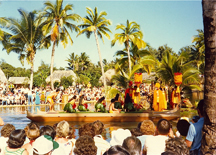
“I guess we will get to try poi at this luau,” Mom said that night as they sat at a crowded table near the beach watching the hula dancers swing gracefully.
“What’s poi?” Jenny asked.
It’s a kind of starchy food. Natives eat the paste from a common bowl by scooping it up on their first two fingers. But I think we’d better try it with a spoon.”
“Yuk,” said Jenny.” What else are they serving?”
“Let’s check the menu board,” Dad suggested. “Hmm... baked sweet potato sounds OK. Lomilomi salmon sounds good, too. The dish has tomatoes, green onions and diced salmon in it.”
“Wait a minute,” Mike interrupted. “The salmon is served raw!”
“Raw fish? Yuk,” Jenny held her nose.
“Fresh fish doesn’t smell bad,” Mom told her. “But if you want something cooked, how about some chicken long rice? The chicken is cooked with ginger and garlic but no rice. Instead they use noodles made of bean paste.”
“Look, more raw seafood,” Mike pointed out. “The dish is called Hawaiian Poke Salad. It’s made with crab and octopus, soy sauce, red pepper, onions, sesame seeds, oil and macadamia nuts. Don’t they cook anything here?”
“You think that’s the octopus the man caught today?” Jenny asked.
“It’s possible,” Dad said.
“Look at all the piles of fresh fruit – bananas, pineapple, passion fruit, coconut,” Jenny observed.
“Forget the fruit,” said Mike. “That creamy-looking pie is more my style. They call it Lilikoi Chiffon Pie.”
“Ha, ha,” Mike,” Jenny teased. “It has passion fruit in it.”
An hour later, Dad loosed his belt and said: “I’m stuffed. And I think I’m going to flip if I hear another Don Ho imitator sing “Tiny Bubbles.” Let’s get some rest tonight.”
“That’s fine with me,” Mom said. “Tomorrow we fly to the Big Island. With any luck we will have seen our ranchette by tomorrow night at this time.”
LOOK IT UP
Surprise attack on Pearl Harbor: It came early on a sleepy Sunday morning in December 1941. The Japanese sent up their aircraft from a base approximately 230 miles north of Oahu. Their assigned first target was to disable the aircraft carriers and land-based aircraft so that the U.S. airmen could not get into the air and return fire.
Although no aircraft carriers were in port that day, many of the U.S. airplanes were lined up outdoors, wingtip to wingtip, to prevent sabotage. That strategy made the planes easy targets for the Japanese attackers who struck the various airfields on Oahu at nearly the same time.
Of the eight U.S. battleships in the harbor, two were sunk and the other six were badly damaged. These battleships represented a large part of the entire U.S. fleet in those late days of the Great Depression when little tax money was available to the military.
In 1962, a memorial was set up to honor all those who had died in the Pearl Harbor attack, including the 1,177 officers and crew of the U.S.S. Arizona. That memorial is reached only by ferry. It straddles the sunken hull of the Arizona, which could not be fully salvaged.
Diamond Head (Le’Ahi): It’s an easily recognized landmark. The saucer-shaped crater was formed 300,000 years ago by a volcanic explosion. Diamond Head State Monument includes both outer and interior slopes of the silent volcano over a 475 acre area with a walking trail that goes into the interior of the volcano.
Don Ho: He was a Hawaiian with Chinese and Portuguese ancestors. He was extremely popular as a singer in the 1960s and 1970s. His theme song, “Tiny Bubbles” was imitated by nearly every luau entertainer in Hawaii for many years. In 1976, he entertained on a popular U.S. TV show.
Poi: The traditional Hawaiian staple is a starch dish made by pounding boiled taro roots and mixing the peeled roots with water until it forms a starchy paste. In the same way that bread is something we eat all the time, poi is a food that Hawaiians have relied on for centuries. Taro is easy to grow in this tropical climate the way wheat is easy to grow in the U.S. Some Hawaiians season their poi with salt or sugar or even soy sauce.
Chapter 5 – Surprises
“Today we get to see our land,” Mom called cheerfully as she woke her family. “We’ll be flying in to the Big Island of Hawaii late this morning.
“Why do they call it that?” Jenny asked.
“It is the largest of the island and also the newest,” Mom told her.
“Wasn’t all this land made at the same time?” Mike asked.
“No,” she said. “Around here, land was formed because there’s a hot spot underneath the crust, so hot iron and nickel and other minerals are turned into a liquid. When the pressure becomes great enough, the molten minerals, called magma, force their way through breaks in the crust and push up through volcanic craters. As the molten lava slides down the outside and cools off, it forms layers of rock. Maybe we can stop off and walk through a lava tube sometime.”
“What’s a lava tube?” Jenny questioned.
“It’s a natural pathway for the hot lava to travel through.”
“Why doesn’t it get clogged with lava?”
“I think because there is enough gas behind the lava to push it all the way through.”
As they circled the airport, Mom told them more about the Big Island.
“There are two big towns on the Big Island, Hilo and Kona. We will land in Hilo, rent a car and head south toward the small town of Keeau,” she said. “There, we’ll meet the real estate agent I spoke with.”
“I can’t wait,” Jenny shouted, clapping her hands in excitement.
“I hope we won’t be disappointed,” Dad warned.
“Why should we be?” Jenny asked.
“I’ve been concerned since your Mom found out that the real estate company that sold her the land went out of business the following year.”
“But Alex,” she interrupted, “I told you it doesn’t matter. We were paying the money to a bank and they sent us the deed. I have it in my purse.”
“But the man at the bank didn’t know anything about where the property is located. And the real estate agent you’ve made a date with is charging us a fee to show us the ground.”
“Oh, you worry too much, Alex. Most people are honest. Besides, he has to charge a fee for the gasoline since he’s driving us out there. Gas is really expensive here. Seems like everything else is, too. I wonder if we can afford to live here after we retire.”
“Are we going to see a volcano?” Mike asked the real estate agent as they stepped into his van.
“Yes, we are, but from a safe distance. However, if you want to stop on the way back to Hilo, I’ll give you a map. There’s a place where you can walk through a lava tube.”
“Will the volcano explode?” Jenny stuttered.
“Probably not,” the agent replied. “If it did, you would have plenty of warning. Shield volcanoes usually overflow slowly, kind of like sugar icing does on a cake left in the sun on a hot day.”
“Mom, do we have any volcanoes in Missouri?” Jenny asked.
“I think there are some extinct ones just south of the Arkansas border, but we don’t have any active ones.”
“So why do they have volcanoes in Hawaii?” Mike asked.
“If there were not any volcanoes here, there would not be any Hawaiian Islands,” the agent explained. “The Pacific Ocean is really deep around here. Mauna Kea, one of the volcanoes on this island, is the highest mountain in the world, even higher than Mount Everest.
“If you measure from sea level, Everest is 29,028 feet and Mauna Kea is just 13,793. But most of Mauna Kea is below the ocean. The entire formation is 33,500 feet when measured from the ocean floor.
“Wow,” said Mike. “This island is one big rock, isn’t it?
“Yes, and it’s a rock that’s still growing.”
“It needs to grow,” Dad said. “Right now the whole chain of islands don’t have as much land mass as the state of Connecticut.”
Suddenly, Mother frowned and asked the salesman: “Is our land close to an active volcano?”
“Yes, it is,” the agent replied cheerfully. “In fact, we are almost there.”
He pulled off the narrow road and pointed up to the top of a steep mountain and then down toward the ocean. “See that spot about midway up the lava flow?’
“Yes?”
“The land you purchased is about 30 feet below the surface of the lava flow.”
LOOK IT UP
Visitors to the Big Island can walk a lighted path through Nahuku (the Thurston Lava Tube). The massive 500-year-old cave was formed when a river of lava pushed through cracks in the earth. When the lava flow stopped and the last of the lava flowed out, it left a void bounded by weird shapes and colors that have developed from minerals leaching out of the rocks.
The Kilauea volcano is one of the most active in the world. It has erupted 60 times since 1840. Still active today, the current eruption cycle began in 1983, adding many square miles of new land to the island. The forces of creation and destruction continue to this day.
According to the National Geological Survey, the area around Kilauea volcano felt 22 minor earthquakes during the first two weeks of March 2013. On average, the Big Island has at least one minor earthquake each day.
Kilauea is one of the world's most active volcanoes. Unlike the steep, conical peaks of Mount Vesuvius (near Naples, Italy) Hawaii's main volcanoes are shield volcanoes that produce generally fluid lava flows that harden to form gently sloping shield-shaped mountains. A good example is Mauna Loa, the most massive mountain on earth, which covers nearly half of the Big Island.
Buying land in Hawaii is more complicated than it is in Missouri. There are two ways to buy land in Hawaii. Most of us in the continental U.S. have bought land or a home and property on a fee simple basis, which means we own the land and structures on it and may freely sell that land to anther buyer.
The Hawaiian alternative involves a leasehold system. Because most Hawaiians had lost their land to business interests by 1898, the Hawaiian Homes Commission Act of 1920 provided for 99-year leases to native people who could prove at least 50 percent native Hawaiian ancestry. These leases could not be sold to anyone else.
Today leaseholds still exists. This means that the persons leasing the property may make improvements but do not own the land itself. Most leases are negotiated for 55 years. When that term is up, the leasehold or heirs must renegotiate the lease. The actual property owner is not obliged to extend or renegotiate such leases. In 2013, the advantages of such a lease could include a lower price than a fee simple sale and also might offer some tax advantages.
Missouri takes in about 70,000 square miles. The combination of the area of all the Hawaiian islands is about one-tenth of that.
photos:
Chapter 6 – An angry time
“What do you mean that the land we purchased is 30 feet below the surface of the lava flow?” Edna shouted at the real estate agent.
“Mrs. Pace,” he explained calmly, “when you purchased the ground in 1971, it was on the surface. But since then, the volcano has been flowing actively.”
Mom blinked.
“You mean we couldn’t build anything there?”
“I certainly wouldn’t try. There is no guarantee more lava won’t flow over it again.”
“So my children and I have been scammed.”
“Here we prefer to say that you’ve made a risky real estate investment.”
“Well then why didn’t you tell me that on the phone?”
“Since you said you already had your trip arranged, I though you might like to see the land you had purchased. I also hoped you might fall in love with the Big Island. It really is beautiful, isn’t it?
“It was until you told me this!”
“I’m sorry you are so disappointed. Maybe you would like to visit the condominium resort I represent? You can see it from here.”
The agent pointed, then continued smoothly. “I could arrange for your family to spend the night for free and even throw in a pig roast. The hotel where you were planning to stay won’t charge you if you cancel.”
“My family and I need to talk this over,” Mrs. Pace huffed. “Would you please wait?”
As soon as they had walked a few yards down the road, Mom exploded.
“Oh, Alex, children, what have I done? All that work we did was for nothing. All my dreams; for a slab of gray rocks? We could have sent one of you to college for what we’ve spent.”
Then she began sobbing.
Dad hugged her gently.
“Look Edna,” he whispered. “What do you see in the distance?”
“I see a big building with a beautiful beach that has palm trees and dark colored sand,” she said with tears in her eyes.
“Well, then, let’s cancel our hotel reservations in Hilo for tonight and stay at the agent’s condo.”
“But he cheated us,” Mike shouted.
“Isn’t there a law against this?” Jenny questioned.
Mom thought for a moment.
“This real estate agent didn’t cheat us,” she said. “It was the company we bought this land from that deceived us and that company has been out of business for three years. I just want to scream.”
Dad patted her.
“Remember, Edna, traveling can be as educational as school. I think we will all get our money’s worth even with this big disappointment.”
“Yeah, Mom,” Mike agreed. “We’d never have visited Hawaii if you hadn’t had the idea in the first place. This is a cool trip!”
“I feel the same way,” Jenny stated.
“Edna, when we get home, we’ll find out if we can do anything legally. But right now we are in the middle of paradise. Let’s forget our anger and enjoy our trip. What do you say? Mike? Jenny?”
“Sure,” Mike said. “But if I ever find out who cheated us. . . .”
***
From a table, the family watched a spectacular sunset said that evening. The glowing orange ball of sun touched its tip against the ocean, then slowly slid down into a semicircle and finally disappeared as the earth spun its course.
“We’re here and we’re invited to a pig roast so let’s enjoy it,” Dad said.
Just then, a Hawaiian band started playing “Tiny Bubbles.”
Dad groaned.
Then a Hawaiian native began explaining: “Twenty-four hours ago we prepared the ground. We dug a pit and lined it with banana leaves. This morning we set in heated lava rocks and covered them with another layer of banana leaves. The leaves serve as insulation and also add extra flavor. Finally, we put the prepared pig into the pit and covered it with more banana leaves and heated rocks. Soon, we will bring out the steamy roasted pig and slice it. I think you will find it tender and delicious.”
“What else are we going to eat?” Jenny asked.
“Bet there will be more raw fish,” Mike said, frowning.
“What’s on the agenda tomorrow?” Dad asked.
“Tomorrow we drive back to Hilo and fly to the island of Kauai,” Mom said. “I’ve changed our reservations. Think we will enjoy going there more than staying here and thinking about what might have been.”
LOOK IT UP
The price of real estate in Hawaii always has been very expensive compared with Missouri. With little residential and industrial land available for development, the median price for a single-family home on Oahu was listed by one real estate website in 2012 as $640,000. For $700,000, a buyer might be able to purchase a three bedroom home with 1.5 baths and 1,500 square feet of living space or less (and no garage or basement).
Even in 1978, an example of that $700,000 home described above was already selling for $225,000.
At that same time, a similar home in the St. Louis area could be bought for $17,000 to $19,000 and would include a garage and a basement.
It is difficult to pin down who perpetrated what buyers considered to be scams that were being widely advertised in the 1970s. There were many ads in magazines for ranches or ranchettes in Hawaii listed with very low prices and easy payment scales.
Chapter 7 – An emergency landing
“I'm glad to get off of the Big Island of Hawaii,” Mom declared as the small island-to-island commuter plane took off for Kauai. “I don't think I would have liked living with those daily earth tremors.”
“Me, either,” Jenny agreed.
“And even though people have plenty of time to get out of the way of those slow-moving shield volcanoes, I'd still hate to have seen my house disintegrated by a lava flow,” Dad added. “The stories we heard were tragic.”
“Walking through that volcano tube really gave me the willies,” Jenny said.
“Look, there's the Island of Maui. I can tell by the funny shape,” Mike said, pointing.
“We're supposed to visit there last,” Mom said. “I hear they have really nice white sandy beaches.”
“They also have riptides at times. We may have to use the pool instead,” Dad reminded them. “It seems like paradise here but we still have to pay attention to hazards.”
“Dad, what’s that funny sound?” Mike asked.
“What sound?”
“Like metal ripping.”
“Fasten all seat belts!” an urgent voice came over the loudspeaker. The voice was followed by an explosion.
“Cover your eyes,” Dad shouted.
“What’s happening?” Mom gasped as the plane rolled to the left and then overcorrected sharply to the right. Bits of insulation began flying through the cabin, followed by magazines, cups and other small items. The air became suddenly chilly and foggy.
“I don’t know,” Dad yelled, “but I can see a patch of blue sky above us.” And when he finally caught his breath, he added, “We’re dropping fast!”
“Keep your seat belts fastened,” the voice on the loudspeaker instructed. “When we land, undo them and move quickly to an exit. We will be using the evacuation slides. Do not attempt to bring luggage. Get out as quickly as you can.”
Suddenly the plane lurched and began a bumpy landing.
“Some passengers are injured,” someone shouted as the plane jerked to a stop. “Please help others exit if you are able,” a crew member pleaded.
“Are you kids OK?” Dad shouted.
“I got bumped on the head by someone’s bag,” Mike said. “But I think I can get up and move.”
“Please help my baby,” a woman cried. One of her legs was twisted into an unnatural position. Jenny picked up the baby and cuddled her.
“It's OK,” Edna told the woman. “We will wait with you until help comes.”
“No,” the injured woman insisted. “Take the baby and get to a safe spot.
Reluctantly, Edna, Jenny and the baby escaped down the chute while Alex and Mike stayed to help other passengers.
A few moments later, the family reunited a safe distance from the plane.
“Glad it didn’t catch fire or explode,” a nearby passenger noted.
Looking back at the wreckage brought lumps to the throats of the Pace family. A section of the plane’s roof had sheered off, leaving a gaping hole.
The family soon discovered that such emergencies were so unusual on Maui that only two ambulances were available.
“We can't take the baby with her mother,” the ambulance driver informed Mrs. Pace. “Could you please watch her while we get her mother to the hospital?”
Eventually, the eight most-injured passengers were loaded into the ambulances. A pair of local nurses offered first aid to those with bumps, cuts and bruises.
Later, as the family members settled into the hangar, a nearby church group provided Mrs. Pace with diapers and formula. As they sat on the concrete floor on a blanket, Mike said in a shaky voice, “I never expected the trip to end up like this. I want to go home as soon as we can.”
“Me, too,” Jenny agreed.
“That may take a while,” Dad said. “Until then, we'd better make the best of the situation.”
Eventually six vans from a tour company arrived and took the remaining passengers to a hotel.
***
“You can catch another plane to Kauai,” a representative of the airline told them. “Or we can book you a flight back to the mainland now.”
“What do you say?” Mom asked.
Mike checked to see if his hands had stopped shaking.
“Let’s finish the trip,” both Mike and Jenny said at the same time.
“How soon can we catch a flight to Kauai?” Mom asked.
“Tomorrow morning,” the agent replied.
LOOK IT UP
Maui: In the early 1800s, the port of Lahaina on Maui became a center for seabound traders and whalers. Soon afterward, Protestant missionaries began to arrive. It is said that “they came to do good; and they did right well.” Many of them or their children went into business and by the late 1800s controlled much of Hawaii’s economy and most of the land.
In 1893, a group of U.S. businessmen in Hawaii staged a coup and overthrew the last of the royal Hawaiian line. In 1898, Hawaii became a territory of the U.S.
Plantations growing sugar and pineapples required many agricultural workers. The jobs attracted Japanese, Chinese, Filipino and Portuguese laborers. Many came for a season. Often they stayed, building a diverse population.
Hawaii became the 50th U.S. state in 1959.
Chapter 8 -- Good fun and bad dreams
“Observe the sugarcane fields on the left,” the bus driver pointed out as the Pace family rode to the Coco Palms Resort on the island of Kauai.
“Kauai was the first island in the chain to be formed. It is the most eroded,” the driver continued. “The soil here is deeper and much of it has been used for agriculture. Recently, tourism has began to earn the landowners more cash than growing crops like pineapples and coconuts and sugar cane. Now new resorts are being built and tourism continues to grow. But as you can now see, Coco Palms is still the most authentically designed resort on the island.”
He pulled the bus into the grand entrance.
“Meet me here at 9 o’clock tomorrow morning and we’ll travel to see Waimea Canyon. Then we’ll take a ride on a riverboat to see the Fern Grotto.
“Here we are now. Aloha oukou. Goodbye to all of you until tomorrow.”
***
“Hurry up, Mom and Dad. I don’t want to miss the lighting of the torches,” Jenny said that day as she finished brushing her hair.”
“Wow, those torches look like dozens of flitting fireflies,” Mom said, as they watched costumed natives running from torch to torch, lighting each one instantly and then resuming their mad dash.
“That sure brightens things up. Now I’ll be able to see my dinner,” Dad said with a smile. “When do we eat?”
Promptly at 7:30, the deep melodic tone of a conch shell blown by a costumed Hawaiian rang out. It was followed by another tone from the distance telling all that dinner was served.
“Let’s take a walk across the road to the beach,” Mom suggested after the delicious meal.
“Wow, it’s a good thing there’s a half-moon out tonight,” Mike noted as they crossed the empty highway between the resort and the beach. “It’s really dark out here.”
“Yes, it is,” Mom agreed. “I wonder why they don’t have more lights near the beach.”
Together, in silence, the family watched entranced as the white-capped waves crashed against the shore, then slowly retreated into the ocean.
On the way back to their cottage, they couldn’t help but notice that many people were using candles.
“How romantic,” Mom sighed.
“Romanic my foot,” Dad said. “Wish I’d brought a flashlight.”
“Is the electric off?” Mike wondered. And sure enough, when they asked, they discovered that once again the electrical station had failed. “Happens pretty regularly,” the desk clerk told them. “Most visitors don’t mind.”
***
Somewhere in the middle of the night, Jenny awoke in terror. She had been dreaming about the airplane. In her dream, the entire ceiling of the aircraft had sheered off and the passengers were all falling out of the plane screaming.
I won’t tell anyone about this, she decided. I don’t want to spoil the trip for everyone else. But she couldn’t get back to sleep. Each time she tried, her frightening dream began anew.
“What happened to you?” Mike asked her at breakfast. “You look awful.”
“Nothing,” she replied. “I just had a little trouble sleeping.”
“So did I,” said Mom. “I kept thinking what would have happened if the plane had caught fire. Or if more of the hull had been ripped apart.”
Mike gave a smug grunt.
“Look, Mike,” Dad said. “I don’t know what to call it but when people have had a life-threatening experience, it’s not unusual for them to have flashbacks. It may happen to you, son. It did to me after I was involved in an auto accident a few years ago. I want all of you to know that you should talk about it if you feel panicky or have bad dreams.”
“To tell the truth, Dad, I did wake up in a cold sweat last night,” Mike said, “but I didn’t think I should talk about it.”
“Neither did I,” Jenny added. “I didn’t want to spoil the trip. I also didn’t want you to think that I was weak.”
“Being honest about your fears is not a sign of weakness,” Mom reassured them. “That’s what families are for, to help each other through our fears. It was tough to get on that airplane this morning and I suspect it will be even more difficult to get onto that trans-Pacific flight in two days. But we will face it together.”
LOOK IT UP
In the mid-1800s, the area around Coco Palms still sheltered the court of Kauai’s last reigning queen. Kauai’s royalty had lived there for at least 600 years.
At that time, the resort had 416 rooms, many decorated in the style of native hunting lodges. The resort was set in a coconut grove with 2,000 coco palms shading it. When one tree died, a new one was quickly planted in its space. The scenic lagoons were once the royal fish ponds of the rulers.
The torch lighting ceremony, “Call to Feast,” took place every evening at Coco Palms at 7:30 p.m. for 40 years.
In 1961, entertainer Elvis Presley made the movie “Blue Hawaii.” Part it of was filmed at Coco Palms. The movie increased the resort’s popularity. Since the movie, many couples traveled to be wed in its romantic setting.
On Sept. 11, 1992, Hurricane Iniki hit Kauai. Many of the cottages were destroyed and the resort was closed.
Chapter 9 – Lost luggage
“I’m so glad to be back home,” Jenny exclaimed as she and her brother sat on the front porch of their Maxville home the night of their return.
Mike sighed, then swatted a mosquito.
“Me, too, Sis. What a vacation. We learned about fraud. We nearly got killed in an airplane accident. But we made it.”
“Yes, we did. But I’m thinking no more plane trips for a long time.”
“Me, too,” he said.
“Mom and Dad must have really been worn out, Mike. They both went to bed an hour ago. It wasn’t even dark yet.”
“I just hope the airline finds our suitcase,” Mike said. “All our souvenirs are in that one.”
“Yeah, me too,” Jenny said. “I collected some neat seashells. I’m still mad we couldn’t bring home some black sand. I don’t know why. Seems like they have plenty of it and the volcanoes and erosion keep making more.”
“Hey sis, did you notice that the fish and crabs that live in the water by the black sand are all black or gray?”
“No, but I did notice it’s hard to get used to walking on black sand,” she said. “It’s really coarse and sharp.
“That’s because it’s so new and the rolling tidal water hasn’t had time to shape the grains round,” he explained.
“Guess we’ll never have another chance to wash our hands in a giant sea shell lavatory like at Coco Palms,” Jenny said, “but would you really want to live all the time in Hawaii?”
“I don’t know. It was nice to have the same weather every day. But not many Hawaiians have had the fun of building a snowman or throwing snowballs.”
“And what about how pretty the leaves are here in the autumn?” she added.
“They sure have some big bugs though. We only have to put up with them half the year. The Hawaiians can keep their huge roaches and their fire ants, too.”
“That fern grotto was really pretty wasn’t it, Mike? I’d never seen ferns grow upside down before.”
“Yeah, but it was hot and sticky there.”
“How about the river cruise?”
“Kinda boring except for that pretty Hawaiian dancer.”
“You looked happy learning the hula.” Jenny punched her brother, then asked: “Have you ever seen anything like Waimea Canyon? Those volcanic mountains are so wild. I wonder how many people try to climb them. Hard to get to, though with such bad roads.”
“And I wonder if people get tired of having a only a few roads to drive on and not many places to go,” Mike said. “We could drive all the way to California if we wanted. I overheard they only have 90 miles of good road on all of Oahu. That would get boring fast.”
“Yeah, but you loved your surfing lesson.”
“That’s true, but I can water ski around here. There are plenty of fun things to do here at home. And I guess it’s OK to live in a place called Arnold. It turns out the Hawaiians named places after people and traditions, too.”
“So, my dear brother, Mom built a fantasy that she and Dad would be happy if she could just live in a little house in Hawaii. She thought then everything would be perfect.”
“Yeah, but when she went after that dream, she found that problems came with it.”
“But she still got part of her dream, Mike. It’s just that things worked out so that she had to figure out what was real. After the plane crash, we all learned the reality that being together is most important. I also learned to forgive Mom for not doing a reality check about her purchase. Dad really showed us how to handle the disappointment well, didn’t he?”
“Yes, he did. And I learned how hard it was to help people who were bloody and hurting. Don’t you dare tell anyone, but I nearly threw up and I wanted to run away the whole time.”
“But you didn’t, Mike. You helped. I’m so proud you are my brother.”
“You were pretty brave, too.”
“Oh, look. Someone’s pulling up in front of our house. I think he’s carrying our suitcase.”
Jenny took the suitcase and thanked the delivery man, then resumed her seat.
“No place like home, is there, Sis?”
“You’re right, Mike. No other place is as good as home.”
LOOK IT UP
There is snow in Hawaii. Because of the high altitude of Mauna Loa (13,678 feet above sea level) and Mauna Kea (13,796 feet above sea level), the temperature in the winter sometimes is cold enough to sustain snow. Both are well above the 8,000-foot elevation where snow might occur. Although snow is most likely to fall in winter, one snowstorm arrived on a June day in 2011. In the winter of 2012-13, snow fell on both mountains. Mauna Loa is still an active volcano.
Taking black sand from Hawaii is not against any law so long as it is for personal use and no more than one gallon and is taken from the seabed, but not the beach. But convention says that in respect for this land in which early residents did not recognize private property, it is wrong to own any kind of sand. Legend also says it is extremely bad luck to take black sand from Hawaii.