


Chapter 1 – Flight to Denver
The flight from Lambert-St. Louis International Airport to Denver will take about two hours, Amie’s grandmother had told her that morning just before she dropped the girl at the airport.
“You have a good trip, dear,” Grandma said as she bid goodbye. “Be kind to your father. He’s been through a lot,” she added as she laid Amie’s suitcase on the curb.
Since the previous Christmas, Amie Scott of High Ridge had anticipated a trip to meet her father in Denver. She was excited about spending a week-long vacation with him before she began the ninth grade at school in the fall.
I wish the people at Lambert Airport would pronounce my name correctly. It’s Amie, like in America, not Amy, she thought as another official misread her identification card aloud. Her grandmother had explained that the checks were being prepared for her safety inspection by the Transportation Security Administration before she boarded her airplane.
I don’t see why they check out a little kid like me, she grumbled. Do I look like a terrorist? Then she remembered that she wanted to be treated as an adult.
Amie took off the ugly shoes that her grandmother had made her wear to the airport. She waited in line in her stocking feet, in plain white socks that her grandmother had also made her wear.
Why couldn’t I wear flip-flops? I see other women wearing them. I’m old enough to decide for myself.
She set her small suitcase and her backpack on the conveyer belt and watched them disappear into a black box, along with the luggage of other travelers, only to reappear on the other side as she walked through a narrow gate.
Something she was wearing had set off the metal detector, a uniformed TSA agent told her.
“You will have to enter this booth, spread your feet to match the yellow footprints on the floor and hold your arms up over your head,” he ordered.
After something had spun around her head and she had left the booth, the male agent called to a woman who checked the zipper on her shirt and made her take out the compass she had been hiding in the pocket of her jeans.
“OK,” the TSA agent said in a bored voice. “You can go.”
I’m glad she gave my compass back, Amie thought. I can’t complete my plan without it.
“Because you are younger than 14, you may board early if you wish,” the attendant at the airline desk of her boarding gate told her.
Why does everyone treat me like a child? Amie wondered resentfully. I can take care of myself and everyone will know it once I put my plan into action.
She thought about her father. She would meet him in Denver and they were to share a week’s vacation driving through the Colorado mountains. Her friend, Hailey, had told her she was lucky to be going on vacation just before school started again.
Easy for her to say, Amie thought. Hailey has a father and a mother to live with. I have to live with my grandparents in High Ridge while my dad runs around the country being something called a consultant. I don’t see why I can’t live with him in his downtown apartment in St. Louis. I can take care of myself when he’s away nights traveling. I’ll show him I can.
Amie smiled to herself as she thought about the extras she had packed into her backpack.
“What do you need that for?” her grandmother had asked suspiciously. “When I travel, I take only a very small purse. Why do you need to carry a backpack?”
“Dad might want to do some camping,” Amie replied, hoping her nosy grandmother would not inspect the contents. She didn’t want to explain why she needed two emergency foil blankets, matches, tablets for purifying water and a collapsible cup, plus an assortment of breakfast bars.
“Your father will be so glad to see you,” her grandmother had assured her as she kissed Amie goodbye at the entrance to the airport. But Amie had her doubts. He hasn’t acted happy to see me once since my mother got sick and then died.
LOOK IT UP
Denver is about 850 west of the St. Louis metropolitan area and is about 12 hours away by car on I-70. Sometimes known as the Mile High City, the Denver area is considered to be the gateway to the Rocky Mountains. It is located on the high plains at some points 5,280 feet above sea level or more. Surrounding the city to the west are mountains that soar up to more than 14,000 feet above sea level.
Colorado’s geography includes various features high mountains, deserts, foothills and high plains. Mountains and nearby valleys have a strong influence on climate.
The climate of Colorado varies greatly. In general, where the elevation increases, the rainfall increases and the temperature decreases.
Chapter 2 – A garden fit for gods
The flight to Denver had taken a bit more than two hours. Amie had amused herself by playing video games on her phone. By the time she arrived, the battery was nearly spent.
Dad was waiting for her at the Denver airport.
He’s smiling, Amie noted. And so will I. I don’t want him to suspect a thing.
The first thing Dad did was to apologize. “Amie, I am so sorry but I haven’t been able to complete my business. You will have to wait at the hotel until I do. I should be done by tomorrow afternoon. In the meantime, there’s a swimming pool at the hotel and I’ll give you my charge card in case you want to buy something at the shops.”
Amie tried to look disappointed.
Perfect! she thought.
The following morning Dad shaved, dressed and left the hotel around 9 a.m. Amie pretended to be asleep. As soon as the door closed, she jumped up and Googled the items she still needed to buy. One store was more than a mile away but Amie hurried there in spite of the heat of the day.
The beefy-looking male store clerk seemed taken aback when Amie asked to see the long hunting knife.
“What do you need this for?” he asked with suspicion.
“I don’t think that’s any of your business,” she replied, handing him her father’s credit card.
Dad won’t see the bill until it is too late, she reasoned.
She also bought a pair of stout hiking boots at another store.
“You’ll need some of this,” the salesman told her handing her a sample of waterproofing oil. Amie tucked it in with the boots.
Back at the hotel, she hid the sheathed knife in her backpack. Then she spent the rest of the morning swimming and exploring the hotel. Later that afternoon, Dad came back smiling. “I’ve finally made the deal. Let’s get ready to have some fun.”
They ate a quiet supper and went to bed early.
***
The following morning they headed south for Colorado Springs and stopped to visit the Garden of the Gods.
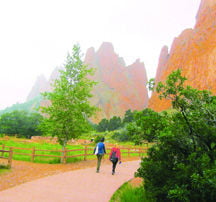
Even Amie was impressed by the strange pinnacled formations that confronted them as they walked along the concrete pathways.
“Dad, the top of that one looks like the beast in Beauty and the Beast.”
“It sure does. And this formation could look like the head of a bull if you framed it just right, Amie.”
“Look, someone has carved their initials and some pictures into those rocks, Dad.”
“The Ute Indians thought this place had a sacred connection to their god. They left many petroglyphs. When we see new carving in rocks, Amie, we call it unwanted graffiti but a thousand years from now, someone may call those scratches petroglyphs.
“Many Native American tribes believed in a universal spirit of good some called Manitou, Amie. Nearby Manitou Springs was named after that spirit,” he explained. “The Utes and other tribes felt there was a mystical connection in the red rocks here.”
He’s been reading a guide book again, Amie thought. Guess I’d better go along and act interested.
“So how did the red rocks get here?” she asked.
“Geologists think they were created during an upheaval along a fault line millions of years ago. Erosion by wind and water did the rest, working away all but the strongest of these weirdly twisted sandstone formations.
“The rocks do look kind of scary,” Amie noted. “So does the sky. Why is it such a pasty white? Those don’t even look like clouds.”
“From what I’m hearing,” Dad replied, “that is airborne ash from some of the big fires west of here.”
“You mean like in forest fires like I see on TV?” Amie shivered.
“Yes, that’s what I mean. Fortunately, it has rained here recently, so people in the area don’t feel threatened for the moment.”
“Why is that ‘no climbing’ sign there, Dad?”
Some people can climb some of the monuments but they need a special permit. Amie.”
“Why? I thought it was a free county.”
“It is, but people also expect some protection, even from their own mistakes.” Dad sighed. “The sign clearly states that these rocks crumble easily and that makes them dangerous for all but experienced climbers.”
They just put up signs to scare us, Amie thought as they finished their short hike and headed back to the rental car.
“We have to hurry on now, Amie. I have a surprise treat for you.”
LOOK IT UP
The 1,367 acre Garden of the Gods Park, which has been designated as a National Natural Landmark, is owned by the City of Colorado Springs. Visitors from all 50 states and more than 60 countries routinely visit the area. There, the grasslands of the Great Plains meet woodlands typical of the American Southwest, then merge with the mountain forest of the 14,115-foot Pike’s Peak.
An ancient trail that still runs past Colorado Springs was used by the Spanish when they arrived in the 1500s. John C. Fremont used that same trail when he was a young military lieutenant exploring the west, before he became a political figure.
Around 1859, the area was called Red Rock Corral. When two surveyors helped to set up Colorado City. One suggested the area was “a place fit for the Gods.” The name has stuck.
Colorado City later merged with Colorado Springs. The history of the park’s development began in 1879 when Gen. William Jackson Palmer, who founded Colorado Springs, convinced his friend, Charles Elliott Perkins, to buy 240 acres that contained many of the dramatic formations we know as the Garden of the Gods.
In 1899, Perkins bought another 240 acres. In letters to Palmer, he expressed his desire to donate his 480 acres to Colorado Springs. Palmer had already donated more than 1,000 acres of his own land to become public city parks.
After his untimely death, Perkins’ children deeded the 480-acre Garden of the Gods to Colorado Springs, with the stipulation that it remain “free to the entire world.”
Chapter 3 – Sliding Into Canon City
Amie’s father explained as he drove. “The road to Canon City leads through lower mountains,” he said. “We’ll seen the tall 14,000 foot mountains tomorrow when we head further west.”
As the miles passed, Amie mused about a time when her family was happily together. The news of her mother’s rare Fahr’s disease had interrupted their happiness just as Amie had celebrated her 10th birthday. She and her father watched her mother suffer from mystery symptoms for many months before the disease was diagnosed.
They had first noticed her clumsiness. Dad had kidded her about it. But then her mother had begun doing unpredictable things. They found the dog’s dry dog food in the refrigerator and potato salad spoiling in the pantry.
Once the disease was diagnosed, her father had explained to Amie that her mother’s body was depositing calcium in the wrong places and those deposits were causing her problems with her thinking process and muscle control. As time passed, she began to lose her vision as well.
For two years, Amie had done what she could to take care of her mother. Finally, her mother had to be placed in a nursing home. Her father sent Amie to live with his parents in High Ridge.
Amie thought with bitterness about how her father had continued his frequent business travels during those two years and how her mother had sometimes cried out for him, and he wasn’t there.
Dad had patiently explained that her mother’s treatments and care cost a lot of money and he had to keep working to pay for them. Amie thought about that but still decided that he didn’t love her or her mom enough to stay home.
Then her mom died. Her dad was out of town the day she fell asleep and didn’t wake up. Her grandparents, who had visited Amie’s mother faithfully, also had to make the burial arrangements.
After the funeral, Dad decided to sell the home where Amie had grown up to help pay the medical expenses and that Amie would live with her grandparents indefinitely.
For the following year, he traveled even more often, staying in a small apartment in the city when he came home. On those infrequent stops, he would try to spend as much time with Amie as possible, taking her to the zoo and ballgames and even to church services.
“Why can’t I live with you?” she would ask and would always get the same answer: “You can’t live in the city alone when I am on the road and you have to go to school.”
***
“We’re here,” Dad announced as he pulled into the parking lot of the Royal Gorge Railroad.
As the train slowly chugged up the steep gorge, carved by the flood-swollen Arkansas River, a conductor pointed out strange slots and holes in the side of the jagged mountains.
“Until a few years ago, the water supply for Canon City was piped in from further up the gorge,” the conductor explained. “Convicted criminals put in the pipeline.”
“Young lady, do you know that Colorado has more prisons than any other state?”
Amie nodded at him but then thought, I never considered escaped convicts when I made my plan.
“The pipeline was built in the early 1900s,” the conductor continued. “The pipe itself was made of curved wood wooden stays like a barrel, only it was a mighty long barrel… more than seven miles long. You can see where the convicts drilled small tunnels through the rock and other places where they chiseled out ledges.
“On the steepest parts, they had to build metal platforms to support the wooden pipes right over the water. After they set them in, they bound them into place with metal strips.
“And now we are coming to the famous Royal Gorge Hanging Bridge. There used to be games and rides by the bridge but a forest fire destroyed them last year. Any questions?”
“Yes,” one man asked. “How are we going to get back? There’s only one engine and it’s in the front of the train. Do we turn around somewhere?”
“No,” the conductor replied. “Once the engineer takes his foot off the brakes, this train will slide back down all the way to Canon City.”
“We’ve still got a three hour-drive ahead of us to get to Aspen tonight.” Dad said as they left the train. “There, we’ll see the Maroon Bells. I’m looking forward to tomorrow.”
So am I, Amie thought. So am I.
LOOK IT UP
Fahr’s disease is a rare degenerative neurological disorder characterized by the presence of abnormal calcium deposits. Researchers do not understand why such calcification happens. Symptoms include progressive deterioration of cognitive abilities and loss of acquired motor skills, with muscle stiffness and restricted movements. There may also be gradual deterioration of the nerve fibers that transmit impulses from the retinas to the brain and are associated visual impairment.
Canon City was founded in 1860 by miners looking for mineral deposits. When silver and lead were found in nearby Leadville in 1877, it became necessary to build a rail line that could follow the narrow gorge. By 1890, the Royal Gorge route was also being used by passengers for transcontinental rail travel as well as for moving ore.
In 1929, the officials at Canon City began building of the Royal Gorge Bridge. That bridge held the record as the highest bridge in the world (955 feet above sea level) until 2001. Since then, a theme park was built near the bridge.
On June 11, 2013, the park suffered extensive damage when a wildfire destroyed 48 of its 52 structures. Fortunately, the bridge sustained only minor damage.
The park reopened earlier this year.
Chapter 4 – Amie’s plan
Amie had a problem as she and her father were driving early Monday morning.
“I didn’t know that high altitude could make me feel so sick,” Amie said as they headed toward the Maroon Bells in White River National Park.
“Amie, I read last night that we were trying to breathe air with about 20 percent less oxygen at the top of Independence Pass,” Dad said. “The pass is about 12,000 feet above sea level. It’s not unusual to feel light-headed and sick to our stomachs like we did. Anyhow, I’m glad we’re not going to travel above 10,000 feet today.
I thought I’d done my homework so well but I hadn’t thought of altitude, either, Amie realized. Should I really go through with my plan? I wonder what else I haven’t thought of.
The towering mountains grew closer and closer as they drove up the narrow mountain road. By 8 o’clock, when they arrived at the parking lot of the Maroon Lake Wilderness Portal, the misty sky had cleared to a vivid blue.
“Why do you want to carry that heavy pack to the lake?” Dad asked as they left the car. “I was only planning to stay an hour before we head for Glenwood Springs. You are going to love that hot springs pool, Amie.”
“I want to be sure I have water and a snack with me,” she said.
Amie gasped as they came to the place in the pathway where they could see the sky and steep pyramid-shaped mountains reflected in the small lake below.
“Those mountains are beautiful,” Amie whispered, “but they aren’t maroon.”
“It depends on the lighting,” Dad said. Then he pointed to their right, to a series of lower peaks glowing mauve to purple in the distance. Their conical shapes did remind Amie of bells.
“We’d better enjoy the solitude while we can,” Dad said, “because after 9 o’clock only buses are allowed to drive up here and park. Tourists will have to come in by the busload. There isn’t enough room for all of them to park otherwise.”
Amie could only see a few people slowly wandering along the edge of the barely rippling lake. Most had cameras. Then a group wearing backpacks walked by.
“Where are you going?” Amie asked one of them.
“We’re off for a four-day hike,” one girl patted her large pack and attached bedroll. “We’ll wander wherever we want, carrying everything we need.”
“Sounds like fun,” Amie said.
Dad was busy taking photos of the mountains from every angle, when Amie said, “Dad, I need to use the restroom. I’m going back to the parking lot.”
“Sure, just watch out for bears,” Dad said and laughed.
Once she was out of her father’s sight, Amie checked the hiking map near the restrooms and then chose one of many paths that circumvented the lake and led off into the mountains. Before long, she caught up with the backpackers.
“Care if I hike along a little way?” she asked. “My dad just wants to take photos.”
“Sure,” the girl said. “Just be sure you remember how to get back.”
Amie took out her compass and began to enter the coordinates into her phone, where each path diverged.
“Where did you learn to do that? the girl asked.
“My dad was in the Army,” Amie said.
“Shouldn’t you be turning back now?” the girl asked after they had hiked for an hour.
“Yes, I guess I should,” Amie agreed and headed back until she was out of sight. Then she turned and continued following the trail.
***
At the lake, Mr. Scott, Amie’s father, was becoming worried. He had spent more than an hour taking hundreds of photos of the splendid mountains, the landslide and the noisy, bubbling creek that fed from the lake, before he realized that Amie had not returned.
Where is that girl? Guess I will find her at the parking lot.
When the first bus began to unload and a crowd of noisy tourists began heading for the lake, he realized just how long it had been since he had seen her. After checking the parking lot carefully, he took her photo from his wallet and began asking the parking attendants if they had seen her recently. He became alarmed when no one had.
That kid had better not be playing a trick on me, he thought angrily.
LOOK IT UP
Two high mountains form the Maroon Bells: Maroon Peak (14,156 feet above sea level) and North Maroon Peak (14,051 feet). The view of the Bells to the southwest of the Maroon Creek valley is one of the most photographed scenes in Colorado. These mountains are located in the Maroon Bells-Snowmass Wilderness of the White River National Forest.
Below them, Maroon Lake (9,580 feet) occupies a basin sculpted by glaciers and later dammed by landslides and rock debris.
The area is Colorado's fourth largest designated wilderness. One hundred miles of trails lead over nine passes above 12,000 feet. Six peaks rise above 14,000 feet.
Chapter 5 -- Hunting for Amie
By noon on Monday, Amie’s father’s emotions had gone from angry to worried and now to extremely concerned for the welfare of his daughter. He had haunted the parking lot where his rental car stood, showing Amie’s photo to anyone who was willing to speak with him.
At first the head ranger had not been particularly responsive, telling him that it was not unusual for teenagers to wander off on their own for a while and then show up smiling with the perfect pine cone or wildflower or rock, even though they weren’t supposed to pick them up. The ranger pointed out that he was a father, too.
But after two hours of waiting, the ranger took Amie’s photo and copied it, then began asking hikers who registered to look for the girl.
***
In the woods, Amie stopped to rest after two hours of hiking. She had thought that her packing was adequate, but already she had a problem. She was getting thirsty. She had quickly consumed her one large bottle of water, and now was discovering that the dry mountain air was already causing her some dehydration. She’d planned on refilling the bottle from a spring or stream but so far she hadn’t run into any. The trail had led her uphill. The water purification tablets she had packed would do no good without water.
As she rested, she examined the contents of her pack. She had her compass but there was no signal available for her cell phone. She had packed sunscreen, sunglasses and a flashlight with extra batteries and a whistle. She had brought matches and the large knife, along with two large reflective blankets, one to sleep on and the other to cover with.
Munching on a breakfast bar made her even more thirsty. So far, she had carefully noted her direction as she hiked along a trail. But now she listened carefully, hoping she could hear the sound of water.
I’ve got to keep moving, she told herself. I have to find some water and shelter for spending the night.
The trail continued uphill, so she decided that she needed too take off through the woods to find water.
She was startled by a browsing elk in the distance. There might be more threatening animals around as well, she thought.
Near a lower elevation, Amie found a clear, fast-running stream. She lapped the water, washed her face with it, filled her bottle and then noticed that the sky had turned dark. Not far from the stream, she spotted an outcropping of rocks sheltered by some low-hanging evergreen trees. She curled up under the outcrop just as thunder rolled through the hollow. As the lightning crashed and cold arrows of rain began to fall, she covered herself with one of the metal-covered plastic blankets and prayed.
The rain seemed to last forever. Before it was over, Amie fell into an exhausted sleep.
***
At the parking lot, the head ranger was placing radio calls to the other rangers in the area. The sudden storm interrupted communications for some time.
Amie’s father paced back and forth until the storm drove him and the others inside a small building where the rangers and parking attendants rested.
“Aren’t you going to do something?” Mr. Scott demanded occasionally, with growing anger.
“Are you sure your daughter didn’t intend to go for a hike?” the ranger asked reluctantly.
Her father frowned. “The truth is that she arrived in Denver carrying a suitcase and wearing a school-type backpack. When we walked to the lake, she insisted on wearing that backpack.”
“Do you know what was in it?” the ranger asked.
“Not really. I assumed it was full of makeup and stuff girls carry.”
“Well, we can’t do much until this storm passes.” the ranger replied. I’ll call in for a search-and-rescue team but we probably won’t be able to get started until morning. And with all that rain, I’m not sure the dogs will be able to track your daughter. But we will try.”
LOOK IT UP
The Maroon Bells-Snowmass Wilderness today takes in about 183,500 acres. The area was established in 1964 by the Wilderness Act.
Many mountain climbers come for the challenge. The peaks are among the most difficult in the state. Caution and skill are advised.
The Snowmass Creek Trail travels 16 miles to Maroon Lake and provides some of the best views of the area. Hot springs steam at the head of Conundrum Creek and attract many hikers. In mid-summer, the wildflowers are enchanting. Elk and deer still abound in the Elk Mountains.
Overnight visitors are required to have a self-registered permit. This registration permit is located at the trailhead.
Chapter 6 -- Temporary shelter
Amie woke in the middle of the night. Her feet were cold. Although the rest of her body had been protected by the reflective blankets, she had turned over at some point and stretched out her legs. Now her boots were rain-soaked.
Guess I should have put that waterproof conditioner on them like the salesman suggested, she thought.
Then she realized where she was and shivered. She drew out the hunting knife from her backpack and laid it by her side.
Nothing will hurt me, she consoled herself. But she did not sleep the rest of the night and often flinched at the hoot of an owl or the scratching sounds of the night.
Tuesday morning, realizing that she hadn’t brought dry socks or an extra pair of boots, she thought about heading back to Maroon Lake.
But then I won’t have showed Dad how self-sufficient I can be, she thought. I have to stay out longer.
***
Mr. Scott had arrived at the Maroon Bells parking lot not long after daylight Tuesday morning. He immediately began asking what the park service employees were willing to do to find Amie.
“We’ve arranged for some rescue volunteers with dogs to head out soon,” the head ranger said. “Hope you have brought us some items with her scent on them.”
Amie’s father handed him the shirt and jeans his daughter had worn on the plane ride.
“This should do it for getting the scent, but with that heavy rain last night, we can’t promise anything,” the ranger said.
“I understand. But may I go with them? I don’t think I can stand waiting here doing nothing.”
“Guess that’s a better idea than having you wander off by yourself. Then we might have two people to find. There are two other groups looking as well. We’ll stay in contact by satellite phone.”
***
After hiking for most of the morning, Amie found an opening in the brittle rocks. Without thinking what might be lurking inside, she picked up her flashlight and walked into the A-shaped crevice. Past the entrance, the space was damp but not wet. The back wall was only a dozen feet from the opening.
Amie quickly cleaned out the evidence that some animal had sheltered there recently. Then she began stockpiling tinder to build a fire, laying some in the sun to dry. She also picked up pine needles and piled them on the floor of her shelter until she had made a soft mattress.
After taking a nap, Amie picked up some more twigs and thicker limbs and lit a fire, coughing when an errant breeze pushed smoke into her retreat. Pulling off her shoes and socks, she dried them close to the smoky fire on sticks of wood. She examined her shriveled-up feet and wiggled her toes until they dried out. Then she covered her feet with her jacket, munched on another breakfast bar and finished off her water.
Amie felt lucky that she had not seen a single soul that morning as she trudged along. No one will know where I am, she congratulated herself. Then she realized that it was indeed true that no one knew where she was, even if something unfortunate were to happened.
***
Mr. Scott struggled to keep up with the volunteers and their dogs. They were used to hiking through the mountains and he was not. He stumbled often, shouting Amie’s name at each turn in the trail. He became hopeful when he heard the dogs barking. The blur of motion turned out to be a deer, running away.
He realized as he struggled along how much he would have enjoyed such an outing if he were not so worried about his daughter. If it turns out she is OK, I’m going to make her life miserable, he thought.
He tried to focus on his surroundings and not on his fears. She could have been kidnapped and in another state by now, he worried. She could have wandered off and fallen somewhere. A tree could have fallen on her. That’s something the rangers warn hikers to watch out for.
The leader’s radio crackled.
“Yeah,” he answered, then listened.
“The other search parties haven’t found anything yet,” he reported.
LOOK IT UP
The Maroon Bells are also called “The Deadly Bells.” Signs warn would-be climbers that they should avoid their treacherous slopes. Unlike other mountains in the Rockies made of granite or limestone, the Bells are made of metamorphic sedimentary mudstone that breaks easily and increases the threat of landslides. The color of that mudstone that gives the Bells their distinctive look.
Alpine timberlines (or tree lines) mark the point where the elevation is too high and the temperature too cold to sustain tree growth. Observing a range of mountains, it becomes obvious that the trees don’t stop in a distinct line. Instead, the landscape shows shorter trees, sparsely spaced trees and then a transition to shrubs and lower-growing plants. In Colorado, the most prevalent trees just below the timberline are quaking aspen and lodgepole pine.
Chapter 7 – Are you lost?
On Tuesday afternoon, after another nap, Amie woke to find that her fire had died out but her socks were now dry. Even though her boots were still damp, she put them on and headed down the rocky slope to a nearby stream for a drink and to refill her plastic bottle.
As she slid down the slope, she saw a marmot climbing out of a smaller cleft in the rocks. Amie expected the furry creature to scramble away. Instead it climbed on top of a flat rock and stood on its two hind paws.
“Do you expect me to feed you?” she asked. “I really don’t have much food left. And I suppose the rangers don’t want me to feed the animals. But you are so tame, it’s obvious other people have fed you before.”
She reached into a pocket and pulled out her last breakfast bar. Pinching off a corner, she threw it in the general direction of the marmot. He dived for the morsel, ate it and then looked expectantly at her.
“Want more? OK, here’s another piece but that’s all. This is my breakfast for tomorrow.”
Thirst drove her to walk on until she came to a valley where the water flowed by gently. Resting by the stream, she drank her fill and then filled her bottle again.
She had just finished and had stood up to climb back to her shelter when a young couple broke through the trees and came toward her.
“You lost, young lady?” the man asked.
“Oh no, I’m getting some water for the others at our campsite,” Amie said, lying. “My parents are just beyond that hill.”
Amie pointed in the opposite direction of the shelter.
“What are you doing so far from one of the trails?” the woman asked.
“My dad wants me to see what the wilderness is really like,” Amie replied. “How about you two?”
“We’re newlyweds out for a day hike,” the woman said. “Just enjoying the scenery.”
The man looked at Amie and frowned. “Are you sure you know where you are?” he asked.
“My dad does.”
“I’d like to show you just in case,” he replied, still frowning.
“Here’s where we are on this map,” he pointed. “And here’s where the trailhead runs by Lake Maroon.”
“Thanks,” Amie said with confidence. “But I knew that already.”
Amie waited until the couple had hiked out of sight. Then, she re-crossed a meadow. No longer thirsty, she had time to enjoy the fresh air and the scents of colorful wildflowers that seemed to bloom everywhere.
It looks as though the sunflowers are all pointing toward the sun, she thought. Is that why they call them sunflowers?
Some of the white and purple flowers were so tiny she had to stoop down close to see them. Then she noticed insects, bees and beetles and butterflies but also some she had seen in books but never come close enough to observe before.
One was a large tick that was crawling up her cargo pants when she caught it. I’ve got to remember to put on more repellent, she thought. Rocky Mountain spotted fever is probably more dangerous than bears.
At her shelter, she prepared for another night’s sleep by gathering more sun-dried sticks and limbs.
***
By Tuesday evening, Mr. Scott was exhausted from the disciplined stalking of the rescue crew, with each rescue worker forming a line 20 feet from the next. The searchers had climbed up hills and down valleys and found no trace of his daughter.
More exhausting to Mr. Scott were his conflicting emotions that went from hope when they spotted the colored clothing of hikers, to disappointment when none of the hikers proved to be his daughter.
As darkness fell, he sat in the parking lot with the head ranger trying to think if there was anything more he could do. Then a young couple walked past.
“Have you seen my daughter?” he asked them using his flashlight to show them her photo.
The man studied the photo. “Yes, I think we saw her this afternoon, about three miles from here. Only she was wearing cargo pants and a St. Louis Cardinals shirt.”
“Hey, these folks have seen my daughter,” Mr. Scott shouted. When the head ranger approached, the hiker showed them on his map where they had seen her.
Mr. Scott had been full of fear for his daughter, but after hearing how glibly she had lied, his anger nearly overwhelmed him.
LOOK IT UP
Marmots are common in the Rocky Mountains. They live in colonies of 30 or so. They hibernate for up to eight cold months a year in burrows they dig out in the soil. These burrows may include multiple entrances with tunnels to connect chambers for sleeping and also a large community chamber in which the colony hibernates together. Young marmots like to play-fight, wrestle and groom each other or nuzzle nose-to-nose. They like to sun themselves on warm rocks. To warn of predators, they may make distinct calls for alarms by whistles, growls or whines. They have many predators including golden eagles, bears, wolves, coyotes, red foxes, lynxes, cougars and wolverines.
Rocky Mountain spotted fever can be a severe or even fatal illness if not treated in the first few days of symptoms.
The tick-borne disease is caused not by the tick itself but by bacteria is injected into the bloodstream when an infected tick bites.
Symptoms may include fever, headache, abdominal pain, vomiting, and muscle pain. A rash may develop after the first few days. In some patients it never develops.
Chapter 8 -- Regrets
Guess I’d better head back today, Amie decided Wednesday morning. Her half a breakfast bar had not satisfied her hunger pangs. I’d really like some bacon and eggs or a hamburger.
She was sure that her dad would be so happy to see her that he would be glad to take her to a restaurant.
And now he will see that I’m able to take care of myself, even in a wilderness, and let me come live with him, she thought.
But then a less positive thought occurred to her: What if he’s really mad at me?
In her attempt to return to the Maroon Lake parking lot, Amie tried to follow the coordinates she had noted with her compass. But when she succeeded, the terrain didn’t look familiar. The sudden presence of a herd of rams put her on alert that she had climbed way too high.
I hope I didn’t forget to enter something. Then she recalled her desperate hunt for water the first morning. Oh no! I don’t think I wrote all that down, she remembered.
Amie started to panic. Then she remembered some advice she had read in a guidebook as she had prepared her plan.
I’ll follow this stream downhill and when I come to a larger tributary, I’ll follow it. Sooner or later it will take me down to a valley where there are people. But I hope it is sooner.
She walked for hours. She had watched as the sun had run its daily course. With alarm, she realized that the sky was turning purple. The shadows were gathering when she saw a large bear ambling in her direction.
Don’t run. Lie down and play dead, she reminded herself. And so she did. The bear sniffed her indifferently, then continued on his way.
Dear God, please help me find my way out of here, she prayed. It’s going to be dark soon.
Shortly after that, she found an abandoned shack with a dirt floor. The door opened with a squeaky protest.
Amie gathered three rocks as large as she could carry, closed the door behind her and propped the rocks against the door. By then it was too dark to gather leaves and pine needles as she had done the night before to soften her bed. She was hungry and tired and more than a little afraid she really was lost.
Amie tried to calm her fears. In her mind, she replayed the fantasy of how her reunion with her father would be. She would rush to him and he would sweep her into his arms and tell her how glad he was to see her safe. Then she would tell him how well her plan had gone. He would be so proud of her that she could make such adult plans that he would immediately tell her he would welcome her moving in with him. They would live happily ever after.
The irregular floor of the cabin littered with rocks poking up into her body brought her back to reality and made her sleep even more uncomfortably.
***
Mr. Scott did not sleep well Wednesday night, either. He tossed and turned.
He’d been relieved to hear from the hikers that Amie was safe. From what they said, it appeared that she was willing to stay lost for a while longer.
This waiting would have been even worse if I still thought that she had been abducted, he realized.
But what in the world made his daughter do such a thing?
Didn’t she know I’d be worried sick? he wondered resentfully. Doesn’t she know that I love her?
Then he tried to answer that question for himself.
While her mother was dying, I did withdraw emotionally from both of them, he realized. My traveling was a convenient reason to be gone. And it has been so easy for me to leave her with my parents. Mom and Dad were good parents to me and they’ve been good parents to her.
I know Amie has complained because Mom is strict. She makes Amie dress like she did when she was in school and the day Amie asked about getting a small tattoo on her ankle, she had a fit.
Well, that’s just the way it has to be. How else can I earn a living?
Although he thought the words defensively, a voice inside him kept asking the question: Could you be earning your living a better way?
LOOK IT UP
Evidence suggests that Native Americans had lived on the eastern side of the Continental Divide as long ago as 13,000 years ago. The eastern edge of the Rocky Mountains was a major migration route for the Pueblo, Ute, Apache and Comanche tribes. Arapaho and Cheyenne also hunted there.
In 1803, with the signing of the Louisiana Purchase, the United States acquired a territorial claim to the eastern Rocky Mountains.
The Continental Divide separates the drainage (watershed) areas to the east and west of the high Rockies. From the Western slope, rain water drains toward the west through a series of streams, then rivers, that find their way to the Gulf of California. To the east, the Arkansas River wanders on a journey to the Mississippi River and then into the Gulf of Mexico.
Chapter 9 – A new plan
Amie had hiked away from the MaroonLake trailhead on a Monday. On Thursday morning, she left the shack and continued her downhill trek. Finally, she came to a recognizable hiking trail. Soon, she noticed some geese floating in a placid pool. The tranquility of that scene was not matched by her state of mind.
She followed the trail, limping along. Her damp boots had caused blisters to form. Her feet hurt. Her mosquito bites itched. Her arms ached where they had been scratched by briars. She felt hungry and miserable.
As the trail went up yet another rise, she looked down and to her great joy, saw a paved highway below. She stumbled down the mountain and sat down next to the road. Suddenly she began crying.
Amie remembered a day when she had complained to her dying mother that her dad wasn’t there again.
“Honey,” her mother had said, “We all do the best we know how. Your dad still has some things to learn but so do we. The best thing we can do is to forgive him for his shortcomings. He will have to forgive us for ours.”
“I don’t want to forgive him,” Amie shouted at the empty road. But part of her said, Yes you do and you want to be forgiven. He’s been worried and scared, too.
Just then, Amie saw a car driving slowly past her. The woman driver was eyeing her with concern. The car stopped.
“Do you need help?” the woman asked?
“Yes, I do,” Amie answered. “Could you please take me to the parking lot at MaroonLake? I’ve been lost in the forest.”
The woman smiled: “Hop in. I’m sure someone will be glad to see you.”
When Amie told a parking attendant who she was, he immediately radioed the news to the head ranger.
Amie’s reality didn’t quite work out the way her fantasies had led her to believe they would. When she saw her father walking toward her, she started to run into his arms. But when she saw the thunderous look on his face, she stopped cold.
“How could you do this to me?” he snarled. “I was worried sick. Did you really want to punish me that much? Don’t you think your mother’s death was enough?”
Shock filled Amie’s face: “Dad, I had a plan. I just wanted you to see that I could take care of myself so you’d let me move in with you…”
She hesitated.
“I guess I never thought much about how you would feel.”
“Well, you’ll know now, young lady. I’m putting you on the first plane home and instructing your grandparents to ground you until you turn 16! Now get into the car.”
He stalked away, boiling with anger.
After walking around the parking lot, trying to clear his head, he stopped long enough to thank the head ranger for his help.
The ranger, who had heard the exchange between father and daughter, asked him to stay for a moment.
“Mr. Scott,” he said, “I’m the father of three grown girls. What your daughter said about her plan is probably true. I don’t believe she was trying to punish you. I know this is none of my business but it took me a long time to realize that young girls’ fantasies are very real to them.
“I will leave you with a question: How much have you thought about her feelings?”
The ranger walked away quickly, leaving Mr. Scott to contemplate what he had just said.
Amie’s father paced up and down the concrete still trying to get beyond his anger. As he passed Amie, waiting for him to unlock the car, he noticed the big red mosquito bites and the places where her shirt and cargos had been torn by thorns. He could see how dejected she looked.
How defeated she must feel, he mused. Then he asked himself again: Do I still need to keep working out of town?
He had already realized that financially he didn’t. He had finally paid off the bills for his wife’s medical treatments. More to the point, he was sure the company would let him transfer to a job with less traveling, although he’d lose the generous bonuses he was receiving.
He looked over at Amie again. She was sitting on the sidewalk waiting. The expression on her face said that she had lost all hope.
He walked to the car and unlocked the door.
“Get in,” he said in a gentler voice. “We’re both flying home together. And when we get there we need to make a new plan.”
LOOK IT UP
Although the United States had acquired a territorial claim to the eastern Rocky Mountains in 1803, that claim was disputed by Spain. In 1806, Zebulon Pike led an Army expedition of discovery into the disputed area. Through many political twists and turns, the dispute with Spain was not settled until 1848.
Colorado did not join the union as the 38th state until Aug. 1, 1876, 16 years after its residents first applied to become one.
Colorado is the highest state in the union because its lowest point is 3,317 feet, higher than the tallest point of 18 of the other United States and the District of Columbia. The summit of Mount Elbert is the highest point at 14,440 feet.