
Chapter 1 – A New Home
Jemma and Fiona Junger stood on the sidewalk of a Savannah row house, gazing up at the massive brick building.
“Is this where we are going to live, Mom?” Jemma asked.
“For a few weeks,” Teresa Junger replied. “We will stay here until we can find a more permanent place to live. Since your father is overseas I’ll have to make the decision whether we should live on or off the nearby Army base.”
“I wish we could have moved here when Dad came for his special training,” Fiona said.
“But you know why we didn’t,” Mom said. “We wanted you to finish your sophomore year at your high school back at Fort Campbell first.”
“And I had to finish seventh grade,” Jemma added.
“This is an awfully big house,” 12-year-old Jemma noted as she stared at a long row of brick fronts.
“It seems to be,” Mom replied. “But what you are looking at is four separate houses. We will stay in the furthest one on the right.”
“Mom, look! There’s a park with a fountain at the end of the street,” 15-year-old Fiona interrupted.
“That is one of the squares, girls. There are 22 of them and we will try to walk to all of them before we leave Savannah.”
“Why so many, Mom?”
“That’s the way the colony’s founder, James Oglethorpe, designed the layout of the town. He thought up the design nearly 300 years ago.”
“It sure is hot here for June,” Jemma complained. “I hope this place has air conditioning.”
“I’m sure it does, Jemma, but we will have to turn it on. It may take a while for the house to cool down. We can walk to that nearby restaurant and have lunch. According to what I’ve read, part of it was built in 1790.”
“That is really old, Mom. Is our house that old?”
“I don’t know, Fiona. Judging from outside, I’d say it was built in the early 1800s.”
“That’s still old, Mom. Let’s see what’s inside.”
“This house is really big,” Jemma called as she rushed through the central hall downstairs, checking out each room.
“It’s not as big as it appears,” Mom replied. “The very high ceilings make it seem larger. Here’s a living room and it looks like we’ll have to eat in the dining room because there is no table in this small kitchen.”
“What’s this extra room for, Mom?” Fiona asked.
“I guess we can use it as a den and TV room. Look upstairs too, girls. There’s a surprise for you. You don’t have to sleep in the same bedroom. There’s a sitting room with a pull-out couch, so you don’t always have to be together.”
“You mean it’s good for you, so when we fight you can make us go to separate rooms?” Fiona noted.
Mom smiled.
“I like this place. Why can’t we just live here forever?” Jemma asked.
“Because the friend of your grandmother who owns this house will be moving back here in the fall. She prefers to live in Minnesota where it is cooler during the summer. Right now we can stay here for free because your grandmother’s friend appreciates what your dad is doing for all of us. This is her way of saying thank you for protecting our country. ”
“What about what we do for our country, too?” Jemma snipped. “Moving all the time isn’t easy. We’ve already had to live without Dad for months. Fiona’s moping because she had to leave her boyfriend Bill behind.”
“He said he’d write,” Fiona snapped.
“I wish Daddy were here to be with us,” Jemma pouted. “Where is he, Mom?”
“You keep asking, but I don’t know exactly. He can’t tell me. But wherever it is, I’m afraid there’s lots of sand and no ocean.”
“When will he come home?”
“He says he will be here in time for Christmas.”
At least I hope he will, she thought.
“Are there any ghosts around here?” Fiona asked.
“I don’t know. Your grandma said this was supposed to be a town full of ghosts. But then she explained that the stories are mostly told for the tourists who like to take ghost tours.”
“Don’t you believe in ghosts, Mom?”
“I don’t believe in the kind that businesses promote,” Mom explained.
Did you know?
The city of Savannah in the colony of Georgia was begun in 1733. The original town was laid out around four open squares, each surrounded by four residential (“tything”) blocks and four civic (“trust”) blocks. The layout of a square and eight surrounding blocks was known as a “ward.” The original plan of James Oglethorpe allowed for growth of the city and thus expansion of the grid. Additional squares were added and by 1851 there were 24 squares in the city.
Most of Savannah's squares are named in honor of a person, persons or historical event. Many contain monuments, statues and other tributes to prominent historical figures.
The Bird Girl Statue marked the grave of “little Wendy” for 50 years at Bonaventure Cemetery in Savannah. After it appeared on the cover of the book, “Midnight in the Garden of Good and Evil,” it was moved to a place of honor at the Jepson Museum.
Chapter 2 – Adjustments and choices
While eating breakfast the following morning, Mom made an announcement.
“I’d like to take you out to see Fort Stewart. I want to go to the post to get some groceries from the commissary,” she said. “Besides, I want you two to see where your dad was living this past winter and where he will to be working when he returns home from his tour of duty.”
“Is it a long way from here?” Fiona asked.
“About 40 miles.”
“You promised to take us swimming,” Jemma whined. “Where’s the nearest swimming pool?”
“I really don’t know, but there’s a popular beach on Tybee Island about 15 miles from here. We can swim in the ocean.”
“And make sand castles?” Jemma asked.
“Yes, but not today. On the way home, we can look at a few houses that are advertised in the newspaper.
“Where will we be going to school?” Fiona asked
“I don’t know yet. Fort Stewart is in Liberty County but there are six surrounding counties where we might decide to live.”
“Wouldn’t Dad want to live on the post? That’s where his job is, right?” asked Fiona.
“He might be in the mood to live in a place with more than one bathroom, girls. That’s the limit for us on post.”
“Only one bathroom? How can anyone live with only one bathroom?” Jemma asked.
“Speaking of bathrooms, Jemma wakes me up when she uses our bathroom. The door sticks and squeaks. I think we need three bedrooms and three bathrooms.”
“I think we can manage with two,” Mom said less than patiently.
“Girls, I’ve got a problem sleeping here, too. The tour trolleys drive past my front bedroom until nearly midnight. I’ll grease the hinges on your bathroom door but beyond that, you will have to get used to the inconveniences, too.”
***
As they rode to Fort Stewart, Mom’s comments about choices continued.
“If we do move on post, you girls are not going to be happy with the curfew. You only had our family rules when we lived off base,” she said.
“What’s a curfew?” Jemma asked.
“For you two, it would mean that you’d have to be home by 10 p.m., even on weekends.”
“But Mother, I’m too old for that.” Fiona protested. “This year you let me stay out until midnight on the weekends if there was a school dance or something.”
“That may have to change,” Mom said with a frown.
“Mom, it’s awful that we have had to change schools every couple of years and I have to start all over making friends,” Fiona complained.
“It’s hard for me too, girls. Moving involves a lot of paperwork and I’ll have to get new license plates and a Georgia drivers license. My list of responsibilities keeps growing and growing. Soon, I want to visit with someone from the Board of Education in each county and see what the schools offer.”
“Yuk! School is school,” the girls both said in chorus.
“Why are we stopping?” Jemma asked.
“We have to go through this gate,” Mom replied.
A soldier carefully looked at Mom’s identification and then the girls’. Then he inspected the inside of the car.
“You mean, every time we enter the base, we’ll have to stop so they can check us out?” Fiona asked. “We didn’t do that in Kentucky,”
“Yes, we did at first, girls. It’s just that the soldiers on guard duty recognized us after a while and waved us through so it didn’t take this long.”
“Why do they have to be so careful, Mom?” Jemma asked.
“Army bases need to be safe. There are a lot of secret programs going on in here. We don’t want someone who doesn’t like us to come in and find them out.”
Mom drove a short distance. “Here’s where your father lived in the barracks,” she said, pointing. Just then a group of soldiers marched past.
“What are they singing, Mom?” Jemma asked.
“It sounds like: 'G.I. beans and G.I. gravy – Gee, I wish I'd joined the Navy!
G.I. gravy, G.I. beans – Gee, I wish I'd joined the Marines!' ”
Jemma giggled: “That’s funny, Mom. Why do they do that?”
“It’s a cadence to help them keep time as they march. If they are doing close-order marching, it helps them keep from stepping on each other.” Mom grinned. “Dad says it also increases their morale and team building.”
“Here’s the commissary, girls. Lets go shopping.”
Did you know?
The U.S. Army has its special marching song often called “The Army Goes Rolling Along.” The song’s official title is “The Army Song.”
Intro: March along, sing our song, with the Army of the free
Count the brave, count the true, who have fought to victory
We’re the Army and proud of our name
We’re the Army and proudly proclaim
Verse: First to fight for the right,
And to build the Nation’s might,
And The Army Goes Rolling Along
Proud of all we have done,
Fighting till the battle’s won,
And the Army Goes Rolling Along.
Refrain: Then it’s Hi! Hi! Hey!
The Army’s on its way.
Count off the cadence loud and strong (TWO! THREE!)
For where e’er we go,
You will always know
That The Army Goes Rolling Along.
Chapter 3 – Around the squares
On the way back to Savannah from the Army post, the Junger family drove past another square within a long block of where they were staying.
“What’s the name of that square?” Jemma asked.
“I’ll look it up when we get home,” Mom replied.
“Mom, may I walk up to Columbia Square?” Fiona asked.
“I want to go, too,” Jemma insisted.
“First we’ll unload the groceries, then we’ll all go,” Mom decided.
“Why are you carrying a book with you, Mom?” Jemma asked as they walked the half block to Columbia Square.
“This tells me about all the squares and how they came to be.”
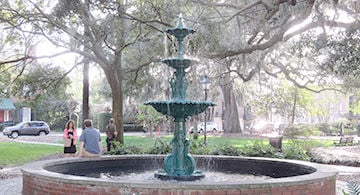
“What a pretty fountain,” Fiona said. “And look, there’s a place to sit. Who takes care of all this, Mom?”
“Your grandmother told me that the people who live around the squares plant the flowers and maintain the grass and trees or pay someone to do it,” Mom said. “Then they get to enjoy having a pocket park by their house. See, that man is sitting on a bench reading a newspaper just as if he was at home.”
“Mom, there’s a plaque. It says the fountain is called the Wormsloe Fountain because it came from the old Wormsloe Plantation, that was settled by one of the first English families in Georgia,” Fiona read. “It was donated by one of their descendants in 1970.”
“Ugh! What kind of name is Wormsloe?” Jemma asked. “It sounds icky.”
“We’ll ask when we drive out to see it later in the week,” Mom answered.
“Let’s go see the park on the other side of our house, too,” Fiona suggested. “What does the book say?”
“Oglethorpe Square,” Mom read.
“Wasn’t he the guy who founded Savannah?” Jemma asked.
“Yes,” Mom said, “but according to this book, the monument to James Oglethorpe is located in Chippewa Square. That’s confusing.”
“Look Mom, there’s a bus and a whole load of people are going into that house,” Jemma said. “Do you know anything about it?”
“Let’s walk by and see. The sign says the Owens-Thomas House. It also says there are tours. Let’s ask.”
A few moments later, Mom returned to her waiting daughters: “OK, we have tickets for an afternoon tour. Now let’s go see Oglethorpe Square.”
“The flowers are pretty, but there’s nothing in the middle of the square but trees,” Jemma noted. “I’m disappointed.”
“I’m surprised,” Mom said. “According to my book, this square and Ward Square were both laid out in 1742. James Oglethorpe personally laid them out soon after he returned from England. It says more were added later.
“After the Revolutionary War, the names of the streets around this and Ward Square were changed to wipe out the English influence. President Street had originally been called King Street. Prince Street was renamed State Street. This is interesting: Lincoln Street was not named for Abraham Lincoln but for Gen. Benjamin Lincoln, a hero of the Continental Army, who was involved in the unsuccessful siege of Savannah. I guess President Lincoln was not very popular around here.
“If you girls have seen enough for one day, let’s walk back, eat lunch and then take the house tour.”
***
Just after lunch, Mom’s cell phone rang.
“No doubt another sales pitch,” she said as she answered. Mom stood waiting in silence for some time and then her face lit up.
“Oh, Ken, I’m so glad to hear your voice.”
“I want to talk to Dad, too,” Jemma demanded.
Mom punched on the speaker setting.
“Talk quickly girls. Your dad has only five minutes of phone time.”
“Are you girls enjoying Savannah?” Dad asked.
“Yes Dad, we are, but we miss you so much. When are you coming home?” Jemma sighed.
“Sorry dear, I can’t say for sure.”
“What time is it where you are?” Fiona asked.
“It’s about 21:00 hours here.”
“Is it dark out?”
“Just about.”
Dad laughed: “I’ve taught you well, Fiona. Now quit playing detective. I can’t tell you where I am. I have to go now. I only wanted to tell you all that I love you and miss you. It’s so good to hear your voices.”
“We love you, too,” all three shouted.
In a heart-stopping second before the phone disconnected, they heard what sounded like a large explosion in the background.
Did you know?
The names of all but the two “lost’’ squares in Savannah are: Franklin, Ellis, Johnson, Reynolds, Warren, Washington, Liberty, Green, Telfair, Wright, Oglethorpe, Colombia, Green, Elbert, Orleans, Chippewa, Crawford, Pulaski, Madison, Lafayette, Troup, Chatham, Monterey, Calhoun, and Whitefield.) In the 20th century, three of the squares were demolished or altered beyond recognition, leaving 21. In 2010, one of the three “lost” squares, Ellis, was reclaimed.
Chapter 4 – Fun and fear
After Dad’s phone call was disconnected, Mrs. Junger and her two daughters stared at each other with fear on their faces.
“Was that an explosion we heard?” Fiona asked. “Isn’t there any way you can find out?”
“Not right now, girls. If something really bad occurred, someone will notify us. In the meantime, we will have to hope that the sound was a truck backfiring. Why don’t we stay home this afternoon and rest? I’m not in the mood to do a house tour anymore. I’ll reschedule for tomorrow.”
***
The following morning, they all stayed home and waited, both hoping for and dreading a phone call. By early afternoon, when no one had called, they had begun to relax.
“You have your cell phone with you, Mom. Let’s go see what that Owens-Thomas House looks like. It’s only a block away.”
“You are right, Fiona. No need to borrow trouble.”
A gate led into an elaborate courtyard. The three were directed into the lower level of a large plain building. In a plain room, they examined the many historic pictures and photos on the wall as they waited.
“This building served the residence across the courtyard,” a guide began her spiel. “On this level, the horses, carriage and tools were kept. In the loft above us, the slaves slept.”
“Did they really have slaves?” Jemma asked the guide.
“Yes,” she answered, “although not for the first 20 years. The governor of this colony, James Oglethorpe, refused to allow slavery. In 1752, the British king and lords took over the governing of the colony and declared slavery not only legal but desirable.”
“Why?” someone asked.
“Slave labor made the colony more profitable for the king and his friends. Now, let’s walk across the courtyard and up the steps.”
The guide continued: “The Owen-Thomas Home was designed by William Jay, a noted architect. As an adult, he worked with a surveyor in London. Within five years of his arrival, people were saying that he had transformed Savannah into a splendid city with architecture worthy of London.”
“This house has such big rooms and is so pretty,” Jemma whispered. “And look at the wonderful toys their children had. Did everyone live like this, Mom?”
“No they didn’t, Jemma. Very few people were this wealthy. Many slaves and servants were required in order to do all the work.”
The guide cleared her throat: “This home is one of the three remaining Regency-style houses designed by Jay. It was built for a wealthy banker and cotton broker, Richard Richardson, who was famous for launching the first steamship to cross the Atlantic, the SS Savannah. However, due to financial reversals, he lost the home shortly after the ship was completed. George Welshman Owens bought it for $10,000. He and his descendants lived here until 1951, when his granddaughter, Margaret Thomas, willed it to the Telfair Museum. Now it is one of three unique museums in the Telfair system.”
“I wish I could buy a mansion for $10,000,” Mom whispered. “Then even you girls would be satisfied.”
From room to room, the visitors marveled at the artwork, the carved woodwork, the high ceilings and gilt decorations.
“That was some fancy house,” Mom said when the tour was over. “Just dusting everything must have taken forever.”
“And setting up all those fancy place settings for a dinner,” Fiona added.
“Yes, Mom, but I didn’t like the contrast between how the rich families lived and how the slaves did. It was all beauty and light upstairs but downstairs the slaves cooked and did the laundry in that terrible damp basement. Then they had to spend the night in the loft smelling the horses below them.” Jemma held her nose.
“Let’s go see the other two Telfair museums tomorrow,” Mom suggested.
“I’d rather go to the beach.” Fiona said.
“We’ve got plenty of time for that,” Mom insisted.
***
“So what did you think of the Jepsom Museum?” Mom asked, the following afternoon.
“It was much more interesting than the Telfair Academy Museum with all those dead-men statues in front,” Jemma said.
“I liked that part where the black marks on the white walls played music, once I downloaded the app,” Fiona said.
“I thought the electronic setup that made cartoons of our faces was the most fun,” Jemma said.
“So, are you girls ready to go to the beach tomorrow?” Mom asked.
“Yes” they both shouted.
Did you know?
The Telfair Museum system includes three separate buildings: The Owen-Thomas Home, the Telfair Academy and the Jepson Center.
Architect William Jay also designed the building that houses the Telfair Academy, a former mansion built from 1818-1819 for Alexander Telfair, son of Revolutionary War patriot and Georgia governor Edward Telfair.
In 1875, Alexander’s sister Mary bequeathed the house and its furnishings to the Georgia Historical Society. The building opened to the public in 1886 as the Telfair Academy of Arts and Sciences. Today, the Telfair Academy houses 19th- and 20th-century American and European art.
The modern Jepson Center, designed by Moshe Safdie, opened in 2006. In 7,500 square feet of gallery space, the museum features important works from the 1900s, including serious works and a number of novel electronic art displays. Most interesting to visitors is often the original Bird Girl statue, made famous on the cover of the book “Midnight in the Garden of Good and Evil.”
Chapter 5 – Playing in the Sand
Two days had passed with no word about Dad, so Mom began to relax. There has been nothing on the news, she reasoned, so I guess Ken’s OK.
It had rained the previous day and she and the girls had spent the day in the house playing board games. When Jemma became restless, called them “bored games,” and wanted to go back to her computer, Mom changed her tactics. The three of them cooked a tasty meal with fresh shrimp, pasta and a tangy salad. For dessert, they drove the three blocks to Leopold’s for ice cream in a heavy rain.
“Look, there’s no line today,” Jemma said as they parked on a side street. “Sunday, the line ran down the whole block.”
“I can’t make up my mind,” Fiona mused as she checked the menu. “Look, they even have lemon custard and coconut-flavored ice cream along with chocolate and peanut butter and so many more.”
After making up their minds and then changing them a dozen times, Fiona settled on a cherry-and-chocolate sundae with while Jemma chose a strawberry sundae with coconut ice cream. Mom enjoyed a coffee-chocolate chip ice cream cone.
“If it finally stops raining tomorrow, we can go to Tybee Beach,” Mom announced as the girls spooned out the last of their ice cream.
“Yeah!” called Jemma.
“What should I wear?” asked Fiona. And then, “Do you think any other teenagers will be there? I haven’t made a single friend yet. Wow! Look at that cute guy over there. I’d like to meet him.”
“Boys, boys, boys,” Jemma chided. “I’m glad I’m not boy-crazy like you. What would Bill think?”
Fiona started to cry. “I’m not boy-crazy. I miss Bill and my friend Sara and I miss her brother, Bob, too. I’m so tired of making friends and then having to move on.”
Mom frowned.
“I’m sorry, Mom. I didn’t mean to complain.”
“I understand, Fiona. I have friends I miss, too. When I married your father, he was already in the Army. I thought I knew what I was getting into … but...”
Then she quietly sobbed.
“We all need a day at the beach,” Jemma exploded, and began laughing.
***
After a misty early morning, the sun rose and shone brightly. By 10 a.m., the temperature had risen to 85 degrees. Jemma had dressed and was waiting expectantly. Fiona still hadn’t come downstairs.
“What’s keeping you?” Mom called up the stairs.
“I don’t know which bathing suit to wear,” she called back.
“Put on something,” Mom insisted.
The drive to the beach was uncrowded. The road rose barely higher than the tidal pools around it.
“Does the water flood the road?” Fiona asked.
“I doubt it,” Mom said. “I think today there must be an extra high tide. If it is, we’ll see more sawgrass and less water on our return.”
***
“Look, there’s a bus load of teenagers getting off and heading to the beach,” Jemma noted as they got out of their car. She grabbed her towel and went racing down to the water, then plunged into the surf and swam out a dozen yards.
“Get back here,” Mom shouted. “That surf is rough today. You need to get used to the ocean more gradually.”
Reluctantly, Jemma headed back. She arrived at the shore more quickly than anticipated when a particularly high wave shoved her toward the beach. As she struggled to gain her balance, a young man grabbed her arm and helped her stand up and walk back to the dry sand.
“Thanks,” she said. “Haven’t I seen you around Columbia Square?”
“Yeah, I live around there,” he replied. “I’m Mike.”
“I’m Jemma,” she said blushing. “That’s my Mom and my sister Fiona. We live down the street.”
“See ya around,” Mike said. Then he turned and joined a group of teens who were throwing sand at each other and laughing. One boy picked up a dead jellyfish and chased a screaming girl around with it.
“Look at that cute little girl with her dad,” Fiona said a few minutes later. “She looks about 3 years old, but she doesn’t seem to be a bit afraid of the waves as long as he stays with her.”
“I miss Dad,” Jemma said.
“I do, too,” Fiona sighed. “I wish he’d come back soon.”
Watch what you wish for, Mom thought to herself.
Did you know?
Tybee Island is the easternmost point in Georgia. Located approximately 15 miles from downtown Savannah, Tybee consists of a sandy beach on its eastern shore and a tidal salt marsh on the western side. The breadth of the sandy beach varies with the tide. The interior consists of a maritime forest. The Savannah River empties into the Atlantic Ocean north of Tybee Island. The island has long been a quiet getaway for the residents of Savannah and more recently has become a popular vacation spot for tourists.
Native American tribes inhabited the island in the years before the arrival of the first Spanish explorers. In 1520, the Spanish laid claim to the island. Located at the northern end of Spanish-controlled Florida, the island was frequented by pirates. After the founding of South Carolina in 1670, warfare increased between the English and their pirate allies and the Spanish and their Native American allies. In 1702, residents of South Carolina invaded Spanish Florida with an Indian army and a fleet of militia-manned ships. The invaders failed to take the capital of Florida at St. Augustine, but after another invasion by South Carolina in 1704, the Spanish retreated south to St. Augustine. This made possible the establishment of new English settlements in what is now Georgia.
Chapter 6 – At the Colonial Cemetery
The summer days flew by quickly for the Junger girls. Dad called occasionally, assuring them he was “just fine.”
With Mom, they took tours of more historic homes. They walked to Forsyth Park and sat in the shade while studying the elaborately decorated statues of the fountain. They visited Wormsloe Plantation and drove the mile-long road covered by a canopy of live oak trees, then stayed to listen as re-enactors told the story of the early years of the colony.
And they visited the Colonial Cemetery.
“Even in the daytime, that Spanish moss makes everything look creepy,” Jemma said. “I’ll bet this is a scary place at night.
“Mike said there were all kinds of ghosts in this cemetery. He said it was because of the yellow fever epidemics that happened a long time ago. There were so many bodies, the gravediggers would dig one big hole and dumped them in. Their ghosts are mad because they didn’t get decent graves and markers.”
“Who is Mike?” Fiona asked.
“He lives up the street from us. I saw him at the beach and then at the ice cream shop last week when I brought home pints for all of us. We walked home together.”
“How old is Mike?” Mom asked suspiciously.
“Uh, he’s about my age,” Jemma lied.
***
Around midnight a few days later, the phone rang. Mom grabbed it in fear.
“Hope it’s not the Army,” she muttered.
“Is this Mrs. Junger?” an official-sounding voice asked.
“Yes,” Mom replied.
“We have your daughter Jemma here. She was caught inside the Colonial Cemetery a short time ago.”
“That can’t be,” Mom protested. “She’s here. I’ll check her room.”
She quickly walked into the back bedroom and past Fiona, who was sleeping. In the sitting room, Jemma’s bed was empty.
“Where are you located?” she asked the officer, then jotted down directions.
“Wake up,” she demanded as she shook Fiona. “We have to get your sister out of jail.”
***
The ride home from the County Jail was not pleasant.
“I’m not going to question you while I’m driving,” Mom said. “But when we get home, you’d better have a good explanation.” She could hear Jemma crying in the back seat.
I wish Ken was home now, Mom thought.
At home, Mom confronted Jemma. “Now tell me what happened.”
“I wish I’d never met Mike,” Jemma sobbed. “And I wish I hadn’t lied to you. I didn’t just meet Mike at the ice cream shop that day. He was with a gang of his high school friends. On the way home, they all started telling me about the ghosts at Colonial Cemetery, about the little boy who runs through the burial grounds and the great giant man who was hanged there. Then they asked if I’d like to go along and see ghosts some night. I said I would.”
“How did you get out of the house with the alarm on?” Mom asked.
“One day when you were gone, I tried the bolted side door and found out that the alarm didn’t go off when I used it.”
“So you went sneaking off without telling me?” Mom’s face was getting red. “Just how old are Mike and his friends?”
“They’re all juniors in high school.”
“You are 12. You went off with kids who are 16 and 17?” Mom sputtered.
“Boy, are you in trouble,” Fiona volunteered.
“I just wanted to make some friends,” Jemma whispered.
“They took me to the cemetery. We walked around outside the fence for a while. Someone heard some strange noises and someone else saw shadows moving but I didn’t see anything. Then one girl said we should go inside. They told me that they had gone over the fence several times before and never gotten into trouble. They said they would scale the fence too but since I was so much smaller, they’d help me over first.”
“So they helped you and then they ran off,” Fiona guessed.
“How did you know?” Jemma groaned.
“I was so scared. The gate was locked. The wind came up and the shadows began to move toward me. One shadow was so tall, I thought it was the big ghost.”
Jemma shivered. “Do you think any of the ghosts from the cemetery have followed me home?” she asked.
“I don’t think so,” Mom reassured her, trying to suppress a grin.
Did you know?
The Colonial Park Cemetery, the first public cemetery in Savannah, opened in 1750, 17 years after the founding of the English colony of Georgia. It is estimated that more than 10,000 people have been buried there. Less than 1,000 grave markers remain.
As the city expanded, many private family burial grounds were built on or paved over. Because of this, Savannah is consider to be the City That Lives Upon Her Dead.
Some of these dead were buried in mass graves during times of epidemics such as yellow fever. Over more than 200 years, many markers have toppled and broken from age or have been vandalized. It is suspected that some graves have been covered over by the lumpy sidewalks that ring the cemetery. These circumstances give substance for many to believe that not only Colonial Cemetery, but many areas of Savannah, are haunted by unhappy ghosts.
Today, the city of Savannah has numerous cameras fixed on the Colonial Cemetery grounds, poised to catch human visitors who are routinely caught and fined.
Visitors are allow to walk around outside the tall, wrought-iron fence or sit on a nearby bench and observe. Many report hearing strange sounds, feeling cold blasts of air or seeing strange lights. Some ghost hunters have claimed to have recorded strange voices.
Chapter 7 -- A change of plans
After the incident at the cemetery, Mom kept a close eye on Jemma. Once again, the three of them began touring notable places in Savannah.
“Here’s the Kehoe House,” Mom pointed out. “It was built in 1893 as a private residence for a steel magnate named William Kehoe. Later it became a funeral parlor.”
“Mom, did you know that the Kehoe House Bed and Breakfast is haunted?” Fiona asked. “I read that two of Mr. Kehoe’s children died while playing in a fireplace. Some overnight guests have said they could hear children playing while running up and down the stairs at night.”
“Maybe there were real children there,” Jemma suggested.
“No, it happened on nights when there weren’t any children in the building.”
“I also read that the 1790 Inn and Restaurant down the street is haunted,” Fiona added. “Sometime after 1820, a woman named Ann was locked in her room by her jealous husband. She tried to escape out a window, but fell and died. People who stay overnight have reported being wakened by what feels like a caressing woman’s hand. Ann also likes to move around women’s jewelry and cosmetics.”
“Enough of the ghost stories,” Mom insisted. “Let’s walk down to the Riverwalk and watch the cargo ships headed for the port of Savannah. I want you to see the statue of Florence Martus, a real person. Many years ago, as a young woman, she fell in love with a sailor. He promised to return. Any time word was passed that a ship was coming in, Florence would run down to the river and wave, hoping to see her lover. He never did come back, but year after year for 40 years she continued welcoming each returning ship. Recently, a statue of her, still waving, was placed in a park near the waterfront. Lets go see it.”
As they walked down a steep, stone-paved path, the family got its first look at the vast commercial and industrial riverfront.
“Mom, look at how those huge ships fit under that bridge. How big are those cargo containers?”
“I think I read that each is nearly 50 feet long and 10 feet tall by 8 feet wide,” she answered.
“Wow, they just look like toys from here,” Jemma said.
“And girls, the Talmadge Bridge complex goes all the way from this side of the Savannah River to Hutchinson Island then across the Black River, where an older bridge connects with Jasper County.”
“There sure is a lot of water around Savannah,” Jemma said.
***
July passed quickly. Mom insisted the girls go with her when she looked for housing. Mom settled on a rental home about halfway between the base and Savannah.
“I’m impressed with the schools,” Mom said. “The house is big enough, although I will miss having a basement. They don’t seem to build many that way around here.
“The climate’s warmer here,” Fiona said. “We’ll be spending more time outdoors anyhow.”
“I think I will put money down tomorrow,” Mom decided. “When you girls go back to school, I’m going to look for a job. If you girls want more than just basic clothes and activities, it will help our budget if I’m working.”
***
Mom’s plans changed when the phone rang late that night.
“Mrs. Junger?”
“Yes.”
“This is 1st Sgt. Anderson,” a weary-sounding voice said. “I’m sorry to inform you that your husband, Kenneth James Junger. has been wounded in the line of duty. He is being transferred to a local hospital for treatment. The injuries do not seem life-threatening. You will be receiving more information as soon as it becomes available.
“Where is he?” Mom cried. “May I come see him?”
“I’m sorry. I don’t know. Tomorrow, someone else will call you with more information. All you can do right now is wait.”
Quickly, Mrs. Junger knelt by her bed and prayed harder than she had in years: “Please help my husband.”
“What’s the matter, Mom?” Fiona asked as she crept into her mother’s bedroom. “I heard the phone ring and then it sounded like you were crying.”
“Your father has been injured,” Mom explained, trying not to sob between words.
“Will he die?” Fiona demanded.
“The sergeant said the injuries do not seem life-threatening. That’s all I know. We have to wait until tomorrow.”
“Should I wake Jemma up?”
“No, let her sleep if she can.”
Did you know?
The Talmadge Bridge honors Eugene Talmadge, who served as the governor of Georgia from 1933-37 and 1941-43. It replaced a bridge that was too low to accommodate large container ships. The port of Savannah is now the largest ocean container terminal on the eastern seaboard of the U.S.
History does not record why Florence Martus (1868-1943) began waving at incoming ships. She lived with her brother in a cottage along the river, along with her faithful collie. As a young woman, she began waving her handkerchief at sailors returning to port. She soon earned the title of “The Waving Girl,” and sailors began waving back, sometimes accompanied by a blast of the ship’s horn. Even when ships arrived at night, she waved a lantern instead. She continued her greetings for about 40 years.
Florence was buried next to her brother in Laurel Grove Cemetery in Savannah. The headstone inscription reads: “In memory of the waving girl and her brother, keepers of the lighthouse on Elba Island, Savh River for 35 yrs.”
On Sept. 27, 1943, the SS Florence Martus was christened in her honor.
Chapter 8 – A new way of life
When Jemma came down to breakfast the following morning, she immediately sensed that something was wrong.
“What’s going on, Mom?” she asked. “You have dark circles under your eyes.”
Mom explained. Then all three hung around the phone and waited. Each time it rang, they jumped to answer. The second military call came at suppertime.
“He’s being moved to a hospital in Germany,” a new voice reported. “If you wish to join him, Mrs. Junger, arrangements can be made. Looks like he won’t be sent back to the States for several weeks.”
“What’s wrong with him?” Mom demanded.
“His legs were injured in an IED explosion. The doctors are trying to save one of them. It will be some time before they know if they have succeeded.”
Mom gasped: “What’s happened to the other one?”
“It has been amputated.”
Mom nearly dropped the phone. Fiona reached out and steadied her.
After writing down instructions about travel with trembling hands, Mom hung up and quickly dialed her husband’s mother.
“Ken’s been seriously hurt. Can you stay with the girls while I travel to Germany?” she asked.
“Thank you. How soon can you be here?”
***
Within two days, the Junger girls’ grandmother had arrived and the three had watched as Mom took off for Germany.
“You girls have been very brave and helpful in getting your mom ready for travel,” Grandma Junger said as they drove back to the row house.
“There’s no reason to stop living because your dad has been injured,” she advised. “But if you have questions or need to cry, I’m here to help.”
“He’s your son. Aren’t you sad and afraid?” Jemma asked.
“Of course I am,” Grandma replied. “But I encourage you to think about your dad often. Pray for him and your mother. I also suggest we take time to learn how we can support him and your mother when he comes home.”
***
For two long weeks the girls did little but mope. Food didn’t taste good and they quarreled frequently over small matters. The only time they became more cheerful was when Mom called and told them that Dad was healing slowly. Then one day, they were allowed to speak to him briefly on a speaker call.
“How are you, Dad?” Fiona asked.
“I’m doing OK,” they heard him whisper.
“When are you coming home?” Jemma demanded.
“Soon. I will be glad to get home,” he reassured them.
“Thanks for watching my girls, Mom,” Ken said in a strained voice. “Having Teresa here with me has been a great help. I love you all.”
Then Teresa said: “Ken is getting tired now. We’ll talk more later.”
***
Grandma tried to be patient with the grumpy girls, but one day announced, “We’re going to Charleston today.”
“Why? What’s in South Carolina?” Fiona replied. “I don’t feel like taking any more tours,”
“You are going to take this one,” Grandma insisted. “We’re going to the VA hospital. I don’t know if that’s where they will send your father, but wherever he is sent, you will need to be able to face seeing him. It will go easier if you’ve faced what medical hurdles he will have to go through.”
***
The hospital was huge. A volunteer led them through a maze of corridors filled with sights and sounds that made the girls feel sick. She finally showed them a room in which men and women with legs or arms missing were receiving therapy.
“Hey, where’d you get that paper cut?” one soldier missing both arms shouted to another missing a leg. Then both soldiers laughed.
“That’s not funny, Grandma,” Fiona said indignantly.
“No dear, but sometimes people have to laugh or cry. These soldiers are choosing to laugh.”
Jemma began crying. “See that man over there with the stump. Is this how my dad will look?”
“I don’t know,” Grandma answered. “Probably. But remember he is still your dad and he still loves you. And you love him, too.”
“How am I supposed to act when Dad comes home?” Jemma whined.
“It’s not a matter of acting,” Grandma replied. “It’s OK for you to show how you feel. You may ask him questions about how he feels … once. But if he finds it difficult to answer, then ask your mother or me instead.”
“Are you going to be with us much longer, Grandma?” Fiona asked.
“I’m going to stay as long as I’m needed,” Grandma replied.
Did you know?
An IED, or improvised explosive device, is a bomb built and deployed in ways other than in conventional military actions. They often are used as roadside bombs and are commonly used by terrorists.
Advice to parents or other family or supportive friends: Finding out that a parent has been injured may be frightening. Children or teens may feel numb or physically ill when they learn about the injury. Next they may have questions. Be sure to find someone who can take time to listen to their questions, even those that cannot be answered right away. Don’t be surprised if it takes time for them to get used to what is happening. Be patient. Answers may come slowly. Letting them confide their questions and concerns to an adult may help them adjust.
They should talk with a parent or loved one about going to see the injured person in the hospital and have a voice in the decision whether to go. Encourage questions before and during the visit. Encourage them to talk with friends who have experienced an injured parent.
Chapter 9 – Celebrating Halloween
In mid-August, Grandma told the girls that Mom and Dad were coming home.
“Your dad will be staying in the VA Hospital at Charleston for about eight weeks. Your mom will be here with us for long enough to buy a house and begin to have modifications made for when your dad comes home. She will be commuting to the hospital in Charleston until your dad is released and can move in with you. After that he will be visiting the VA Outpatient Clinic in Savannah for treatments.”
“What kind of modifications will he need?” Jemma asked.
“Your home will have to have smooth floors and wide doorways,” Grandma replied. “He’ll need a ramp so he can go places easily in a wheelchair.
“What about his new leg?” Jemma asked.
“Your dad will want to be as independent as possible. Even after he gets used to his prosthetic leg, he will need a walk-in shower and chairs that are easy to get out of.
“You girls will face changes, too. You’ll be starting another new school. I know that will be a difficult adjustment for you.”
“I will lose some credit hours because of this move.” Fiona noted. “But that is nothing compared to the problems Mom and Dad are facing. There was a big write-up in the Savannah paper right after Dad’s accident. But I’ll bet most of the readers have already forgotten him and the other soldiers who were wounded.”
“You’d be surprised,” Grandma replied. “Many people are grateful and have offered to help your Mom get your new home ready, including some carpenters and a plumber.”
***
In mid-October, Dad was able to leave the hospital and move into the new home. Mom smiled joyfully as she wheeled him up the ramp and into the house through a widened doorway. Dad wheeled himself around the house, checking out the modifications, then sighed: “It is so good to be home.”
The girls beamed as they showed him the welcome-home cake they had baked.
“It’s a little lopsided,” Fiona said, “and some of the icing has kind of slid off, but we wanted you to know how glad we are to have you home.”
“The cake makes me happy,” Dad said. “Seeing you girls work together makes me even happier.”
***
Once Dad settled in, the family decided to take him on a horse-drawn wagon tour through the squares of Savannah.
“This is Chippewa Square,” Fiona pointed out. “You can tell by the statue of Gov. Oglethorpe. But most people remember it as the place where Forrest Gump talked about life being like a box of chocolates.”
“And if you look around, you might see Forrest Gump walking down the street,” Jemma added. “I’ve seen him myself with his funny little suitcase and checkered shirt and red hat.”
“Is that true, Teresa?” Dad asked.
“Sure is,” Mom replied grinning. “I’ve also seen him and even have a photo of the back of him walking around the squares.” Then she grinned. “I’m pretty sure it wasn’t Tom Hanks, though.”
As the horses clip-clopped on, the family admired many homes built before the Civil War. “Savannah wasn’t burned down like Atlanta,” Fiona explained. “The Confederate Army withdrew and the city’s officials surrendered, so Gen. Sherman let the town stand.”
“You girls sure have learned a lot of history,” Dad marveled.
Some time later, they passed Franklin Square. “Here’s a story I’ll bet you don’t know about, Dad,” Fiona said. “A group of freed men from Haiti sailed here to join in our revolution in 1779. The youngest soldier, Henri Christophe, was only 12. He later helped lead the revolution in Haiti that started in 1802.”
***
By the end of October, the family had begun to fall into a predictable routine. On Halloween, the church the girls attended in Savannah held a costume party for families. The girls laughed as they taped racing stripes onto their father’s wheelchair and handed him his racing helmet and mask. Dad laughed, too. They stopped and took a photo of themselves in costume in Colonial Park just before the gate closed.
Together the family entered the hall and joined the celebrating crowd.
“We used to live among the ghosts of Savannah,” Jemma whispered to Fiona. “Now we will live in the town of Midway among the hopeful living. We are so lucky to have Dad home with us.”
Did you know?
In October 1779, a force of more than 500 Haitian gens de couleur libre (free men of color) joined American colonists and French troops in an unsuccessful attempt to drive the British from Savannah and coastal Georgia. Recently, a memorial to these fighters for American Independence was dedicated.