

I waited nervously last week for a promised call from a relative I had never met, never talked to, and hadn’t even been aware of.
“Linda?” I asked tentatively, when I picked up my cell phone on the second chime.
We talked for 75 minutes as I learned information both about my newfound paternal first cousin and her mother, my late Aunt Ruthie, someone I’d heard of but had never met or known much about.
The conversation was a life-enriching experience that came about because of a DNA-testing kit my sister, Kathy, received as a Christmas gift several years ago.
Linda had signed up for the service, too, and after she and Kathy both submitted DNA samples, Linda was notified that a DNA comparison indicated my sister was a probable first cousin.
Linda, who lives near Houston, Texas, reached out through a message app on the testing platform, and, after a time, my sister responded.
Only a year apart in age, the two women connected on a core level, quickly becoming close and helping each other through a season of grief last winter.
Linda’s husband of 35 years died on Feb. 23 and Kathy lost her little sister (mine, too) on March 17.
“The cause of death was basically the same thing, kidney failure due to diabetes, and the things they went through were similar,” Kathy said. “It was good that we could be there for each other.”
Linda said her mother and my father kept in touch during our childhoods, but as the years passed, they drifted apart. Then, after Ruthie died in 2000, and both of my parents in 2009, the link was broken.
Linda had lost all of her family documents in a hurricane, so she couldn’t find us, and we had no knowledge about her or her two brothers. We vaguely knew our aunt had lived in Texas and had passed away, probably from lung cancer, just like Dad.
Some of what we shared was painful. Linda said her mother had never spoken with her about the traumatic upbringing she and my father shared as children in an alcoholic home. Sadly, I learned that Ruthie’s marriage was also blighted by her now-deceased husband’s alcoholism.
But there were some good memories to discuss, too.
After her husband’s death, Ruthie spent a happy decade in Linda’s home. For my part, I had never known that my father was the apple of his little sister’s eye.
“Oh, she said he was a stinker,” Linda said with a laugh. “But she loved Uncle Jesse with all her heart.”
My father was marked by his rough childhood and he struggled in life. Good-looking and charming, he excelled as a salesman, but he was also deeply insecure and was combative and intimidating under the influence of alcohol.
No collector of close friendships, he was a difficult neighbor and lived his last three decades mostly in isolation with my mother on acreage alongside Big River. Thankfully, by that time, he’d stopped drinking.
It was a balm to hear from Linda that her mother had loved my dad unconditionally and kept a lifelong good opinion of him.
We’ve all read many heartwarming stories about connections made through genetic genealogy companies, but those encounters aren’t the whole story.
Some worry about threats to privacy, about possible police investigations against innocent people tied to errant DNA matches, and about long-buried family secrets that might come to light and cause harm.
My family has some experience in the family-secret arena. Linda wasn’t the only unknown first cousin to come to light through Kathy’s DNA. An uncle apparently fathered an unacknowledged child decades ago. It was a shock when we learned about it, and of course made us wonder whether any family members in our uncle’s generation knew the secret. We’ll probably never know, since he and all of his siblings have passed on.
Legislatures in several states are looking at ways to protect DNA privacy, while other lawmakers are trying to guarantee police access to millions of DNA samples in the search for violent predators.
That’s just how Joseph James DeAngelo, known as the Golden State Killer, was apprehended and brought to justice. DeAngelo, who has now been sentenced to life in prison without parole, is implicated in at least 12 murders, 51 rapes and 120 residential burglaries in California from 1976 to 1986.
But before police zeroed in on DeAngelo, they investigated two of his relatives whose DNA put them under suspicion. That’s a little scary.
A 2020 Pew Research Center survey of 4,200 adult Americans found division on whether DNA testing companies should share customers’ genetic information with law enforcement (the two largest companies are resisting). Some 48 percent of respondents were not opposed, but 33 percent were, and 18 percent were undecided.
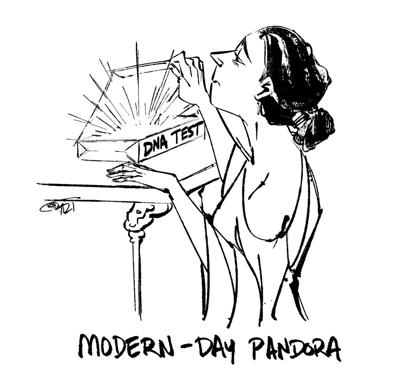
It reminds me of Pandora and her famous box.
The Greek myth describes her as “all-endowed” because of gifts bestowed by the gods. But along with her beauty, intelligence, wit and charm, she also was insatiably curious. She came to Earth with a container she was not supposed to open.
Regardless, Pandora lifted the lid, allowing all manner of evil to escape into the world.
No doubt, Pandora should have been more careful.
And while I found a personal boon through DNA matching, care is also advisable, on all sides – by the companies, by lawmakers who are trying to make some rules, and by the users themselves.
“You have to be careful,” my cousin Linda said. “The information is only as good as the people putting it in. And you can make some bad connections, too.”