
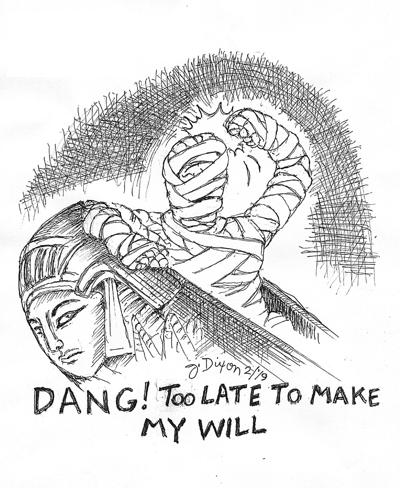
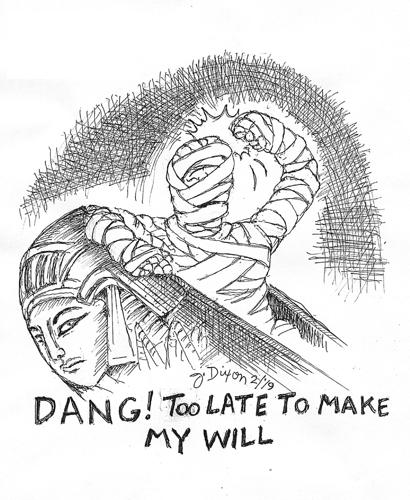
The following are words to NOT live by – or die by.
“Oh, I’ll get around to that sometime soon.”
People put off so many important things in life. Procrastination is so easy, so natural – especially when it comes to confronting our own death. If you live as if you’ll never die, you may not regret it, but your relatives will.
Yes, we all gotta go sometime. No, it’s not pleasant to think about. But as some wise soul said, “A failure to plan is a plan for failure.”
I worked for 32 years in three different outposts of the life insurance industry, which would not exist if people didn’t plan ahead and care about loved ones who will survive them. What’s the point of owning life insurance (which in reality is death insurance) if you don’t care what happens after you die?
Most people do care. But acting on it is another matter. A 2015 survey found that 64 percent of Americans don’t have a legal will.
I was shocked to hear that the late singer Aretha Franklin, the “Queen of Soul,” had died “intestate,” without a will or trust. She had a large family and tons of wealth and assets (an estimated $80 million), and relinquished total control to the state of Michigan. Her attorney, Don Wilson, said he had pleaded with her for years to put her assets in a trust; she just never got around to it.
Turns out Franklin is only the latest entry on a long list of famous people who died intestate. Many of them, strangely, are from the music world: Prince, Jimi Hendrix, Bob Marley, Kurt Cobain, Barry White, James Brown.
Artist Pablo Picasso died in 1973 with no will or trust, so his seven surviving heirs were left to battle it out in court over ownership of his 45,000 works of art, which some appraisers estimated to be worth billions. It took six years and $30 million in legal fees to sort it all out.
Civil rights icon Martin Luther King, Jr., assassinated in 1968 at age 39, left no will or trust and his children have fought over his legacy ever since.
Would you believe Abraham Lincoln, a very successful attorney before he became our 16th president, died intestate?
The worst case was Howard Hughes – film producer, pilot and businessman who made mega-millions in movies and aviation and died in 1976 with an estate worth about $2.5 billion. No will, no trust, and no surviving spouse, children or siblings.
The alleged heirs came flying out of the woodwork – more than 600 of them. The estate took 10 years to sort out among 22 cousins.
Planning your estate, even if your net assets won’t amount to much, is just plain common sense – and easier than ever. I just checked legalzoom.com and you can get a will through that website in about 15 minutes for $69.
If you prefer a conversation, Jefferson County has a number of qualified attorneys who can help you through the process. That’s the route my wife and I took.
You also can find free tools and resources through the federal government at usa.gov/legal-aid and through the Missouri Bar Association (mobar.org) and Missouri Legal Services (lsmo.org). Additional help is available for veterans, the disabled, low-income families and the elderly; you can find out more from the American Bar Association at americanbar.org.
I served as executor of two estates – my father’s (he died in 1992) and my brother David’s (died in 2014). They were in different states (Mississippi and Louisiana), so the probate process differed somewhat, but the main thing was simply to carry out the wishes of the “decedent,” which I did.
There were some modest complications, but nothing that common sense (there’s that term again), patience and fairness couldn’t handle.
A will or trust cannot guarantee peace and harmony among survivors and heirs. I’ve heard horror stories of families torn apart by fighting over assets, even with legal documents in place.
But planning ahead with appropriate tools gives your estate a good chance of being resolved fairly and efficiently.
I will also admit to some bias in the role of life insurance in estate planning. As I used to write about in marketing the products, the genius of life insurance is that the event that creates financial needs (your death) also creates the money to meet the needs. Some of the agents I used to work with liked to call it “love insurance,” because people buy it out of love for those who will live on after them.
Before you accuse me of shilling for my old profession, I recognize that life insurance can be expensive and many people only need a small policy to pay for their funeral/burial/cremation. But I have yet to meet anyone who suffered a death in the family and said, “I sure wish (the dearly departed) hadn’t bought that life insurance.”
One more dimension of this is funeral pre-arrangement. Survivors appreciate it. My brother, David, learned he had pancreatic cancer and quickly acted to set up cremation, and I will always be thankful he did.
I could write much more on this subject but you get the idea.
Ernest Hemingway wrote: “Every true story ends in death.” Yes and no. We live on in the memories of our loved ones. Remember that the next time you tell yourself, “Oh, I’ll get around to that.”