


It seems like nary a week goes by when I don’t see a social media post by one of my friends of a certain age (OK, I’ll just say it – Boomers!) lamenting the fact that “kids don’t play outside anymore.”
First off, that’s empirically false. I see children playing outside on a regular basis. All I need to do is go down to the local park to see kids playing basketball or tennis, on playground equipment and riding scooters and bikes.
If you are someone who “never sees kids outside anymore,” perhaps you live in a neighborhood that does not have many children to begin with. If the neighborhood you moved into 40 years ago as a young parent was full of other young parents, you may now live among retired empty nesters.
But it may indeed be true that children play outside less than they used to 30 to 50 years ago. But why? I believe the answer to that question, like many things in life, isn’t simple. But let’s give it a shot.
■ Concerned parents: One reason you may not be seeing kids outside is that their parents aren’t allowing them to. While children are no more likely to be abducted now than they were 50 years ago, the nationalization of news media probably has something to do with parents feeling like the danger is more prevalent than it really is.
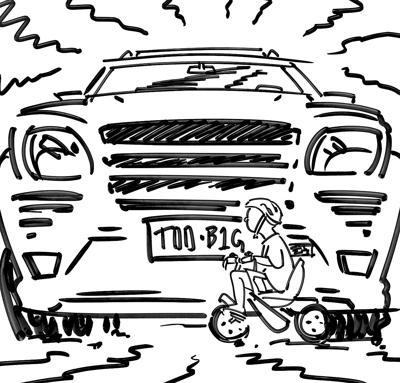
But stranger danger is not the only threat. Cars are larger than they used to be. According to the Environmental Protection Agency, the average American car today is the heaviest ever. In the 1970s, 80 percent of the car market was sedans. Today, only about 25 percent of the car market is sedans, with trucks and SUVs making up much of the rest. These vehicles are much taller than sedans, so it’s more difficult for drivers being able to see smaller things lower to the ground (such as children).
A lot of parents are scared to have their children playing on sidewalks near the roads, especially where large vehicles are driving, a lot of times distractedly. Getting hit by cars is one of the leading causes of death for children. According to Parents.com, every year 1,700 children pedestrians under the age of 16 are killed in the U.S. and 240,000 are injured.
■ It’s not fun: Many neighborhoods have no sidewalks, or the ones that exist are in such poor condition that it’s simply not enjoyable to try to skate, bike or ride a scooter on them.
I bought a pair of roller blades during the pandemic and decided to put them to the test. Alongside well-maintained streets, most of the sidewalks were uneven, broken, crumbling or grass was growing between the cracks. It was about impossible to get any speed going while trying to navigate obstacles every few feet. I used the skates exactly one time before throwing them in my garage, never to be used again. It simply was not fun.
Added to that is the fact that it’s hotter during the summer than it used to be. According to climatology and weather records going back to 1874, of the top 30 hottest summers in the last 148 years, 13 of them have occurred since 2000. It’s not that kids don’t want to be outside during the summer anymore, it’s that nobody wants to be outside during the summer anymore. It’s miserable. You certainly won’t catch me outside in the afternoon between June and September. No thank you!
■ Parents want to spend time with their kids: A common refrain from older people is “My mom kicked us out of the house in the morning and wouldn’t let us back in until the streetlights came on at night.” To me, it’s kind of disingenuous to frame being forced to play outside as a personal choice that you were making as a child.
But to that point, families used to have more children than they do now. I grew up one of five kids, and that’s a small family compared with many. Before birth control was as widely accessible, a family with six or more kids was not uncommon. Of course, moms kicked the kids outside. Who on Earth would want eight kids nipping at their heels all day long?
When I was growing up, the thought of voluntarily spending time with our parents was basically unheard of. However, times have changed. More parents now are very intentional with their kids, having far fewer of them and wanting to spend more time with the ones they do have. Sometimes kids don’t hang out with other kids because they are having family time with their parents and siblings.
■ Nobody cruises anymore: As a kid, my friends and I would spend hours after school wandering in endless loops from the local gas station to the community center, to the school, to the graveyard and back to the gas station to start the process all over again. (Essentially the kid version of “cruising.”) We did this until we bumped into other kids whom we wanted to hang out with.
But kids don’t have to do that anymore. According to Common Sense Media, 42 percent of children have a phone by age 10. By age 12, it’s 71 percent. By 14, it’s 91 percent. Youngsters don’t have to wander around for hours with their fingers crossed hoping to bump into playfellows. They can text their pals and find out exactly where they are.
■ Adults ruin everything: For the kids who do choose to go outside, often adults immediately put the kibosh on fun. Too often, adults yell at (or call the police on) kids just doing normal kid things such as running, yelling, jumping, accidentally breaking stuff and sneaking around where they probably shouldn’t be. And that’s if they’re lucky.
Too many times on the news there are reports of adults shooting children for minor missteps or misunderstandings.
Adults give too little grace to children whose brains are not fully formed. Kids make mistakes and do stupid things. That’s how they learn. Adults love to reminisce about how great things were when they were kids running free but many feel no obligation to provide the same opportunity to the next generation.
So instead of saying “kids don’t play outside anymore” as if it’s some sort of defect of today’s youth, why don’t we put the blame squarely where it belongs – with adults? We are the ones who have made outside inhospitable places for children. We’ve made it unsafe, uncomfortable and most of all, unfun.
After all, fun is kind of the point of going outside to play.