

I had pulled my 5-year-old baby blue Chevette over to the side of southbound I-55, about halfway through my 15-minute commute to work.
Something was wrong with the car’s innards, and in that time before cell phones, I wasn’t sure what to do.
Baby Peter was ensconced in his car seat. No way could I leave him there while I walked to a gas station to make a phone call, but he weighed more than 20 pounds and I didn’t relish carrying him that far.
I figured the drivers in the cars whizzing by could sense my anxiety. One of them pulled up behind me on the shoulder.
The Missouri State Highway Patrol officer walked up to check my well-being.
“Will your car start?” he asked.
It would.
“Where are you going?”
When I explained that I needed to drop off the baby at his sitter in Festus, the officer offered to follow me there, to make sure I made it safely before I called someone to check out the car.
So, that’s what we did. Suzy the Chevette complained but managed the trip. The officer waved goodbye, and I used my baby-sitter’s phone to get the help I needed.
Thankfully, I can’t remember the amount of the repair bill. But not long after, Suzy took up residence in a friend’s backyard, providing scavenger parts to keep his own Chevette on the road.
The patrolman’s good deed made an impression that has lasted all these years.
Good cop.
Fast forward two decades. Our 16-year-old daughter was at the wheel and I was in the passenger seat when a work truck wrecked our car at a stoplight.
Following my driving-instruction directions to slow and come to a stop when a yellow light was on the verge of turning red, my daughter braked.
In my passenger-side mirror, I spied the truck bearing down on us from behind and I counted to three while I prayed he would stop.
He didn’t.
Skidding the last couple of seconds, he smashed into our trunk under a solid red light.
The responding patrolman went first to the truck driver to get his account. Then, the officer told me what he’d heard: My daughter had caused the crash, speeding to get in front of the truck right before the light, and then braking hard.
Being human and a mom, I admit to some spluttering. The officer asked for my version but shushed me quickly when I started to talk, and then shushed me more forcefully when I tried again.
In a rush of anger and fear, I felt the temperature rise along with the hair on the back of my neck. I sensed there might be handcuffs in my immediate future if I persisted. Really?
I felt slammed by the officer’s prejudice. He thought he had a hysterical mother on his hands. But I wasn’t hysterical and simply wanted to be given the same courtesy as the other guy. Nope. We were done.
The report came out several days later, and my daughter was absolved. The officer had measured the truck’s skid marks and discerned that the other driver’s account was bogus.
So, he investigated. Good. But that didn’t undo his disrespect.
Bad cop.
I’ve told both stories many times, but the one that grips me hardest is the second, when I felt mistreated.
I’ve done a lot of thinking about our country’s troubled history concerning interactions between law enforcement and minorities.
We never forget when we’ve been done wrong, and we tell everyone who will listen. If enough bad stories are told enough times within a community, a core belief will result.
At their core, many Black Americans fear and distrust police.
Their personal experiences contribute to that belief, as do statistics.
Studies show that Black Americans are more likely to be pulled over by police than white Americans (by a margin of about 20 percent, per a Stanford study that analyzed data from 93 million traffic stops nationwide from 2001-2017), and that Black Americans are more than three times as likely to die in encounters with law enforcement than white Americans (per a Harvard study that analyzed data from 2013-2017).
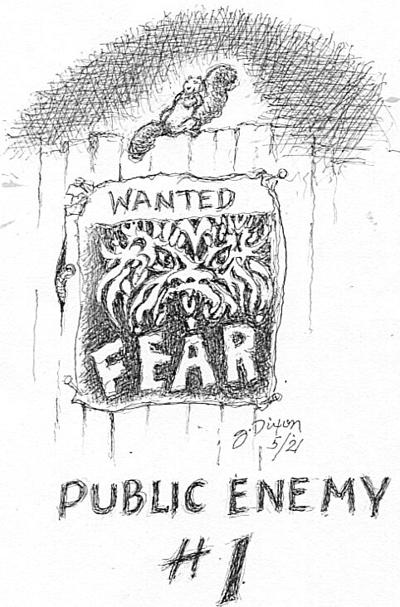
When it comes to tragic outcomes, there are many factors that should be addressed, but fear is the soft underbelly.
The narrative is becoming all too familiar. A suspect is stopped, acts out in terror, then is injured or killed when the situation escalates.
It’s not like police officers don’t have reason to be afraid themselves. According to the website maintained by the National Law Enforcement Officers Memorial Fund, 295 officers were killed in the line of duty in 2020, the most since 1974.
The possibility of death at any moment is a stark reality for police officers. They are humans and will try to survive perceived threats. We can’t expect them to do otherwise.
Borrowing from President Franklin Roosevelt in 1933, it really is fear itself we have to fear.
So, how do we remove it from both sides of this tragic equation?
Answering that question must be at the root of any proposed policing reforms.