


The 2020 Summer Olympic Games, postponed a year by COVID-19, will start in two weeks (July 23) in Tokyo, Japan.
Not a moment too soon for me.
I know some of you reading this care a lot more about the Jefferson County Fair that will take place – also after a one-year hiatus – in Hillsboro right at that same time (July 22-25). My best wishes to the county fair organizers, vendors and volunteers, but I am looking forward to the drama and spectacle that only the Olympics can provide, even in a COVID-constricted environment.
So much about the Games of the XXXII Olympiad (the official name for the event) is unprecedented, I don’t know where to begin. This will be the first postponed Olympics, although the competition has been canceled three times (1916, 1940 and 1944) by the two world wars.
Also for the first time, there will be no international spectators, only Japanese residents, attending the hundreds of competitions in 34 sports at 42 venues (26 in Tokyo and 16 elsewhere in Japan).
The specter of spreading COVID-19 in an already hard-hit country has led to tightened health protocols that will constrain the movements and interactions of athletes, officials and volunteers. This year’s event may come off as sterile and artificial, but I’m betting the “thrill of victory and the agony of defeat” (to borrow that famous line from the old “ABC Wide World of Sports” TV show) will come through in the end.
At the risk of sounding sappy, the world needs the Olympics.
The original ideal of the modern Olympic Games’ founding father, an aristocratic French historian named Baron Pierre de Coubertin, was to bring the nations of the world together every four years for sports competition that would promote international peace and goodwill.
The template was already there in the ancient Olympic Games held in Greece for a millennium (between 776 B.C. and 393 A.D.).
While Coubertin wrongly believed in the myth that the Greeks suspended their endless internal wars to hold the games, he also correctly saw the inherent value of athletic competition in bringing out the best of humanity across races and cultures. He expressed that in the famous philosophy that still underpins the Olympic movement today: “The important thing in life is not the triumph but the struggle; the essential thing is not to have conquered but to have fought well.”
Some of that same sentiment is found in the Olympic motto, created by Coubertin in 1894: “Citius, Altius, Fortius,” or, “Faster, Higher, Stronger.”
Yes, a lot of political interference and other human failings have undercut the Games for many years. President Jimmy Carter ordered a boycott by the U.S. Olympic team of the 1980 Moscow Summer Olympics after the Soviet Army invaded Afghanistan. The Soviets returned the favor four years later, keeping all the athletes from behind the Iron Curtain out of the 1984 Summer Games in Los Angeles.
The International Olympic Committee has weathered the storms: Naked commercialism, acceptance of professional athletes since 1986, political protests, biased officiating, even bribery scandals associated with the selection of host cities.
To me, the turning point in Olympic survival came in 1972.
Munich hosted the Summer Games and the German people were desperate to show the world they had overcome the black legacy of the Nazi Reich. Just eight years earlier, Tokyo had hosted the Summer Games and made the world forget, oh, so briefly, the ravages of Imperial Japan in World War II.
Aside from Mark Spitz’s seven gold medals in swimming and Frank Shorter’s victory in the marathon, the Munich Games were a memorable disaster for the United States. Track athletes favored for medals got the wrong schedules and missed their events.
One of my running heroes, Steve Prefontaine, was seeking gold in the 5,000 meters but was passed on the last lap and finished fourth, the worst spot to end up in, just out of the medals. Another American hope, world-record holder Jim Ryun, fell down in his 1,500-meter heat and never recovered.
The mighty U.S. basketball team took on the USSR for the gold medal and the officials gave the Russians three – three – chances to score a last-second winning basket. They did and to this day the U.S. players have refused to accept their silver medals.
None of this mattered, however, compared to what happened away from the competitions. The Black September terrorist group murdered two Israelis in the Olympic Village and took nine others hostage.
The hostages, five of the terrorists and a West German policeman were later killed in a failed rescue attempt at a nearby military airbase.
Jim McKay, anchoring ABC’s television’s Olympic coverage, uttered those unforgettable anguished words in delivering the news of the Israeli hostages: “They’re all gone.”
The Games went on, when it looked for a moment like they wouldn’t, and Shorter won the marathon.
But many people wondered after Munich if the Olympics were worth it. In November 1972, Denver backed out of hosting the 1976 Winter Games, still the only time a city awarded the Olympics has later rejected the honor. The IOC scrambled to line up Innsbruck, Austria, as the host, after it had hosted the winter event in 1964.
Yet it’s hard to imagine a world without the Games. No other sporting event comes close, not even soccer’s World Cup.
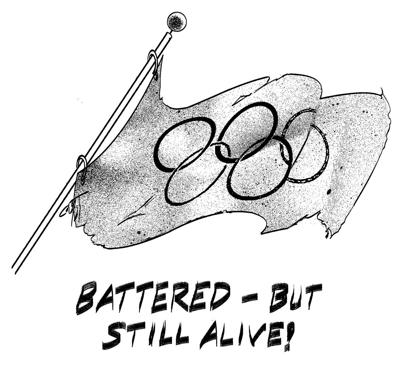
Flawed as ever, and this time fraught with COVID-19 hazards, in a country that isn’t sure it wants to do this, the Olympics are coming.
And I will be watching.