


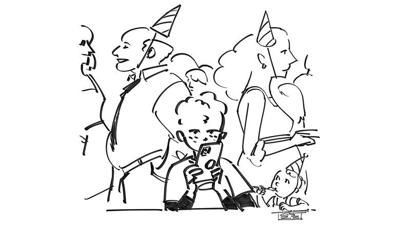

If we’re honest with ourselves, a lot of us know we spend too much time gazing at screens, whether they’re TVs, laptops or cell phones.
What’s worse is a lot of that time is wasted scrolling through social media accounts or watching silly videos.
While focusing too much time on screens is not great for adults, it’s an even bigger problem for children and teens, whose developing brains could benefit from more real-world experiences and in-person social interaction.
According to recent reports, scores on the American College Test entrance exam for students in the class of 2023 fell to their lowest level since 1991.
The class of 2023 were freshmen in 2020 when the COVID-19 pandemic struck the U.S. and many schools had students stay home and learn remotely. As a result, many educators and other child experts lay at least part of the blame for the recent decline in test scores on that lost classroom time.
We all know school shutdowns weren’t ideal for students, but ACT scores have been dropping each year for the past six years, so other factors seem to be at play.
Some education experts point out that part of the decline in ACT scores can be attributed to the change in the kinds of students who take the exam. In the past, only students who were certain they’d be heading to college took the test, but now many schools encourage most, if not all, their students to take it. How hard are students working to prepare for and answer questions on the test if they know the scores don’t matter because they’re not going to college?
So maybe ACT scores are not the best way to measure student achievement, but other tests and studies also indicate American students might not be as prepared to enter adulthood as they were in the past.
For example, reading and math scores for 13-year-old American students have declined since the pre-COVID years, and that decline is even more sharp when compared with scores from 10 years ago, according to recent data from the National Assessment of Educational Progress long-term assessment.
In addition, history and civic scores are down among U.S. eighth-graders, the NAEP’s assessment report says.
It’s hard to pinpoint any one reason for our youth’s apparent learning deficits, but might I suggest their obsession with cell phones and social media plays a role?
Those of us who spend time around young people know how hard it can be to separate them from their phones. They spend hour upon hour scrolling through Instagram, TikTok, Snapchat and other social media, as well as watching videos on YouTube.
If children are spending up to nine hours a day in front of screens, as some reports suggest, is it any wonder they have little time to complete homework, write a paper or study for an exam?
There’s another big problem with young people spending too much time on social media. It’s rife with misinformation. Students are better served by reading books, magazines and newspapers, even on their screens.
Getting news from social media posts and sketchy websites isn’t the same as seeking out information from credible sources, which helps develop critical thinking skills.
Even when youngsters aren’t wasting away their hours on social media, they often are on their phones texting with friends.
Texting is probably more productive than scanning social media, but communicating through texts is not the same as talking with friends or family on the phone or, even better, in person. With texts, you miss the tone, the facial expressions, the body language and other nuances necessary to get a real appreciation for what the other person is trying to get across.
Student academic achievement isn’t the only thing that’s been suffering in recent years. The news also is filled with reports about today’s youth suffering from more mental health issues.
Is it possible that devoting too much time to social media and not enough to real-world experiences plays a role in those problems, too?
Numerous mental health experts say too much screen time can disrupt children’s homework, sleep, physical activities and interactions with others. Those experts also say too much focus on social media can contribute to children developing low self-esteem, anxiety and depression.
Like most things, moderation is key.
Texting is a useful tool, but it shouldn’t be a person’s only, or even primary, mode of communication.
Social media, too, offers many benefits, affording people an easy way to find others with whom they share common interests. I know Facebook helps me keep in touch with my old friends and out-of-state relatives better than I ever did before.
Children or teens with illnesses or disabilities can find social media a particularly important way to interact with others.
However, parents would be wise to limit their children’s screen time and keep an eye on their social media use, which can expose them to cyberbullying and other dangers, including the often-false notion that the people they follow on social media have better, happier lives.
The following are a few recommendations mental health experts have offered parents to encourage their children and teens to use cell phones and social media in a healthy way:
■ Find a bedtime routine for children and teens that doesn’t include screens, keeping cellphones, tablets and other devices out of their bedrooms.
■ Let children and teens know you’ll regularly check their social media accounts.
■ Warn them about what’s safe to share online and talk to them about how their social media use makes them feel.
■ Discourage children and teens from bullying others and gossiping about them.
■ Encourage them to seek out other interests and spend time with friends in person.
■ Seek medical help if children or teens experience signs of anxiety, depression or other mental health issues.