
As a fledgling journalist way back in the day, I didn’t plan on changing my surname – or my byline – because I didn’t plan on getting married.
Rather suddenly, when I was a college senior in Mizzou’s School of Journalism, it seemed I was going to get married, after all, and I had a decision to make.
What about my last name? What about my byline?
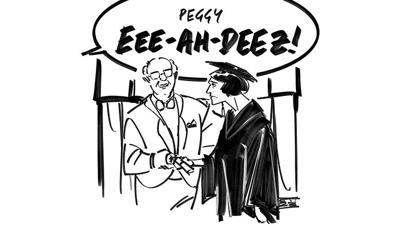
I made up my mind when I crossed the outdoor stage to collect my diploma at graduation, only to hear my last name mangled for the zillionth time. Peggy Eades, correctly pronounced “Eeeedz,” was changed by the emcee to “Eee-ahh-deez,” despite the pronunciation card I had turned in.
Eades would be my yesterday, Bess my tomorrow. Just 10 weeks later, on July 30, 1977, the change became official.
Two other factors helped me across the finish line, because even back then, keeping your surname at marriage was a statement for those who wanted to be seen as independent women – as in, me.
But “Eades” was itself a statement, and one I didn’t like. Originally spelled “Eads” and tied to James Buchanan Eads, designer of the Eads bridge in St. Louis, family lore claimed the extra “e” was added to allow Confederate-aligned ancestors to divorce themselves from that “damn Yankee.”
This was not a legacy I admired.
Also, correct punctuation turned my last name to Eadeses’ to reflect the plural possessive. Hard to say, hard to spell, but sometimes necessary in correspondence. Yuck.
With gratitude, I became Peggy Bess, with only a few twinges of regret when a significant handful of the thousands of people I’ve interviewed over the years believed my last name was my first:
“Yes, Bess, I’m sure you see my point.”
I never corrected them, just as I accepted “Eee-ahh-deez” when I had to. But I felt I had traded up (apologies to cherished relatives who are still Eadeses) and when children came along, I was glad everybody in my household had the same last name.
Case closed. Except, not really.
People were talking a lot about marriage surnames back in 1977, when hyphenated last names were coming into fashion, and they’re still yakking about the subject today. Witness two recent letters to the editor here at the Leader, with one local woman advising others of her sex to keep their birth certificate names and a local man urging just the opposite, using the Bible to make his point.
Ugh. Decisions on your own last name belong to you, not to the world at large.
One of the first court actions I wrote about under my new Bess byline concerned a recently married couple who needed legal permission to create a new last name, made up of letters from each of their surnames.
Statistics gathered in a recent survey by the Pew Research Center would place that decision in the extreme minority.
The survey asked women who were married to men about their surnames and found that 79 percent had changed their last name to their husband’s. Some 14 percent kept their maiden names and 5 percent went with a hyphenated last name.
A September story in Forbes online dug deeply into the survey results and reported that a sea change is potentially on the way. Younger women are already less likely to change their names, and when single women were asked their plans, only a third of them leaned in the direction of taking their future husband’s surname.
My family offers some food for thought. There’s my decision, and those of my daughter, daughters-in-law and brand-new sister-in-law. (The wedding ceremony was held in starkly beautiful Alamogordo, N.M., last weekend).
My married daughter, Joanna, changed her name, but now wishes she hadn’t. One of my daughters-in-law signed onto Bess, but the other kept her maiden name.
From Joanna (no longer a Bess):
“I wish I had put more thought into it. I only considered how having the same last name as my husband would simplify things for our family after having kids, but I should have considered my underlying complicated feelings. I loved my original last name, and I like how it connected me to my family and ancestry. Also, now that I have two daughters, I wish I had this one obvious example of female independence to show them.”
From Sara (the daughter-in-law who’s not gonna be a Bess):
“I’d summarize my feelings to be that my name was just so core to my identity that I couldn’t part with it or change it and it was an incredible act of love and respect that my partner understood that and accepted my feelings without guilting me or pushing back.
“I respect and understand that others may not feel so connected to their original name or may believe that all members of a family should have the same last name. But that’s not how I feel, and I’ve always felt this is a very personal matter.”
From Barbara (the new sister-in-law who might someday be a Bess):
“I’m keeping my name from a previous marriage because it is my daughter’s name and I want her to feel that we are still connected. If she should ever change her last name, I might change my name, too, to Bess.”
We women all have our own reasons for choosing what the world should call us.
Thank you very much to the peanut gallery, but we deserve to make up our own minds on that matter, notwithstanding emphatic letters to the editor.