
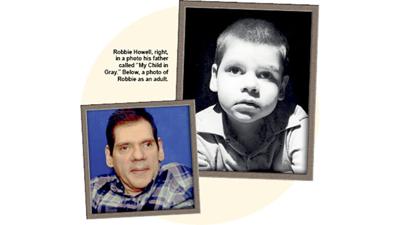
When Robert Joel Howell left this life on April 19, dying of pneumonia at the age of 59 years and 25 days, some might have privately wondered whether he ever really lived at all.
After all, he never spoke a word, never took a step, couldn’t feed himself or use a bathroom. He never even had the ability to change the channel on a TV.
But those who were closest to Robbie know the world was better because he was in it, and they grieve his loss.
“He loved and he was loved,” said his mother, Nancy Howell of De Soto.
“He taught a lot of patience and humility and acceptance,” said Ted Howell, Robbie’s dad and Nancy’s husband.
“He gave joy,” said his nurse, Lisa Adams of Pony Bird, the facility where Robbie lived for the last 25 years, first at a residential home for the profoundly disabled in Mapaville and then in De Soto, closer to his parents.
Robbie was born March 23, 1964, in a U.S. Navy hospital in San Diego (Ted was in the service). The birth had been “difficult” and when Robbie failed to hit developmental milestones, the medical community cited brain damage.
“He was responsive in many ways,” Nancy recalls. “He could smile and laugh, but he also cried a lot and had a failure to develop.”
There were numerous meetings with doctors over the years, searching for treatments to give Robbie a better quality of life, but nothing helpful or even hopeful came of them, Nancy said.
“Every time you’d go to the doctor, you would come away just smashed. You hold out hope for that individual. You want to believe that there is something you can do. You never want to face the reality.”
The Howells couldn’t make Robbie better, but they could love him like he was – so that’s what they did.
For 34 years, Nancy, Ted and their firstborn son, four years older than Robbie, nurtured Robbie at home, with Nancy providing most of the hands-on care while Ted worked at McDonnell Douglas in electrical maintenance, driving an hour-and-a-half to and from his job.
Family, friends and fellow church members “pitched in,” Nancy said, since Robbie required 24/7 supervision and care.
She walks a fine line in explaining how cherished Robbie always was while still acknowledging how difficult it was to meet his needs as he aged into adulthood. Not only was it physically challenging, she worried about keeping him engaged with life.
“Ted and I did our best, but for Robbie, it must have been boring,” Nancy said.
Enter Pony Bird.
In 1998, a spot opened up there, just eight weeks after the Howells made the decision to ask for one.
Nancy remembers it as a wrenching time.
“I cried all the way home,” she said. “Ted felt it, too, of course, but he had to prop me up.”
She remembers waking up in the middle of the night, panic-stricken about the need to check on Robbie and once being in a grocery store, imagining she had left Robbie home alone.
“It was all I could do to keep from running to the car,” Nancy says.
But she and Ted knew they had made the right decision.
At Pony Bird, Robbie had medical care, opportunities to experience life more fully, and a community.
Ted and Nancy visited every Sunday after church and dropped in at other times.
At first, Robbie lost weight in his new environment, but gradually adjusted. In time, a poignant change took place.
“Ted and I began to notice that he didn’t seem to take note of who we were,” Nancy says. “He was willing to spend time with us and let us love him.
“But I could see that the staff at Pony Bird had become his family and we were the nice visitors. It was hard for a while, but you want him to be safe, secure and content.
“Pony Bird was a haven for Robbie, and we’re so grateful.”
Robbie’s nurse, Lisa, ironically also born in 1964, said Robbie oozed personality and she felt privileged to care for him.
“He loved to hold things in his hands and make noises (notably a rubber chicken and a tambourine) – he was a one-man band. He made us laugh. He was very social and very loved, and he lived a fulfilled life.”
Nancy said she was asked once if she would have had an abortion had she known the trials Robbie would face.
“Absolutely not,” she declares. “Life is a precious gift, no matter the infirmity. Every life has a purpose, a plan and a reason.”
Nancy imagines Robbie in heaven, free from his damaged body, but not doing jumping jacks or changing TV channels.
“I see him in my mind’s eye as more of a spirit – we will all be changed. I don’t see him doing earthly things in heaven.
“I was so torn to lose him, but he is a spirit in the presence of God, and how wonderful that must be and how good that must be for him.”
Ted is an artistic soul. As Leader readers know, he is a gifted photographer whose work has appeared in our pages hundreds of times. He also paints and felt moved to write a poem about Robbie, then about 6 years old, after a doctor likened his son’s brain to a piece of “gray dead driftwood.”
There was always more to see, Ted believes, if only you looked closely. Here’s an excerpt from “Child in Gray:”
“Within his dark eyes,
A spark do I see,
A glimmer through gray fog,
A smile just for me.
He knows my voice,
But not his own name,
Yet, trusting is he,
No sorrow, no shame.
For who could withhold,
Any love for one day,
My son, my son,
My child in gray.”