
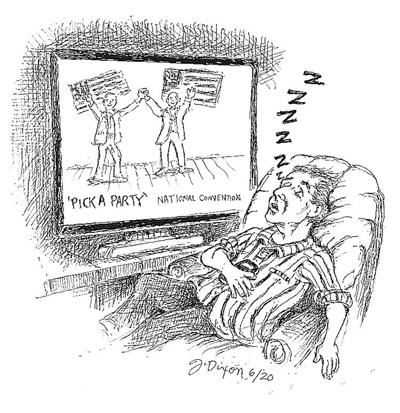

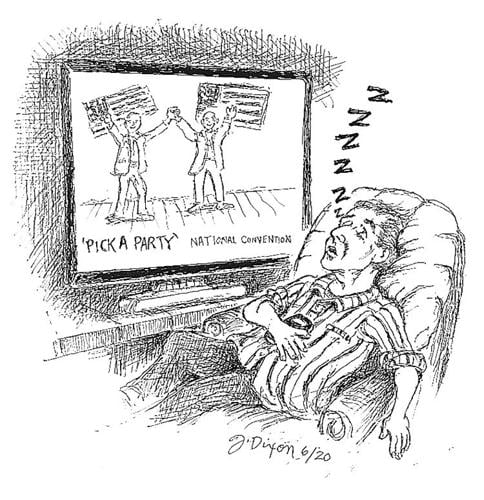
No matter the state of our politics, I have always looked forward to presidential election years, knowing that we will witness history in the making. That’s why I have a problem with the two major parties’ conventions.
They’re too conventional.
The Democrats plan to meet in Milwaukee Aug. 17-20, a month later than originally planned because of the coronavirus pandemic. The Republicans will convene, a week after the Democrats, in both Charlotte, N.C., and Jacksonville, Fla. President Trump yanked part of the GOP convention away from Charlotte when the Tarheel State would not guarantee to permit a “normal” packed-house gathering.
Not that it matters much to the rest of us, because both conventions will be nothing more than elongated coronation ceremonies, filled with enough hot air to float both arenas off the ground. The selection of both candidates was a foregone conclusion back before the virus outbreak.
It wasn’t always like this.
The essence of politics is the struggle between competing ideals, priorities and perspectives, offered by leaders with different personalities, skills and character qualities. For most of American history, in the realm of presidential politics, all those elements came to a head at the party conventions. Sparks flew, tempers flared and party bosses wrestled furiously over multiple candidates.
The conventions would rivet the nation’s attention, crowding everything else off the front pages of newspapers from coast to coast.
In the 20th century, first radio and then television would bring the political pugilism into America’s living rooms. The great media anchormen, like Walter Cronkite, Howard K. Smith and the Chet Huntley-David Brinkley duo relished covering the unfolding drama.
The era reached its peak in 1968, when the infighting at the Democratic convention in Chicago spilled out violently into the streets, police bashing heads with billy clubs live on national TV. At the time, I lived in the northern suburbs of Chicago and could not believe that what I saw was happening not many miles away. (Like the feeling we all had in 2014 with the riots in Ferguson.)
Unpredictable, tumultuous party conventions are distant memories now. The marathon primary process, with all its flaws, makes the conventions an afterthought.
The last time the Democrats took a nomination fight all the way to the national convention was in 1980, when Sen. Ted Kennedy mounted a full-scale floor battle against incumbent President Jimmy Carter. For the Republicans, it was four years before that, when Ronald Reagan tried to pull a similar end run on incumbent Gerald Ford, who went on to lose to Carter.
Today’s primary elections and caucuses virtually eliminate any chance of a “dark horse” candidate rising to the occasion. But when that used to happen long ago, at times it changed the course of American history.
In 1860, the new Republican Party met in Chicago, primed to nominate New York Sen. William H. Seward. He was by far the best-known and most-liked candidate. But after two ballots, Seward could not secure a majority. Among the other three viable candidates, one shrewdly positioned himself as the “best second choice” for delegates who were on the fence about Seward.
He was a folksy backwoods lawyer and two-time failed Senate candidate from Illinois named Abraham Lincoln.
Twenty years later, the Republicans again met in Chicago (what is it with Chicago and party conventions?) to consider three major candidates, including the front-runner, former President Ulysses S. Grant. None could muster a majority and the convention agonized through 36 ballots before finding a consensus candidate totally out of left field. He was Ohio Congressman James A. Garfield, who had no interest in the nomination and in fact did everything he could to resist it.
“I am very sorry that this has become necessary,” Garfield said when he realized that like it or not, he was the nominee.
Earlier in the convention, Garfield had given a nomination speech for another candidate, in which he eloquently appealed to the better, more thoughtful instincts of a bitterly divided party. At the end of his address, Garfield asked, “And now, gentlemen of the convention, what do we want?”
A voice from far away on the floor cried out, “We want Garfield!”
Thus began the tide that lifted Garfield, our 20th president and still the only active congressman ever to win the White House. He was assassinated after only six months in office and historians have wondered ever since how good a president he might have been.
There’s no drama like political drama, which I can illustrate with one more convention story. One of my favorite movies is “The Best Man” (1964), based on a stage play by Gore Vidal. Henry Fonda plays front-running candidate William Russell, dueling for the nomination with Joe Cantwell, a rising, hot-headed senator played by Cliff Robertson.
Cantwell launches a smear campaign against Russell and leapfrogs him as the favorite. Russell, realizing Cantwell is a dangerous demagogue, gives up his own aspirations and throws his support behind a lesser-known but competent candidate who breaks the deadlock to the great delight of the party.
It’s a story, albeit via Hollywood, of political courage – something we rarely see anymore, at conventions or anywhere else.
The lost glory of party conventions is just one of the many ways we find our current politics so disappointing. Until and unless things get better, we’ll have to keep reminding ourselves of Winston Churchill’s famous observation: “Democracy is the worst form of government – except for all the others.”