
If more people had been there back then, maybe fewer would be fearful of vaccinations in 2023.
So says Lola Nosker, my friend and fellow women’s barbershop singer.
Her reference point is 1951, four years before our country licensed and started distributing a vaccine to protect against polio.
Parents of the time were panicked and desperate about a disease that spread mysteriously and mostly, although not entirely, struck the young.
“People of today haven’t seen that,” Lola said. “They don’t understand how terrified parents were.”
Her own life changed forever on Sept. 20, 1951, when she was 14.
“We were outdoors in gym class, learning how to play soccer,” Lola recalls. “There was still dew on the grass, and I slipped and fell, landing on my tailbone.
“The next morning, I was aching all over and sore, and I thought it was because of what had happened in gym.”
But as her muscles stiffened, Lola’s parents feared something worse. Her father took her from their hometown of Mundelein, Ill., to nearby Waukegan for a spinal tap.
Diagnosis: polio.
“I got up to walk to a water fountain, and I fell into the fountain. It was the last time I walked,” Lola said.
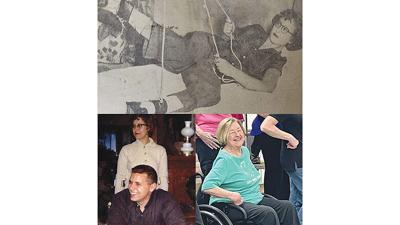
She ran a low-grade fever for 10 days and was diagnosed with paralysis of both legs. Next came 10 and a half months at a rehabilitation hospital in Highwood, Ill., where she tried to regain some movement in her legs and learned to use braces and crutches.
It was a torturous time.
“They would use hot wool blankets – so hot, they couldn’t stand to hold them – and wrap them around your legs,” she said.
“Physical therapists would come in and gradually stretch your body so that you could finally sit up. They would hand me a pillow to scream into.”
Because of fear of contagion, care was provided by volunteers and parents were discouraged from visiting.
Lola was tutored in three subjects at the hospital, but she was behind her peers when she returned to high school, using long leg braces and crutches to get around.
“It was a lonely time for me,” she acknowledged.
And although she built a full and rewarding life in the decades ahead (more on that later) who could avoid thinking, if only – if only – a vaccination had come earlier?
And so, Lola is a believer in vaccines, such a staunch supporter that she volunteered to be part of the Pfizer trial in the company’s development of its COVID-19 vaccination, and now is participating in a trial aimed at developing a more effective influenza vaccine.
“I support vaccination,” she said. “It was a different world (in her youth.) I can’t imagine going back to that. I can’t imagine not wanting to get a vaccination.”
Lawmakers can imagine it.
For a second year, Missouri State Rep. Bill Hardwick (R-Waynesville) is trying to gain approval of a bill that critics call anti-vaccination and claim would hinder the public health community’s ability to fight future pandemics.
The bill would restrict government agencies, schools and businesses from enforcing COVID-19 vaccine mandates, while also disallowing human microchipping for vaccine delivery under the skin.
Hardwick got some ribbing in the press about those nonexistent microchips.
Since we live in the Show-Me State, I wanted to ask Hardwick if he knew of any actual cases of evil chippery, but as I write (2:34 p.m. April 23) he hasn’t called me back.
For the record, my dance card is loaded with COVID-19 shots and I haven’t found any weird new protrusions – just the ones I was born with.
If you think Hardwick has a point, note that delivery of an under-skin injectable chip would require a needle with a point 13 times bigger than what we’re used to. No thanks.
Hardwick’s 2022 bill passed in the House but died in the Senate. His 2023 version needed a final affirmative vote in the House and passage in the Senate before a May 12 deadline, so it looks like a bad bet to clear the hurdles.
Fingers crossed for a big splat, but he’s gotten closer to approval than I’d like.
COVID-19 and its complications have killed close to 25,000 Missourians, so far, and we aren’t done yet with this scourge.
We have no idea what future dangers await or what future solutions we’ll need to save us. No one should be working to pass laws to tie our hands.
Fully vaccinated Lola is now confined to a wheelchair, after a serious automobile accident 20 years ago and the onset of post-polio syndrome. However, she likes to dwell on the positive.
She notes that the March of Dimes paid all the expenses of her care as an adolescent and that legislation to help disabled World War II veterans paved her way to attend the first accessible college in the country, the University of Illinois at Urbana-Champaign. There, she found a world of opportunities and met and married her husband, fellow polio survivor Dean Nosker.
In their 43 years together before Dean died in 2001, the couple had two daughters and enjoyed rewarding careers (he as a commodities analyst and she in workforce development).
He pursued his talent for athletics – “He’s in the (National Wheelchair Basketball) hall of fame,” Lola said – and she developed her musical skills.
The Noskers showed how much a can-do spirit can help in this world.
But Lola believes there’s something just as vital the world can’t do without.
Vaccines.