


One and done.
At least, we hope; your cooperation required.
Faithful readers of the Leader’s letter page might recall a late-March letter from Festus resident Courtney Wisely. It ran in all editions of the paper, and thus could have been seen in 75,000 households.
Courtney was responding to a question I had posed in an earlier column: Should politicians of advanced age be intellectually tested for their fitness to serve?
In a well-reasoned and well-written letter, Courtney said yes, with a shocker at the end. She’d used Artificial Intelligence to write the bulk of her letter because she was worried that old dogs might not be able to grasp such new technological tricks. And to serve us competently, they would need to.
Courtney’s point was valid and thought-provoking. Hence, her letter made the cut.
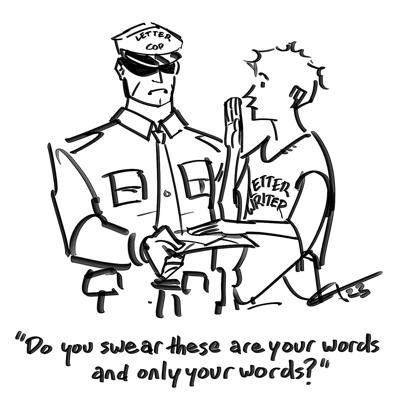
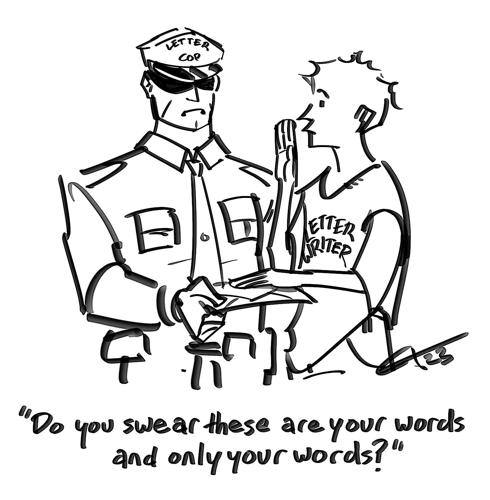
Ever since, though, the Leader’s Letter Cop (not listed on the staff box, but always on duty) has had some provoking thoughts.
Conclusion: We’d like Courtney’s to be the first and last AI-generated letter used on our Opinions Page.
From Day One at Leader World Headquarters, the Letter Cop has tried valiantly to enforce a policy that all published letters to the editor be written by real people, with real names, using their own real words.
It’s been challenging, and although we’ve done our best, I’m sure we haven’t been totally successful.
Former editor Patrick Martin was the first to wear the badge, and he sniffed out a problem letter almost immediately in the Leader’s infancy.
It came from a plainspoken individual who was using fancier wording than would have been expected.
Pat called him: “Did you write this letter?”
He had not, the man said. Someone else who wanted to hide her identity had written the letter and asked him to sign it. Was there a problem?
You bet.
Various ploys were discovered over the years:
■ Form letters composed by political action groups but signed by local residents. Rejected.
■ Letters submitted under false names. Rejected. Sometimes, writers used completely fabricated names. Sometimes, they’d use their initials instead of the first and middle names they went by in real life. Sometimes, they’d use old family names, like Great-grandpa’s or Mama’s maiden name, or their own maiden name, which they’d discarded after marriage.
■ Straight-up plagiarism, where writers would try to pass off another’s written words as their own.
During my stint as Letter Cop, I recall the day I nixed six letters in separate envelopes that came in on yellow legal pad paper, all in the same handwriting and all making the same pro-union points, signed by six supposedly different people.
I was able to track down the writer and she confessed, although she didn’t seem to feel bad about it.
Just last week our crop of new letters included one that parroted another writer’s tweet (rejected for plagiarism) and another that used a name meant to obscure identity (allowed, after the writer agreed to sign her real-life moniker).
Letters generated by Artificial Intelligence fly in the face of the Leader’s philosophy.
“After all, they’re signing their name to something they didn’t write,” said Steve Taylor, current head Letter Cop.
Courtney explained how it works: You sign in to a service, which can cost nothing or up to $200 a month if you want the Cadillac version; you submit a prompt specifying your subject, your point of view, your word count, your style, etc.; you get back a well-written response in seconds.
Courtney, 36, said she loves to write and used AI for her letter only to make the point that technology is growing more sophisticated by the nanosecond.
Although some fret about computers eventually taking over the world, Courtney said she is not frightened by technology, a good thing since she is a technology trainer in her line of work.
“When calculators were invented, people viewed their use as cheating,” she noted. “It’s a new age we’re entering now, where new tools exist and they are at our fingertips. It’s out there, and you can’t stop it.”
Courtney sees the need for well-thought-out human regulation to avoid undesirable consequences, but she believes we’re up to the task, asking ourselves this question:
“Are we playing God, or are we using the tools God gave us?”
AI-assisted communication doesn’t eliminate the human, Courtney pointed out.
“You have to create a good prompt to get a good response, and you have to edit that response. This just cuts out the middle part, and maybe better gets across the point you’re trying to communicate.”
It’s the middle part we treasure here at the Leader, the part where letter writers say what they think, in their own words.
It could well be that we’re sticking our thumb into a dike that has no prayer of holding back the coming flood.
It could well be that we’ll never be able to catch a submitter who prompted her AI enabler to write a letter in the style of a 40-something small-town resident in the Midwest who hates humpback whales.
Even Pat Martin’s sniffer may not be up to the test.
And so, we’ll ask your cooperation in keeping our Opinions Page a humans-only space.
Each of you is plenty smart enough for the likes of us, without artificial assistance.
But we don’t mind if you use spell-check.