


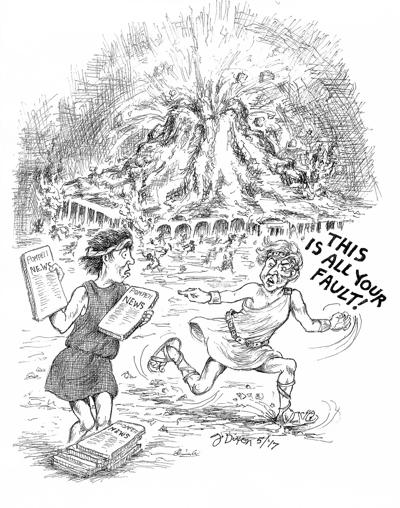

In these times when no one is responsible for anything because, well, anything that goes wrong is someone else’s fault, we should not be surprised when an individual or a particular industry gets anointed as the Cause of All Our Problems.
I stand before you today ready to accept the charge. In politics today, pretty much everything negative is blamed on the liberal, lying, dishonest, corrupt (feel free to insert your own adjective) mainstream media.
(Disclaimer: Community newspapers are about as much a part of the mainstream media as the local Little League is part of the National League, but let’s play along, just for fun.)
We expect that sort of finger-pointing behavior from politicians, who are not famous for owning up to doing anything wrong, but it is worrisome when the attitude starts spreading to other arenas.
Troubling, but it’s still kind of funny.
There was a doozy of an example last week when the reclusive chief executive officer of Sears Holdings made a rare public appearance to launch a 90-minute diatribe explaining why Sears isn’t doing so hot.
It’s the media’s fault. Really.
Hedge fund owner Edward Lampert, the company’s largest shareholder, which probably explained why he is the CEO, addressed shareholders of Sears Holdings at the company’s annual meeting in Chicago.
Sears had warned shareholders in March that, despite closing stores and other attempts to streamline the company, ongoing losses were so severe that it might not be able to continue as a going concern.
Lampert started with a slideshow of negative headlines from as far back as 2008 that detailed the problems of what once was the largest retailer in the United States.
He termed the coverage “irresponsible” and said that it “unfairly singled out” Sears.
He compared the company’s unprofitability to the early days of Amazon, ironically, considering that Amazon is not quite 124 years old like Sears, and that it is probably the main disrupter of the old-school department store business.
Why don’t they write about our turnaround, Lampert demanded to know?
A Reuters news service reporter was one of five press members in attendance, but they were not allowed to ask questions about the turnaround or anything else.
Nowhere in the Reuters report of the meeting did it state that Lampert challenged the accuracy of the headlines he showed.
Instead, he took blaming to a new level.
He said the coverage was “meant to scare our vendors,” which emboldened them to seek better terms with Sears, further eroding the company’s position.
Sears has not been profitable for six years. Apparently, headlines that point this out are part of the conspiracy. Perhaps Lampert would have approved of these headlines:
“Sears Trying Really Hard.”
“Everything is Fine with Sears – Really!”
“Sears Hanging In There In Face of Media Attacks.”
One of the dumber aspects of Lampert’s theory is that the media somehow want Sears to go down, like some sicko who enjoys watching plane crashes.
The reality is that the media exist – even though the relationship is sometimes pretty stormy – because of companies like Sears that advertise with them. Free television and free radio have no other revenue sources. Free newspapers (like this one) are in the same boat. Paid newspapers also are hugely dependent on advertising – subscription revenue is a fraction of what advertising brings in.
So why in the name of James Cash Penney would any of them voluntarily participate in a conspiracy to undermine one of their best and longest-standing customers?
It makes no sense.
Sears is an American institution, going back to its 19th century catalog roots. No one on this side of the fence wants to see it fail.
But if you are a business reporter with Reuters or anyone else, the state of the company has to be reported. The first responsibility is to be accurate with investors, be they readers, viewers or listeners.
Maybe Sears is in the shape it’s in because of – dare we say it? – uninspired corporate leadership and lack of vision during a time of upheaval in the retail business. Bad strategy, perhaps, or misreading how the public wants to shop?
It’s either one of those reasons, or a combination – or those darned headlines.
This is not new, of course. Killing the messenger is a time-honored tradition going back to Sophocles, who penned (if there were pens then) the play “Antigone” in 441 B.C.
“No one loves the messenger who brings bad news,” wrote the ancient Greek.
Ain’t that the truth.