
Welcome to an ongoing, if
irregular, episode of “Language Police,” the fun game anyone can play but hardly anyone can understand.
We’re playing a round today as a public service, in the wake of seven Jefferson County cities and county government putting a tax question on the Aug. 2. ballot.
Most questions are easily understood.
“Did you do your homework?”
“Would you like me to pick up the mail?”
“Does this outfit make me look fat?”
That last one can be treacherous, of course, but you get the point. Most normal people know how to ask a simple, understandable question that should get an understandable answer.
The key qualifier there is “normal people.”
Our esteemed legislators, and especially the pointy-headed staffers and bureaucrats who work for them (or is it the other way around?), sometimes might have a little trouble making the cut on normal.
The tax that will be voted on countywide and in Arnold, Crystal City,
De Soto, Festus, Herculaneum, Hillsboro and Pevely (yes, residents in those cities will vote twice) is one that people have paid for almost 70 years, a sales tax on new boats, motors, trailers and vehicles. But in 2012, the Missouri Supreme Court ruled it was unconstitutional to collect the tax on vehicles purchased in another state unless local voters had approved it as a “use tax.”
For a few months after the ruling, Illinois car and boat dealers advertised like mad that they could save Missourians thousands of dollars because they wouldn’t have to pay sales tax. Left untouched, this would have proved deadly to Missouri dealers located close to a border.
Not only was this unfair to Missouri dealers, it would have poked significant holes in the budgets of local government. Under current estimates, Jefferson County government stands to lose $1.3 million or more per year.
The Missouri Legislature passed a fix in 2013 that allowed local cities and counties to continue to collect the tax, but gave them a 2016 deadline (recently extended to 2018) to secure local voter approval or the tax would go away.
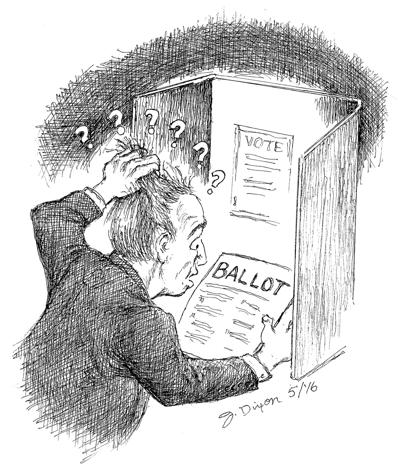
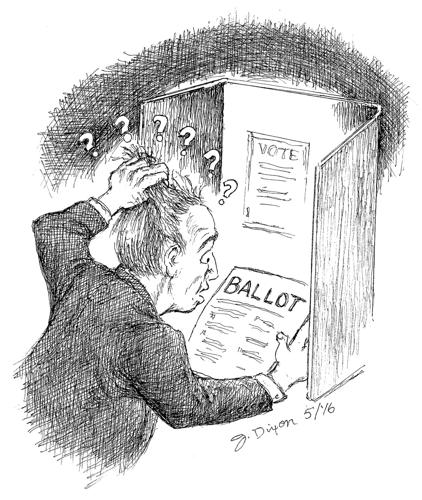
That was complicated enough, but most people probably could understand the issue – until they saw the language on the first city ballots to put it before voters. Here’s what it said when Byrnes Mill put it in front of voters April 5:
“Shall the City of Byrnes Mill discontinue applying and collecting the local sales on titling of motor vehicle, trailers, boats and outboard motors that were purchased from a source other than a licensed Missouri dealer? Approval of this measure will result in a reduction of local revenue to provide vital services for the City of Byrnes Mill and it will place Missouri dealers of motor vehicles, outboard motors, boats and trailers at a competitive disadvantage to non-Missouri dealers of motor vehicles, outboard motors, boats and trailers.”
It was a classic example of a question where the answer No meant Yes.
The Missouri Municipal League, which knows a thing or two about lobbying for its member cities, claimed it was not trying to hoodwink voters with the way it submitted its sample ballot language to its members. The language was taken directly from state statute, the league said.
People who may have only seen the word “tax” and voted No were actually against discontinuing it.
This caused something of an outcry in parts of the state. The measure passed in Byrnes Mill and Kimmswick – which is to say it failed. The tax will stay. Byrnes Mill Mayor Susan Gibson wondered on election night if voters were confused. You think?
Jefferson County Executive Ken Waller said the county/city coalition will change the language for August, with Yes meaning Yes. It’s a matter of principle, he said. However, Arnold city attorney Bob Sweeney said last week there is a small chance the revision could create a legal case for challenging the election, since the statute has different wording. With the extension, the Legislature changed the statute to have more understandable wording, but that won’t take effect until Aug. 28, after Jefferson Countians go to the polls.
At Leader World Headquarters, we sometimes assume the role of Language Police when attempting to edit some of the news items that get submitted to us. People have colorful and creative interpretations of spelling and the rules of grammar. While we appreciate their individuality, we are just conformist enough to want to spell a word the same way every time we print it.
As unusual as some of those approaches can be, hardly ever do we get confused by the Yes-No part.
It’s hard to even conjure up what such a thing might look like. But I’ll try.
“The Cedar Hill Lions will not not hold a chicken dinner next Tuesday. Which is to say we will. If you don’t want to not reserve a table, call us.”
Who in his right mind would write that? It would take an editor in his write mind to right it.
Yet somehow, unsuspecting voters were supposed to untangle something similarly silly when deciding whether to tax themselves.
We at the Language Police will monitor the latest developments and report the August ballot language – the alleged Yes means Yes language – when it is finalized.
We are happy to do so and will hold the ballot language grinches’ feet to a campfire of burning dictionaries if they don’t get it right this time.
Yes, we will – if no they won’t.