


Move.
I said MOVE.
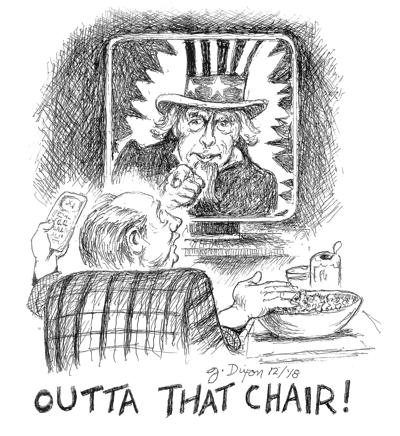
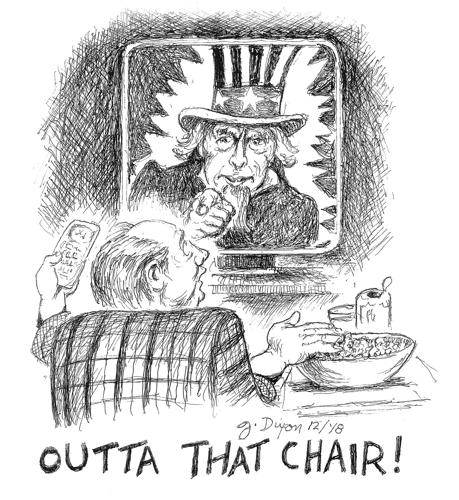
That strident voice you hear is your federal government telling you what you must do for better health and a longer life. And Uncle Sam has every right to wag his finger in your face.
A few weeks ago in this space I wrote about our national health care debacle and noted that “the status quo is killing us.”
The Affordable Care Act (“Obamacare”) is dying the death of a thousand cuts and nobody has come forward with a rational replacement.
There’s a rising tide on the political left in favor of universal single-payer coverage, which sounds so good until somebody asks how we’re going to pay for it. Answer: We can’t. Heck, we can’t afford what we have now, between Medicare and Medicaid.
We have to face facts. And the biggest is this: we should be sick and tired of being sick and tired. Of all the major wealthy countries, we are paying the most and getting the least in our health care because we live unhealthy lifestyles.
So it’s time to change, time for a national New Year’s Health Resolution, and it’s ridiculously simple.
Get off your couch or out of your chair and move.
Forget the new (or old) fad diets, the weight-loss supplements. In fact, forget about food and nutrition (important as they are) entirely for a moment. The federal Department of Health and Human Services recently issued the second edition of “Physical Activity Guidelines for Americans” (available at health.gov/paguidelines) and the big news item from it is: “Adults who sit less and do any amount of moderate-to-vigorous physical activity gain some health benefits.”
The key word in there is “any.” The first edition of the guidelines, issued in 2008, said you should try to get exercise in blocks of 10 minutes or more. But recent research has found that any physical activity of any duration can improve health – things like doing housework, walking across a parking lot or even cooking a meal.
The less time you spend sitting, the better. Period.
The guidelines still encourage people of all ages to shoot for a minimum amount of “moderate-to-vigorous physical activity” (note they don’t call it “exercise”) every week. For children and adolescents, it’s 60 minutes a day. Adults should do at least 150 minutes a week at the “moderate intensity” level or 75 minutes of “vigorous” activity. That goes for pregnant women, too, as well as older adults and adults with chronic health problems or disabilities.
The target range goes up to 300 minutes a week on the moderate side and 150 minutes at the vigorous level. You get even greater benefit if you go beyond those totals.
I can attest to this with a personal story. My dad wasn’t very active in his adult life and smoked for many years before quitting at about age 45. He suffered his first heart attack at 54. Three years later, he underwent double bypass surgery, which at that time (1977) was a brand-new procedure to treat heart disease.
His doctor gave him a simple prescription for his recovery: walk. Every day. So he would take his dog, Mona, out every afternoon for a good 2-mile jaunt around town.
Between the surgery and the regular activity, my dad lived another 15 years. I’m convinced it would have been even longer if he hadn’t stopped his walking regimen (Mona died and he started having knee trouble).
Another story, very different, is what prompted this column. I read an article by Arnold Schwarzenegger about his tough road back to health after open-heart surgery back in March. At age 70, the former world-champion bodybuilder, movie star, California governor and fitness icon was a physical wreck.
“I had to work my way back from the bottom this year, and I learned a lot along the way,” Schwarzenegger wrote. “After (the surgery), I had to use a walker. I had to do breathing exercises five times a day to retrain my lungs. I was frustrated and angry, and in my worst moments, I couldn’t see the way back to my old self.”
So how did he recover, strong enough to star in yet another “Terminator” movie?
“I’d love to tell you it was because of a certain product or workout or diet, but it wasn’t. I just kept walking. I kept breathing. I kept trying … My only goal was improving a little bit every single day.”
And then he made the important, potentially life-saving point.
“Going through that process showed me that many people put too much faith in big moments, believing they’ll suddenly flip a switch and be healthier. There’s no such thing. A healthier future is every tiny step we take, or every little rep (repetition), that ultimately leads us to our goal.
“So here’s my challenge to you: Don’t wait for New Year’s resolutions. Don’t wait for your own heart surgery or emergency. Start right now. And ask a friend to join you.”
Nobody could say it better. So let’s get up and get moving, for our own sake and for our families. And if you’re out walking and you see me run by, give me a good thumbs-up. It will make my day.