


My fourth-grade teacher at Festus Elementary School was a warm woman who handed out hugs like other teachers handed out spelling lists.
The embrace came every day after the last bell rang and we headed out the door to take up our lives. For some of us, the hours before the start of the next school day were going to be challenging, so a hug came in handy.
From the time I was 9 until today, Mrs. (Bernice) Thompson has been a supporting plank for my self-esteem. She convinced me I could achieve anything I wanted in life and was my cheerleader up until the day she died. (Did you know I write well enough to win a Pulitzer Prize? The selection committee has never gotten in touch, but Mrs. Thompson always considered that to be an unfair oversight.)
Besides being kind and insightful, she was a good teacher. But for Festus kids fortunate enough to be in Mrs. Thompson’s fourth- or fifth-grade classes, she had one attribute that was probably more meaningful than all the others, even though it was outside her control entirely.
Mrs. Thompson was black.
That meant the 1,000 or so white children she taught over her education career learned at a young age to love and admire a person of another race. We took that with us, and it influenced how we raised our own children in a racially divided America. What a gift to the world at large.
Sixty-four years ago this month – May 17, 1954 – the U.S. Supreme Court ruled in Brown v. the Board of Education of Topeka that public schools could no longer be racially segregated.
Across America, school systems anticipated anger and unrest as the new law of the land was applied. I wasn’t quite born yet, but I’m sure there was trepidation in these parts, too.
However, Festus R-6 Superintendent Ralph B. Tynes had been working out a plan to guide the transition.
Starting in 1956, black students were assimilated into the schools over a four-year period, and Tynes recruited four black teachers (including Mrs. Thompson) from the all-black Douglass School in Festus to take jobs on the other side of town.
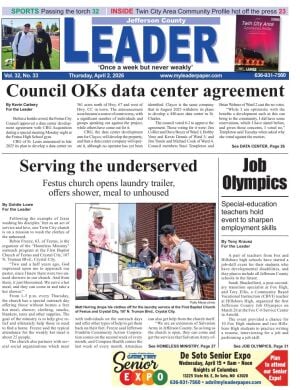
The first teachers to cross the color line were business and English educator Willa McCullough and her husband, Adam “Coach” McCullough, who was destined to become a revered football coach and industrial arts/PE teacher at R-6 schools. The pair, who still live in Festus, are featured today in a Page 1 story by Gordon Bess, in advance of a 6 p.m. May 11 event in their honor at First United Methodist Church, 113 Grand Ave., Festus.
Black teachers eventually taught in other county school districts – Crystal City, De Soto, Dunklin and Fox, for example. But the McCulloughs were the first teachers at the first district. Soon after they made the move, Mrs. Thompson transferred to the elementary school and Margaret Gill to the high school. The impact of these four can’t be overstated as they took their courage in hand and helped a community move into a new age.
“Coach” taught me PE and Mrs. Gill taught me shorthand and typing (I still use both of those skills in my work for the Leader) and was the director of my high school plays. Where Mrs. Thompson was soft and nurturing, Mrs. Gill was fiery and exacting. But I was “her” kid, too, and we maintained a relationship long after I graduated from high school.
I never had a class under Mrs. McCullough, but my sister did, and considered her a favorite teacher. Until caring for Adam moved her to the sidelines, Willa was a frequent visitor to the Leader, running public relations for her church and community. We always jumped to it when Willa asked for help. The woman has “presence,” and we never wanted to disappoint.
These emissaries for integration faced challenges that required strength of character and grace. While the process went smoothly at school – in stark contrast to other places around the country – acceptance wasn’t universal in the community at large, as Gordon’s story notes.
I knew Mrs. Thompson’s story best, because she played a significant role in a series of stories I wrote 30 years ago about those tumultuous times in our community and country. As a youngster in Crystal City, she was barred from the white school system and experienced gaps in her schooling, having to eventually leave the county for some of her high school years and later, college.
The education that white children received for free, she achieved only through hardscrabble effort. That indignity remained in her heart, but she chose to focus, instead, on Tynes’ wisdom and kindness, and she cherished the children – all of them.
Thompson, Gill and Tynes are all gone now, but we can still say thank you to the McCulloughs. Willa is 86, and Adam, who has been in poor health for some time, is 92. Read their story in today’s paper and come, if you can, to honor them tomorrow night.
Their lives loomed large in making our community a better place.