



The greatest personal asset you own today is not your home, or cars or bank accounts or retirement savings.
Far from it.
It’s your health.
Good health is the blessing we take for granted. I don’t get sick that often, but when I do, one thought hammers away in my head: “I’ll be so glad when I’m feeling well again!”
It’s no wonder, then, that health care is the No. 1 political/social issue in our country – or No. 2 if you’ve lost your job.
Yes, immigration policy is a hot-button, complex mess, but it doesn’t directly affect most of us. Health care, on the other hand, hits us all in body and pocketbook.
The current “state of the union” on this depends on your point of view:
■ If you and your family are in good health and have insurance, with no medical bills to pay, the status quo is OK. Not great, with premiums going up, but OK.
■ If you’re in good health but not insured, you live with some level of anxiety 24/7. (Unless you really believe you’re indestructible, a delusion you will eventually be shocked out of.)
■ If you’re sick but insured, you’re glad to be “covered” but worried about the minefield of deductibles, co-pays and surprise charges you must walk through.
■ If you’re sick without coverage, call a good bankruptcy attorney.
Recognizing these realities, can we all agree our pre-Medicare system of private coverage, through employer-sponsored health plans, is broken?
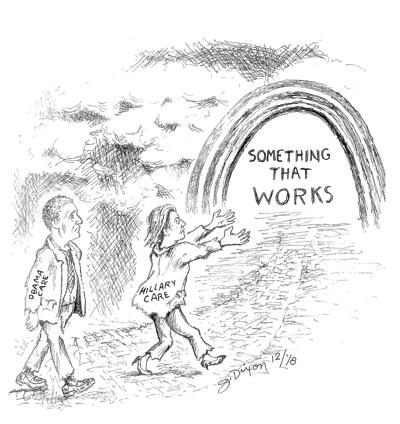
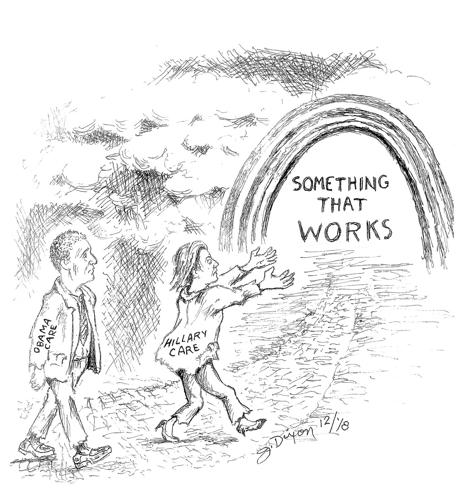
Can we agree that the Affordable Care Act, the “Obamacare” so despised by Republicans, has some good elements but is not, in its current form, the answer?
In a detailed 2017 analysis by the Commonwealth Fund, the U.S. ranked dead-last among 11 of the world’s richest countries in health care system performance.
And yet we pay far more per capita for health care than the other 10 nations. Simply put, we’re paying the most and getting the least.
Let’s start with the premise that the two extremes – “do nothing” or “universal government-run health care” – are equally unacceptable. We need realistic reform; with Uncle Sam dragging $22 trillion in debt, a universal single-payer system is pie-in-the-sky fiscal suicide.
Here are the other parameters I believe any reform effort must include:
■ The simpler the overall approach, the better. People are more likely to “use as directed” if they can understand the new system – what, why and how.
■ The new system MUST include everybody, all 328 million Americans. Insurance is the sharing of risk. The wider you spread that risk, the less it costs each participant. That’s the reason for the Obamacare individual mandate – buy coverage or pay a fine. The problem with it was, the fines weren’t big enough.
■ The new system must not increase federal budget deficits.
■ The new system must slow the inflation in health care costs and eventually bring costs down.
■ The new system should leave Medicare alone, for now. But we must fix it soon (say, no later than 2025). With 10,000 people my age retiring every day, it is a Titanic steaming toward a fiscal iceberg.
■ We must “go radical” on prevention. Seventy-five cents of every dollar we spend on health care goes toward treating preventable illnesses. Start by raising cigarette and alcohol taxes, the higher the better.
How about a health care surcharge on firearm purchases? A study by the Chicago Tribune found that Chicago hospitals charged $447 million to treat 12,000 gunshot victims between 2009 and 2016.
Nationally, the tab just for initial hospitalization of gunshot victims averaged $735 million a year between 2006 and 2014, according to a Stanford University study.
■ And finally, we as a society have to accept the reality of the “iron triangle.” That is, we always want three things: (1) the highest-quality care, (2) delivered quickly, (3) at an affordable price. The iron rule here is that you cannot have all three. So any new and better system will force us to make choices and yes, sacrifices.
Those of you over age 40 will remember that long before Obamacare, there was “Hillarycare.” In 1993, then-first lady Hillary Clinton led a reform effort that designed a new health care system under the Health Security Act of 1993. The thing was a monstrosity and never came to a vote in Congress.
At the time I was working in communications at General American Life Insurance Co. in downtown St. Louis. General American was a major health insurer and Medicare administrator and had a huge stake in protecting the status quo.
The company contributed to a big PR offensive by the Health Insurance Association of America to shoot down Hillarycare. TV commercials depicted “Harry and Louise,” your average American couple, agonizing about government bureaucracy taking over their health care.
I loved the campaign and its success in sinking the Clinton plan. I remember having many arguments about it with friends and family, with me defending the industry I worked in.
Twenty-five years later, the world has changed and so have I. The status quo is killing us. We are long past the question, “Do we need to change the system?”
And one more thing: The right solution will require bipartisan input and support.
OK, Congress, roll up your sleeves, take two aspirin and get to work.