
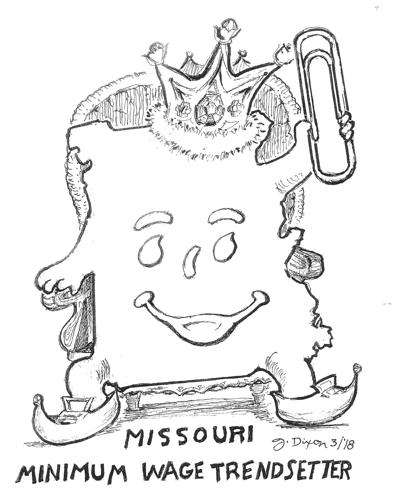
At Leader World Headquarters, the debate about the minimum wage boils down to paper clips and bingo bags.
Throughout the Leader’s 23-year history, we have employed teenagers (many of whom share our blood) to help with lower-skilled work. Our kids learn job skills while giving the company some entry-level support.
The youngsters stuff envelopes, post stories and photos to our website, and type letters to the editor and obituaries, among other chores.
Meanwhile, they learn to report to work on time; to put aside their cell phones; to focus (we tell them that at a newspaper, one mistake is a failing grade); and to show respect for the boss. They can’t sass us like they might at home, or call us morons. (Leave that kind of behavior for the highest level of government.)
When all other work is done, the kids move on to paper clip conservation and bingo bag assembly.
Every week on deadline, Leader page designers print out their work for proofreading, attaching each page to a paper “dummy” that shows where ads should be placed. By the time all four papers are finished on a Tuesday night, we’ve gone through about 150 paper clips.
Our youthful employees remove the clips so we can use them again the next week.
When that chore is finished, they can create bingo bags for players to use at Leader Senior Expos. Each bag needs 10 bingo cards and a crayon (not yellow!).
We pay the kids minimum wage, which currently is $7.85 per hour in Missouri. We can handle that, and take pride in doing our part to break in a new generation of American workers.
But if proponents of increasing the minimum wage to $15 an hour nationwide ever get their way, the outcome here at the Leader would be just what opponents predict.
We’d cut the jobs.
Business owners know what work is worth and set the rate of pay accordingly. It’s good to conserve paper clips, but if it costs $15 an hour to get the job done, we’ll just have to buy more paper clips. You can get 100 “giant” ones online for a buck thirty.
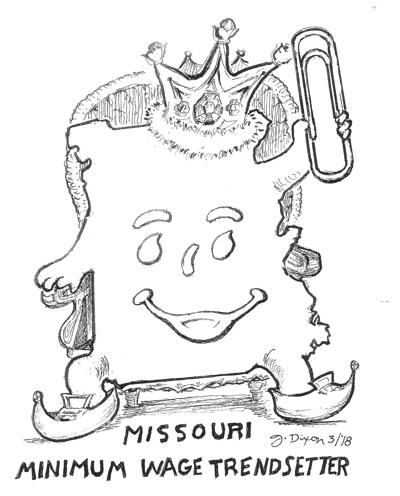
People like to pick on Missouri for a lot of things. But when it comes to the minimum wage, our state was a trendsetter.
In 2006, Missouri voters mandated that the minimum wage should start at the federal rate and rise according to the Consumer Price Index. We’ve been inching up from $5.15 ever since, but in a reasonable, quantifiable way.
It’s such a good idea, 18 states now “index” their minimum wage, with another nine states planning to jump on board in the coming years.
Missouri, however, was one of the first, and one of only four (with Alaska, Montana and South Dakota) that made the decision at the ballot box.
Researching the minimum wage yields some interesting material.
■ The highest minimum wage in the country is in SeaTac, Wash., a suburb of Seattle, where hospitality and transportation workers must be paid $15.64 an hour.
■ Nineteen states adhere to the federal minimum wage, now $7.25 an hour, either by legislation or because the states have not set their own minimum wage.
■ Georgia and Wyoming have laws setting the minimum a couple of bucks lower than the federal rate, both at $5.15 an hour. But in Georgia, federal employees still must receive $7.25 and in Wyoming, the federal rate is the one in force.
■ Oklahoma and Montana allow a much lower rate under special rules. Oklahoma takes the prize for the most chintzy state. If a company has fewer than 10 employees and gross sales of less than $100,000 annually, the boss can pay employees a measly $2 an hour.
That’s $80 a week for full-time work. Imagine the culture shock if you moved from SeaTac to Tulsa.
Montana businesses grossing less than $110,000 can pay only $4.
■ Municipalities across the country have rebelled against their state-set minimums, and Missouri is in the thick of that, too. In 2015, voters in Kansas City and St. Louis approved escalating increases in the minimum wage that would have reached about $11 an hour by now.
But the state Legislature twice passed laws smacking down those attempts, and the courts eventually sided with the lawmakers. At present, our two biggest cities have a minimum rate of $7.85 per hour like the rest of us in the Show-Me State.
We’d probably all agree that $2 an hour is too low, even for paper clip conservationists. But entry-level jobs are good for our business and for the country. They give employees a place to start and an incentive to grow, with higher wages as that growth occurs.
A federal minimum of $15 would be inflationary if applied nationwide. There are some locales where the cost of living is so high, that kind of starting pay makes sense, but it doesn’t in Jefferson County, Mo., and lots of other places.
My kids started out typing Leader obits for basement wages but are now in professions that pay them well. That happened because all three set their sights on a career path and then prepared for it. It’s the American way. So is businesses hiring the best employees they can find and paying those folks what the bottom line allows.
It’s how we keep the lights on.