


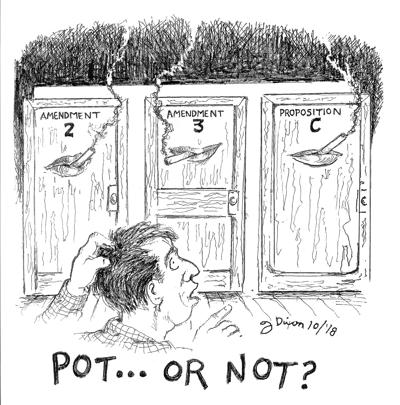
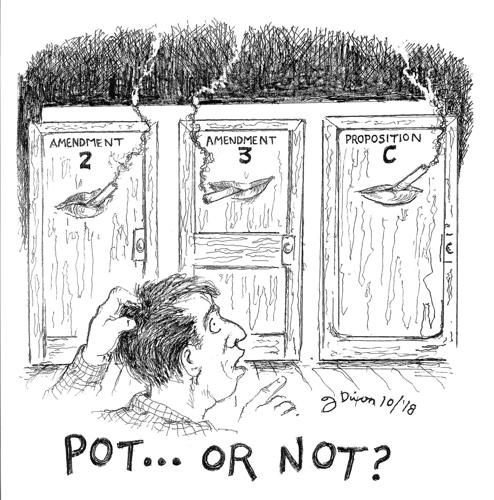
Voters, get ready to be confused.When you fill out your general election ballot on Nov. 6, try not to gag when you get to the statewide issues. There you will see four constitutional amendments (labeled 1 through 4) and three propositions (B, C and D), ranging on everything from bingo to raising both the state minimum wage and the state gasoline tax.
They’re all important, but you’ll scratch your head over not one, not two, but THREE competing measures seeking to legalize medical marijuana.
There are so many problems with this, I don’t know where to start.
First, a personal disclaimer. My first exposure to marijuana came in my freshman year at the University of Missouri in Columbia, when I would walk the corridors of my dormitory, Graham Hall, and smell that strange aroma of “weed” wafting out of the rooms. I never smoked the stuff myself, but a faint marijuana haze was seemingly never far away in my college days.
The thought of smoking anything, let alone an illegal, mind-altering drug, has always repulsed me. So, to be clear, I’m no fan of marijuana.
But I’m also no longer in the majority on this. A 2017 Pew Research Center survey found that 61 percent of Americans now favor legalizing “pot.” In 2000, that number was 31 percent.
Meanwhile, evidence has emerged of effective medical uses for marijuana, particularly for treating chronic pain. Advocates say marijuana can serve as an alternative to opiate painkillers and help stem the tide of opioid addiction and overdose deaths. I believe there is some truth to this.
Nonetheless, the three medical marijuana measures on the upcoming ballot – Constitutional Amendments 2 and 3 and Proposition C – each ask Missourians to take a leap of faith and damn the consequences.
Let’s remember two things. First, possessing marijuana is still illegal under federal law, as it has been since 1970; and second, the short-term risks and long-term health effects of marijuana use, even in medical applications, are largely unknown.
Thirty states allow medical use of marijuana in some form; eight states (Alaska, California, Colorado, Maine, Massachusetts, Nevada, Oregon and Washington) and the District of Columbia have legalized recreational use. So the popular tide is obvious. But that doesn’t automatically mean it’s right.
All three of the medical marijuana proposals on Nov. 6 would legalize the stuff for at least nine specific medical conditions, but the measures differ in the level of sales tax charged (2 to 15 percent), how the tax revenue would be spent and how the drug would be regulated.
If you dig down a little, you can find pros and cons to each of the three measures.
But here’s where it gets confusing. All three require only a simple majority to pass. Based on recent polling, it looks like they all could make it, creating the legal equivalent of a three-headed monster.
Article III, Section 51 of the Missouri Constitution provides that when two conflicting amendments are both approved by voters, the measure with the most “yes” votes prevails. And a constitutional amendment would supersede a statutory proposition.
But you can bet your last joint (ahem) that if two or all three of the proposals pass, in any combination, the result will be challenged in the courts. Then the only real winners will be the lawyers.
Here’s a better idea. Get the sponsors of the three measures – Amendment 2, New Approach Missouri; Amendment 3, Find the Cures; and Proposition C, Missourians for Patient Care – into the same room, cater their meals and lock the doors until they craft a single compromise measure we can all make sense of.
Otherwise this medical marijuana mess will be like tracking the baseball in the “cap dance” at a Cardinals game at Busch Stadium. Half the time I lose the ball and give up.
In the meantime, I suggest we listen to two groups of people who have a lot at stake in this issue: doctors and substance abuse counselors.
The American Medical Association has revised its policies to acknowledge the recent advances in medical marijuana for pain treatment. But it pointedly has not changed its view that “cannabis is a dangerous drug and as such is a public health concern.”
The AMA also “urges legislatures to delay initiating full legalization of any cannabis product until further research is completed on the public health, medical, economic and social consequences of use of cannabis.”
Jillian Bissell, project director for the Jefferson County Drug Prevention Coalition, said “it is critical to understand the risks involved” before we legalize marijuana as medicine.
“Unlike FDA-approved drugs, herbs and botanicals such as cannabis are not standardized or tested for effectiveness,” Bissell said in a written statement. “Claims to their therapeutic benefits are not backed by scientific research and they are not subject to the same regulations as other medicines.”
She also points out that “in no other situation has the public been allowed to vote whether or not a substance is a medicine. This decision should be placed in the hands of licensed health professionals and not by those advocating either for or against legalization.”
And then there’s the “stepping stone” argument. All eight of the states that have legalized pot for recreational use started by approving it as medicine. Are Missourians ready for all of that?
I’m not, so I’m voting no on all three.
Why the needless confusion and uncertainty?
Advocates, back to the drawing board. We have a nice room for you – nonsmoking, of course.