
Published in the January 8 Edition
A week ago St. Charles County switched the bulk of its law enforcement responsibilities to its new police department, headed by a police chief who was appointed by the county executive with the approval of the St. Charles County Council.
St. Charles made the change after a charter amendment was approved by voters.
There will still be an elected sheriff who will head up a reduced staff that will include bailiffs and security for the courts as well as process serving.
The transition in St. Charles County was uneventful. A longtime Sheriff’s Office employee was appointed chief and most of the personnel merely switched uniforms and became police department employees rather than sheriff’s deputies.
So why do it? To lessen the effects of politics on law enforcement.
Based on recent trends, Jefferson County voters only change sheriffs about four times a century. At least that’s been the pattern since the late Walter “Buck” Buerger held forth for 28 years, from 1964 to 1992.
He was succeeded by Oliver “Glenn” Boyer, who last year announced that his current four-year term would be his last. He will have served from 1993 through 2016, a 24-year run.
There will be a new sheriff in 2017. Three current Sheriff’s Office employees have announced they will run. Lt. Col. Steve Meinberg, Boyer’s second-in-command, is running as a Democrat. Support Services commander Capt. Ron Arnhart and Lt. Dave Marshak, Special Operations commander, both will run as Republicans and will face each other in the August 2016 Republican primary election.
No other Democrats have announced and Boyer, a fellow Democrat, has endorsed Meinberg.
All three candidates are longtime professionals in the office. They have pledged to put their current jobs first and not to let campaigning interfere.
More importantly, none of them is running against the boss technically, though the Republican nominee will be tempted to do that if Meinberg is his opponent. Meinberg is his own man but he will be running with the endorsement of Boyer and – as his second in command – will have a large degree of ownership in the current regime.
Remember, though, the conflict with the boss only is avoided when the boss isn’t running, which happens roughly every 24 to 28 years.
Nearly all of the elections in between are likely to feature a disgruntled former employee or even a current employee running against the incumbent. That comes with a whole boatload of possibilities, none of them great.
Foremost, the 250 or so employees of the office will be asked for support by one or more challengers – and their boss. In other words, they will be asked to take sides. That can not only get nasty – it could affect public safety.
That’s what St. Charles County and other charter counties have chosen to avoid.
Going to an appointed police chief also allows a county to set its own standards or qualifications for the person who heads up law enforcement.
The current crop of announced candidates for 2016 would be qualified by anyone’s standards, but you never know who voters may put in there.
The guess here is that the Jefferson County Council is unlikely to submit to voters a charter amendment creating a police department. The charter, passed by voters in 2008, was carefully crafted by the Charter Commission not to eliminate any elective jobs. This was done for two main reasons. First, the pro-charter people didn’t want a motivated team of opponents – current officeholders whose jobs would go away – out there working against the proposal. Second, Jefferson Countians have proven many times that they want to vote on pretty much everything.
In addition, the county did upgrade the qualifications for sheriff when it passed the charter. In addition to minimal state requirements of being a non-felon registered voter and resident, the county also requires a Class A peace officer’s license with at least five years of experience.
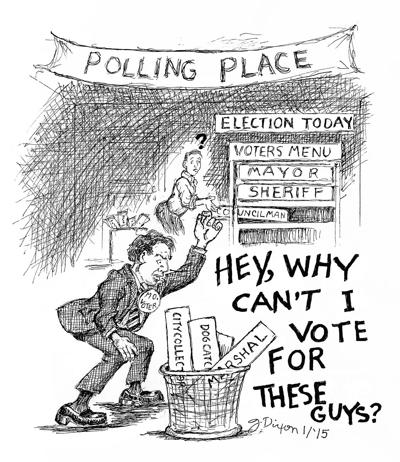
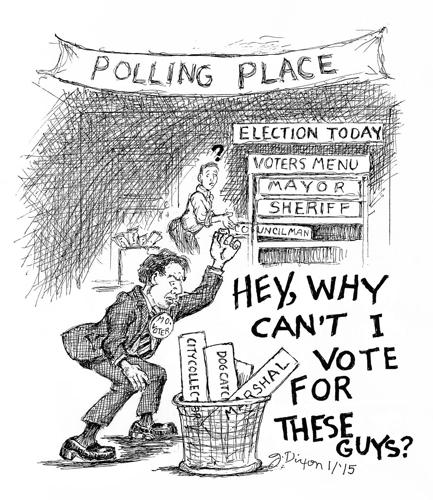
Many years ago, some towns elected their city attorneys and city clerks. Most used to have elected marshals instead of police chiefs. It was a long slog to get rid of those positions.
Herculaneum was the last holdout, in 2004. Voters, on the fourth try, eliminated the position. By then, the Board of Aldermen had hired a police administrator to run things even as townsfolks were still electing and paying for a ceremonial marshal.
My favorite Don’t-Take-Our-Vote-Away tale comes from Pevely. For decades, like other towns, Pevely had a city collector. Also for decades, like other towns, the city found it more practical to contract with the county collector to perform the once-a-year task of collecting city taxes.
In 2005, after Pevely’s longtime elected collector (who was also an assistant city clerk) moved out of town and was no longer eligible to run, the Board of Aldermen asked voters to eliminate the $75 per month job. They refused.
In 2009, the voters were asked again to eliminate the do-nothing job that was costing them $900 per year. Once again they voted no.
When the last collector resigned in 2011, Pevely simply stopped putting the position on the ballot.
Surprisingly, the registered voters of Pevely did not rise up in protest, despite this obvious infringement on their liberties to elect and pay someone who had nothing official to do.
Ain’t democracy grand?