
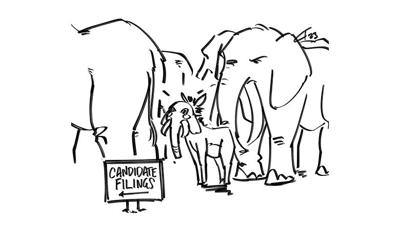
On the eve of what may be the craziest election year ever, it seems like a good time to recount recent electoral history in Jefferson County.
After decades of dominance, the last dozen years were for local Democrats what the meteor was for the dinosaurs.
The fallout from the blast began in 2010 and has continued mercilessly for the next three or four election cycles. The job was completed – all dinosaurs ejected – by the 2020 election. None in the statehouse, none in the courthouse.
At least, none in name.
Longtime Democratic officeholders in those early elections fell on the sword of their principles, facing the voters with the (D) by their names on the ballots as they always had. It turned out that letter might have stood for Dinosaur, Dismissed or Destined for the Dustbin.
They all lost spectacularly — judges, longtime lawmen, everybody.
Their political careers were (D)ead – if they insisted on running as Democrats.
Then, like Saul on the Road to Damascus becoming Paul, a blinding light broke through to the last survivors. They had watched their cohorts go over the cliff one at a time. Were they going to follow them?
Or would they make a B movie-like transformation and become (cue scary music, minor key) Republicans?
History will show that yes, they did.
Like birds of one species who commandeer the nests of other species, this switcheroo is not a new concept in Jefferson County politics. In the ancient days when Democrats ruled, there were plenty of conservative officeholders who would have been right at home in the Republican Party. But it was as practical for them to be Democrats then as it is for today’s pols to be Republicans.
When the first of these recently demonized Democrats decided to shed their donkey ears for elephant tusks, I didn’t think they were going to win any Profiles in Courage.
After chronicling the senseless loss of good public servants whose only fatal flaw was the (D) by their names, I came to a different conclusion – the letter didn’t matter.
The candidate should.
Whether an officeholder is a Democrat or a Republican doesn’t make a speck of difference in performing the duties of any job in the courthouse.
The judges – who are prohibited from running partisan campaigns even though they must declare a party – are still going to hear cases and make judgments on the facts as best they can. The recorder of deeds is going to record deeds. The sheriff is going to run a large department aimed at protecting the public. The prosecuting attorney will try to convict the bad guys.
All the other officeholders will do their duties. If they don’t, the voters get a do-over opportunity at the end of their terms.
Political philosophy has nothing to do with these jobs. There is not a Republican way to record a deed or a Democratic way to process tax bills. They will either do it well or they won’t.
The flight to single-party politics did accomplish one thing – it neutralized low-information voters who relied on the shorthand of the (D) or the (R). That shorthand didn’t say anything about a candidate’s background, experience, intelligence or anything else.
Piling into one party’s primary election forces the voters to perform the ghastly and horrible task of actually educating themselves. They might have to go to a candidate forum to hear the candidates and examine the horseflesh up close. They might have to read a newspaper’s election coverage and see how the candidates answered questions, particularly about their experience and goals if elected.
Oh, the horror – they’d have to be informed!
When the Democrats ran things, I used to opine that a one-party county was bad for voters, that it limits their choices. In theory, that is correct.
In the old days, though, there frequently were spirited races between members of the Democratic Party. Sure, the elections were decided in August, at the primary election, kind of like they are now in the Republican primary.
All of this, of course, is an argument for nonpartisan elections for jobs that do not require – or in many cases, allow – a partisan viewpoint in the execution of duties. If all the candidates were from the same party (or non-party), voters would have to get off their duffs, ask around and learn who is who and what they stand for.
It is the voters’ responsibility to drill down below the lazy (R) or (D) checkmark, to learn about experience, qualifications and character. That chore is one of the conditions of citizenship.
There are at least four judges on the bench in Jefferson County now and one state representative who ran successfully as Republicans and who used to be Democrats. Maybe they remembered the story of Saul becoming Paul. Maybe they just wanted a job in public service.
A scarlet letter shouldn’t disqualify them.