


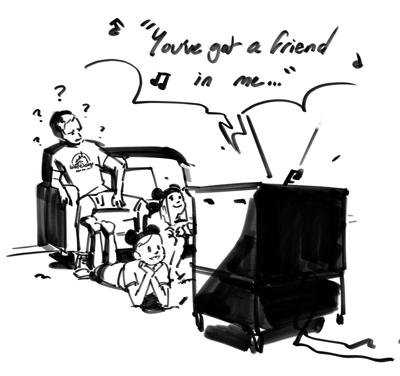
As a father of 4-year-old twins and husband to a self-described Disney fanatic, I have watched more movies and TV shows from the House of Mouse of late than at any other point in my life.
This is not a bad thing, as most Disney productions are enjoyable for all age groups, and very rarely do I need to wonder if what my kids are watching is appropriate.
However, as young children tend to do, my kids have gravitated to wanting to watch the same movie or TV show over and over and over and … well, you get the point.
Somewhere around the 20th viewing of the same movie, your mind starts to wander a bit, and some questions pop up when you start analyzing the stories and the worlds they are set in.
One of the first Disney franchises my kids latched onto was “Toy Story.”
With four movies, at least five holiday or cartoon-lead-in specials and numerous shorts, there is a lot of content to absorb.
I’ve noticed that some things just don’t add up.
In the first “Toy Story,” it seemed to be well established that all the toys knew they were toys.
But when Buzz Lightyear is introduced, he thinks he is the “real” Buzz Lightyear and the concept of him being a toy is unimaginable to him until he sees a commercial advertising him as a toy.
So, do all toys have to go through this epiphany or was Buzz defective?
A similar thing happens in the holiday special “Toy Story That Time Forgot.” In this 22-minute show, some of the toys go on a playdate with their owner Bonnie to her friend Mason’s house.
Mason got a huge haul of Christmas presents, including the entire set of the fictional toy line “Battlesaurs.”
Most of the Battlesaurs don’t know they are toys, and they seem to think they are players in a fictional cartoon that’s part of the “Toy Story” world.
However, one of the Battlesaurs does understand he is a toy, and he wants to make sure Mason only plays his new video game system so he can rule over the other toys in the playroom.
As the show reaches its conclusion, one of the other Battlesaurs breaks away from the playset they have been confined in since being opened, sees the action-figure packaging he escaped from and seems to realize he, too, is a toy.
So again, are the Battlesaurs defective because they don’t know they are toys, or is the one Battlesaur who understands that truth defective? Or did he simply have the ‘I am a toy’ revelation before everyone else?
I just don’t get how and when toys in “Toy Story” come to the conclusion that they are toys, and it kind of bothers me.
Let’s shift over to the “Cars” animated movie series, which has also spawned a number of short cartoons and will soon spin off a cartoon series.
After multiple viewings, I’m not sure if there isn’t inappropriate content in every “Cars” iteration.
Fairly early in the first movie, a couple of cars depicted as female appear to flash Lightning McQueen, the series’ main character. And by flashing, I mean they blink their headlights at him, but it is played off like they exposed themselves to him.
In the “Cars” world, the headlights of all the female characters are always visible. Does this mean all the women cars are driving around with no tops? If this is “indecent exposure,” that doesn’t feel like something children should be watching.
Also in “Cars,” I don’t understand how the fuel intake works.
There are multiple depictions of the “Cars” characters drinking fuel or oil from cans with a straw.
Yet, all of the cars have clearly visible gas caps. Plus, gas pumps line both sides of the exterior of Flo’s V8 Cafe.
I really want to know how the cars fuel up. Is it only by drinking from their mouths, or is it through the nozzles on the gas pumps? And if it is from the pumps, how do the cars operate them without hands?
Another cautionary tale why you shouldn’t overthink entertainment for children is “Zootopia.”
What is described as a buddy-cop film is set in a traditional Disney world where animals act like humans, and it tells the story of a bunny who moves to a city called Zootopia to become a police officer despite being told she can’t be a cop because she is classified as prey and not predator.
This raised the first question. In this world, animals are divided between prey, which are smaller animals with plant-based diets, and predators, which one would assume eat meat. Doesn’t this mean the predators would eat the prey? However, there’s no reference to what the predators prey on.
Another question is how can the city the bunny moves to be classified as a Zootopia? This city is divided into multiple sections with climates that are engineered to meet each species’ needs, such as an Antarctic region, rain forest region, desert region and so forth.
If Zootopia is a play off a utopia, where everyone lives together in harmony, how can a city that assigns its residents to separate zones be considered a utopia?
Also, what happens when the machines powering these different sections break? If the Antarctic region can’t be cooled, do these animals that need freezing temperatures perish? If the desert area can’t be properly heated, do the warm-weather animals meet a horrible fate?
A piece of advice: If you are forced to repeatedly watch any Disney movie or TV show, just zone out.
You don’t want to be like me and have to walk around with all these unanswerable questions keeping you up long after the kids drift off to blissful sleep.