
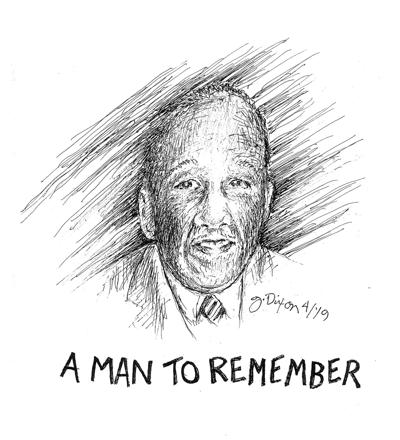
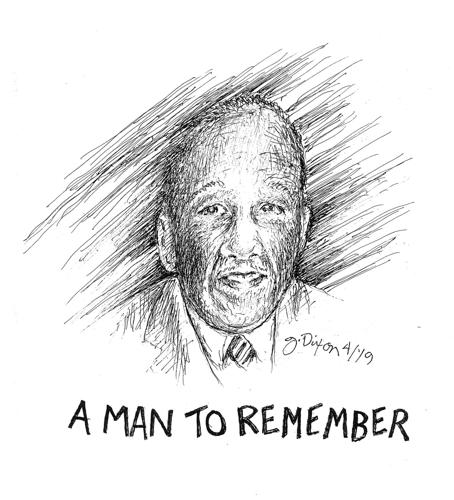
Like a shaft of light piercing the darkness, love is the only power that can overcome the ravages of Alzheimer’s disease. And there is surely no finer example than the love story of Adam and Willa McCullough.
I wrote about this remarkable couple in 2018 just before a rousing celebration of their careers as educators in the Festus R-6 School District. While I focused on their pioneering role in ending racial segregation in local schools – Willa was the first black teacher at all-white Festus High School in 1954, with Adam following her there one year later – I had to leave another great story untold because it wasn’t over.
It ended March 31 with Adam’s death at age 93.
“Coach,” as so many Festus students knew him in his 43 years in education, finally yielded to Alzheimer’s, the most common form of dementia, after a decade of struggle.
Willa lived with it, too – as Adam’s caregiver and wife of nearly 64 years.
He was a man of almost unlimited vigor and accomplishment. Besides his teaching and coaching in Festus – highlighted by guiding the four-man Douglass High track and field team to back-to-back state championships in 1952 and 1953, plus 10 years as head football coach at Festus – Coach McCullough was a semi-pro football player, Boy Scout leader, 33rd degree Mason and the first black sports official in Jefferson County.
He also manned the sideline chains at St. Louis football Cardinals games and served 16 years on the Festus City Council.
This seemingly indestructible molder of young people, however, harbored a secret, silent killer in his heredity. All three of his older brothers died of Alzheimer’s. And after Adam enlisted in a long-term memory and aging study by Washington University, he learned the disease was hunting him down, too, like a linebacker making an open-field tackle.
With Alzheimer’s, there are no fourth-quarter comebacks, no Hail Mary passes. At least, not yet.
Adam retired from education in 1993, and Willa followed the next year. The dark tunnel of dementia lay ahead. Willa, six years younger than Adam, would learn the art and science of caregiving.
“In his mind, he had a job, right up to the end,” she said. “He would wake up in the morning and say, ‘What day is today?’ I’d tell him and he’d say, ‘I’m going to be late.’ And I’d say, ‘Late for what?’ And he’d say, ‘I’ve got an 8 o’clock class.’ And I said, ‘No, not today.’
“I finally got to the point that I would lie. When he’d say, ‘What day is today?’ I’d say it’s Saturday. Every day was Saturday. Then that was all right.”
His mind conjured family visitors, long dead. “He would go through this house looking for Edward (his next-oldest brother, the one he was closest to). And his mother, he remembered his mother.”
The paradox of Alzheimer’s and other forms of dementia is their deferral of physical effects. The brain slowly self-destructs while the body can march on for years. And as a physical education teacher who had long practiced what he taught, Adam remained vital and capable on the outside.
“He was strong right up to the end,” Willa said. “He could catch you by the wrist and he wouldn’t let go. But the last few days when I went up there (to Scenic Nursing Center in Herculaneum) and he had his fists clenched, I would sit there by him and just rub his hand, rub his arm, and he opened his hand so I could hold his hand. That was a good experience, that I felt closer (to him).”
Adam’s final year had two milestones. The first was the community celebration last May at First United Methodist Church in Festus. A parade of friends and former students shared stories about the McCulloughs’ impact and the church band and a choir stirred the spirits out in the pews. Then, in October, “Coach” was honored along with other former Tiger mentors at the school’s Homecoming.
“So many people have been so kind to us and I’m grateful for that, and for the fact that Adam knew that,” Willa said. “(That celebration) last year couldn’t have come at a better time. All of that meant so much to him, that he was able to be a part of it.”
She offers advice to the families of the 5.8 million Americans suffering from Alzheimer’s.
“Try to remember the person at their best, so that you have good memories you can look back on,” she said.
“Remember, this is still a person and he’s still a part of your life.
“Life changes; you’ll just forget so much of it. But if you can think back on things that you used to do together, that sustains you.”
Save some of your strength for yourself, she advised.
“Everybody in life is going to tell you that not only do you need to take care of that person, you need to take care of yourself. Otherwise, there’s nobody to take care of anybody.
“I think about, what else could I have done? Know that you are doing the very best you can to take care of that person.
“Those are lessons that I had to learn.”
Willa donated Adam’s brain to the Alzheimer’s Association Greater Missouri chapter.
“They say that there’s so much that they learn from an autopsy that they can’t learn from just meeting with you,” she said. “I thought, they (Wash U. researchers) had been so kind to us, we ought to do something to aid their cause.”
The reality of widowhood is slow to sink in.
“It’s hard for me to believe that I’m in this situation that I’m in,” she said.
But the good memories will see her through. “He lived a good life and I can’t complain about that. He just enjoyed life and had a chance to do most of the things that he wanted to do. So I’m just grateful.”