


The state of Missouri should repeal the death penalty.
Five members of the Missouri Legislature agree with me and have introduced bills to either scale back executions or ban them outright.
State Sen. Paul Wieland (R-Imperial) is one of them. He introduced Senate Bill 32 for a full repeal of capital punishment. It’s the fifth straight year he’s sponsored such legislation.
Numerous Senate and House capital punishment bills have come and gone since 2012, which tells you misgivings about state-sponsored death linger in the minds of our Jefferson City lawmakers.
And well they should. The case against it has become compelling, resulting in movement on this issue nationally.
Last October, Washington became the 20th state to abolish the death penalty and the seventh in the last 15 years. In March, California Gov. Gavin Newsom imposed a moratorium on capital punishment, a reprieve for the state’s 737 death row inmates. His move was mostly symbolic because legal challenges have held up executions in California since 2006, but it sent a message. “I think if someone kills, we don’t kill (them),” Newsom said. “We’re better than that.”
In fact, 10 other states with the death penalty haven’t executed anybody in more than a decade, including New Hampshire (last one was 1939), Kansas (1965), Wyoming (1992), Colorado and Oregon (1997), Pennsylvania (1999), Montana, Nevada and North Carolina (all 2006) and Kentucky (2008).
Nationwide, courts are issuing fewer death sentences, dropping from 295 in 1998 to 42 last year. Executions nationally peaked at 98 in 1999; last year there were 25.
Here in Missouri, the pace also has slowed dramatically. Since the U.S. Supreme Court reauthorized capital punishment in 1976, ruling it does not violate the Eighth Amendment to the Constitution, our state has put 88 people to death, all by lethal injection.
We executed 16 people in 2014-2015, but only two since then. The last was Mark Anthony Christeson on Jan. 31, 2017.
We can debate whether the slowdown reflects general moral qualms or just legal and practical obstacles. I think it’s both. But in the meantime my thinking has changed 180 degrees on this issue.
For many years I walked that tightrope of moral contradiction, opposing legalized abortion while supporting the death penalty. My justification was brutally simple: Abortion takes innocent human life; capital punishment ends guilty human life.
If only we could be so sure of the latter.
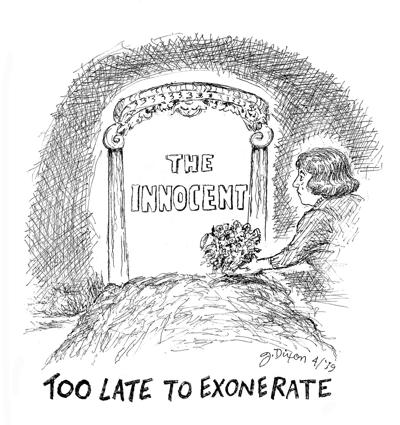
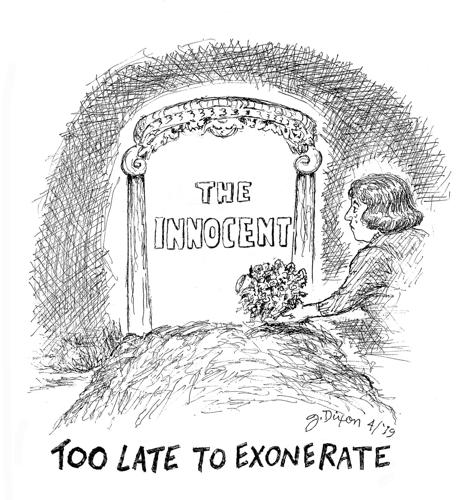
The leading objection to the death penalty is the potential innocence of those convicted. More than 160 death row inmates have been released since 1973 after new evidence exonerated them. A major scientific study in 2014 concluded that nationwide, the probable innocence rate among those sentenced to death is 4.1 percent – one of every 25 convictions.
“A surprising number of innocent people are sentenced to death,” said Samuel Gross of the University of Michigan Law School, lead author of the study published in the Proceedings of the National Academy of Sciences. He noted that with an actual exoneration rate of about 1.6 percent, “It tells you that a lot of them (innocent inmates) haven’t been exonerated. Some of them no doubt have been executed.”
Newsom finds that unacceptable: “I cannot sign off on executing hundreds and hundreds of human beings, knowing – knowing – that among them will be innocent human beings.”
The Supreme Court in Washington state unanimously struck down capital punishment for a different, but related, reason – the inequities in our systems of justice.
“The death penalty is unequally applied – sometimes by where the crime took place, the county of residence, the available budgetary resources at any given point in time, or the race of the defendant,” wrote chief justice Mary Fairhurst. “Our capital punishment law lacks fundamental fairness.”
Numerous studies have shown that death sentences slant disproportionately based on the races of the defendant and victim. Odds of conviction are highest for black defendants with white victims. Of the 310 people executed since 1976 for an interracial murder, 290 were blacks convicted of killing whites.
A key rationale for capital punishment is that it reduces crime. Here, statistics don’t help much. A major project of the National Research Council, reviewing 35 years of studies on the “deterrence effect” of the death penalty, concluded that all that research “is not informative about whether capital punishment decreases, increases or has no effect on homicide rates.” The studies the NRC looked at, it said, “reached widely varying, even contradictory conclusions.”
It’s worth noting, however, that the region of the U.S. with the highest murder rate (6.4) per thousand population in 2017, the southern states, accounts for 80 percent of executions since 1976.
Add to this two other reasons for abolition: cost and botched procedures.
Death rows are the most expensive real estate in America, with spending for trials, appeals and petitions typically running two or three times higher than for life sentences. Colorado law professor Michael Radelet, meanwhile, has compiled a detailed list of 51 botched executions in the U.S. since 1982. Try reading the whole list (just Google it) without getting sick.
And finally, in the court of public opinion, support for capital punishment is declining. A 1996 survey found 78 percent in favor and only 18 percent opposed. In 2015, that split was 56/38, according to the Pew Research Center. And clear majorities of the public are troubled by the risk of executing the innocent (71 percent) and believe the death penalty doesn’t deter serious crime (61 percent).
I fully supported the execution of Oklahoma City bomber Timothy McVeigh in 2001. I believed that if anybody deserved it, he did. The evidence for his conviction was overwhelming.
But as Gov. Newsom said, we are better than that.
Retribution cheapens justice. We should leave the ultimate punishment to God.