
Sixty years ago next week, America suffered a terrible wound that remains unhealed to this day.
The shots Lee Harvey Oswald fired that killed President John F. Kennedy in Dallas on Nov. 22, 1963, still echo in our national consciousness. I believe it not only left a permanent psychic scar on my generation of Baby Boomers, it also marked the second great traumatic turning point in American history, nearly 100 years after another presidential assassination, Abraham Lincoln’s at the close of the Civil War.
I have clear memories of that awful Friday when a popular first-term president, near the end of a whirlwind political swing through Texas, was gunned down from behind while riding in a motorcade.
Kennedy had insisted that the top be removed from his limousine so the crowd of 200,000 could feel a closer connection to him. Instead it gave them their last, best look at a leader who will forever inspire questions of “what might have been,” second only to Lincoln.
I was sitting in my fourth-row seat on the right side of my third-grade classroom at Highcrest Elementary in Wilmette, Ill., that afternoon. We had just come back from lunch when my classmate and closest friend, Tom Cadden, walked in, returning from a dentist appointment. He broke the news that President Kennedy had been shot. Our teacher, Ms. Gwathemy, gasped and had to leave the room to compose herself.
Thus began the four longest days of public mourning that anyone my age or older can remember, rivaled only by the Sept. 11 terrorist attacks. The television choices in 1963 were the three major networks, ABC, CBS and NBC, and they each broadcast non-stop, commercial-free coverage that transfixed the nation.
The shock of events reverberated two days later, Nov. 24, when Oswald himself was gunned down by Jack Ruby in the basement of Dallas Police headquarters – and it all happened on live national TV.
How much worse could it get? My mother was so upset she couldn’t bear to watch any of the news coverage, retreating to her refuge of books and the “New Yorker” magazine. My dad and my two older brothers and I stayed with the TV drama, numb as we were. The whole country was frozen in shock and grief.
Little did we know then what effects, short- and long-term, the assassination would have.
The first was an explosion of theories about Oswald and vast conspiracies lurking behind the now-famous Grassy Knoll in Dealey Plaza, site of the killing. The assassin’s own death just pumped more gasoline into the conspiracy cottage industry that still thrives all these years later.
It didn’t help that the official federal probe into the assassination, the Warren Commission, rushed to complete its investigation before the 1964 election, when it should have been much more deliberate.
I could write a lengthy second column on why and how the conspiracy peddlers get it wrong, but instead I refer you to the definitive 1993 study of the assassination, “Case Closed” by Gerald Posner. I challenge anyone to read Posner’s work and not be convinced Oswald acted alone in killing JFK. The Warren Commission did get that much right.
The long-term consequence of 11-22-63, which could not have been foreseen at the time, was how it triggered a gradual erosion of the American people’s trust in the federal government. Think of what we have learned and experienced in the last 60 years:
■ JFK himself carefully masked both his habitual philandering and serious health problems, which the news media at the time chose not to bring to light.
■ In the slow-motion disaster of the Vietnam War (1965-1973), the government repeatedly misled the American people for years about that unwinnable conflict.
■ The widespread corruption of the Watergate scandal at the highest levels brought down the Nixon Administration in 1974.
■ After relative calm in the 1980s and 1990s, America reacted to 9-11 with invasions of Afghanistan and Iraq, gaining little at the sacrifice of thousands of our best men and women in uniform.
■ We see continuing decline in the “regular order” of governance as dysfunction rules Washington, D.C. Congress is virtually paralyzed by partisan infighting, as seen in the recent debacle of ousting a House speaker for the first time and the struggle to find a successor.
■ Worst of all is a national debt that has topped $33 trillion while Congress can’t even pass a budget and another government shutdown looms.
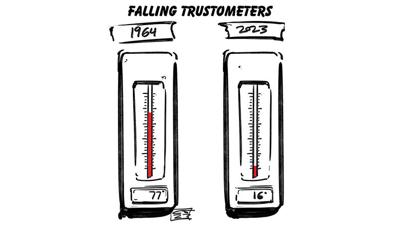
We face a long-term “trust deficit” that began with Kennedy’s death. In 1964, more than three out of four Americans (77 percent) said they trusted the federal government to do what was right “just about always” or “most of the time,” according to the Pew Research Center. Today that number is 16 percent, with only 1 percent answering “just about always.”
The Gallup Organization, one of the oldest and most respected pollsters, reports double-digit declines in how much Americans trust and have confidence in the federal government, compared with 50-year historical averages.
The executive branch (White House) is down from 52 percent historically to 41; Congress, down from 48 percent to 32; and the Supreme Court with the biggest decline of all, from 66 percent to 49 (a 17-point drop).
Rebuilding trust in government will take herculean, bipartisan effort. It will not happen unless We the People insist on it. A year from now we will elect the next president and, here in Missouri, a U.S. senator. Voters, may your conscience be your guide.
Ballots, not bullets, should set the course of American history.