


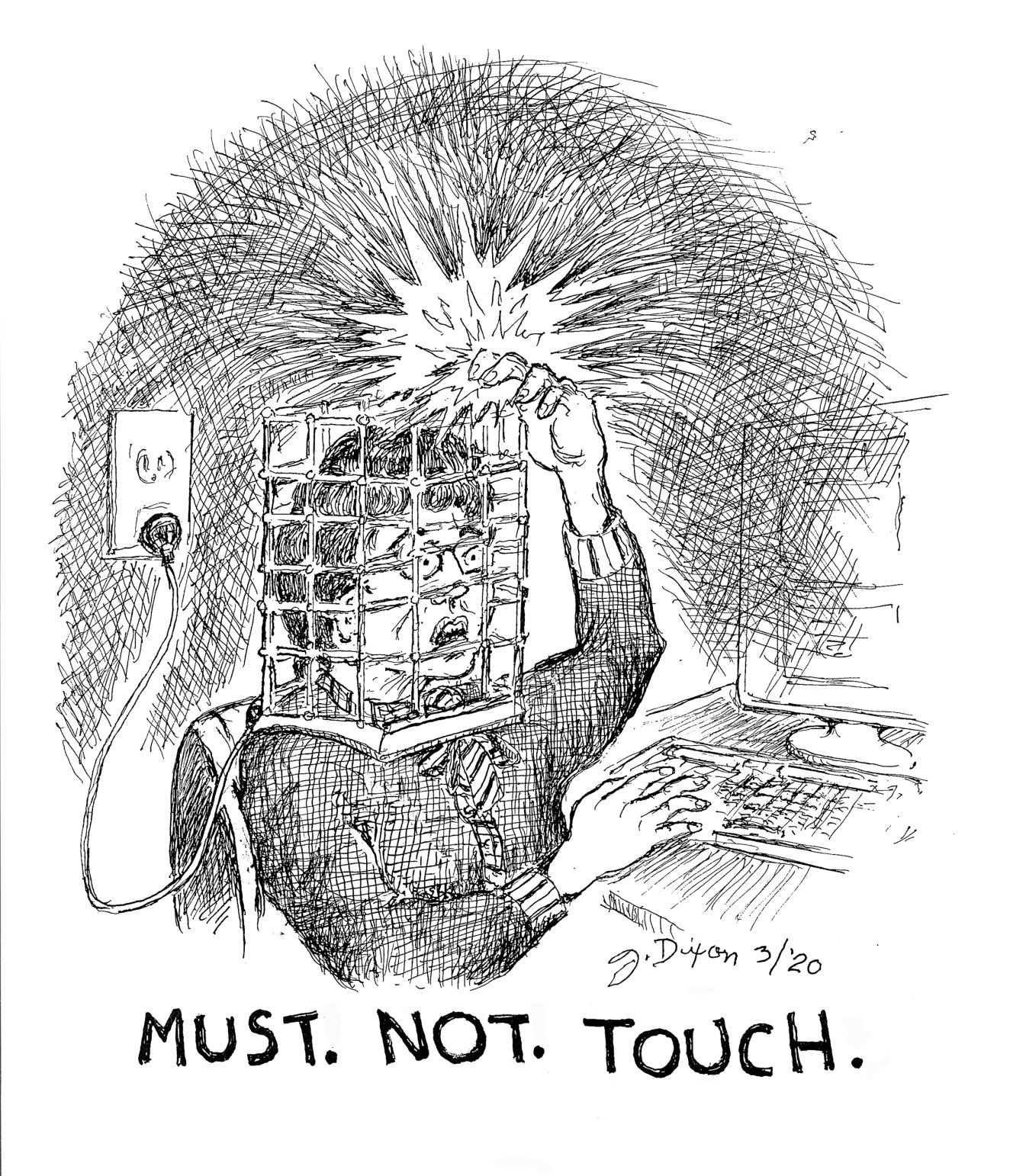
I stopped counting at 32. Probably just like everyone else in Leaderland, I’m trying to curtail touches to my face, and to follow other advice given out by the federal Centers for Disease Control and Prevention on how to avoid catching or spreading the novel coronavirus that is deservedly demanding worldwide attention.
I’ve washed my hands three times so far this morning, singing “Happy Birthday” twice through each time to achieve the requisite 20 seconds. That’s up from 13 seconds yesterday, which seemed like a LONG time to scrub. I’m adjusting to the new reality.
After finding it unavailable in my first three tries, I eventually ordered some hand sanitizer; supposedly it will arrive in a couple of days. A recent reviewer of the product made a comment on Feb. 23 I concur with: “So sad to have to buy this.”
Easily the hardest step of all was to try to stop touching my face. I figured that if I forced myself to count how many times I did it, I’d eventually quit doing it.
I did quit something – counting (I’m actually supposed to be working, after all), but, so far, I haven’t been able to quit touching.
I find I possess a high degree of itchiness – eyes, nose, forehead (where my bangs touch skin), ears. Telling yourself not to scratch doesn’t mean you won’t do it.
It was perhaps a weird thing to notice at a time of deep emotional distress, but as my siblings and I sat vigil with my parents in their last hours, I noted that both of them kept scratching their noses, despite their loss of consciousness.
We humans touch our faces. It’s something we have in common.
But we also share a strong desire to protect ourselves, and others, from harm.
That’s why we must take seriously the CDC’s checklist of things we CAN do as we face this health crisis together.
First off, we must listen to health officials. If they tell us to “self-quarantine,” we must do it. That seems so obvious, but incredibly a St. Louis County family didn’t follow directions after the first Missouri case made itself known. Sheesh.
We must wash our hands better and more frequently. We must touch our faces much less (doing our best).
We must avoid close contact with people who are sick; stay home when we are sick; cover our coughs and sneezes, and throw tissues immediately into the trash; and clean and disinfect frequently touched objects and surfaces.
I have a couple of things to add to the list of preferred behaviors.
In trying times, it’s tempting to shoot the messenger. Please don’t.
The media has a responsibility to keep the public informed, even when the news is unwelcome or scary. Your local and national media must report on the scope and spread of COVID-19, keeping to the highest professional standards.
There is no excuse for exaggeration or fear-mongering, but facts must not be suppressed. Staying informed is one huge step toward staying safe.
Editor and Publisher magazine emails stories to the Leader (and other media throughout the country) every week, advising us all on best practices toward integrity and professionalism in our jobs. Yesterday, I read – and kept a copy of – a story titled: “A guide to responsible coronavirus reporting.”
Written by Tom Jones for the Poynter Report, a media watchdog, the story made several assertions I took to heart.
“Let’s start with this: It’s a science story, not a political one,” Jones wrote. “So listening to spin on the coronavirus from the Democratic presidential nominees or the Fox News primetime hosts or, especially, from someone such as Rush Limbaugh, who compared it to the common cold, is not the smart place to go. Instead, the outlets dealing in facts should be your go-to sources.”
Jones advised following the up-to-date coverage in the Wall Street Journal, the New York Times, the Washington Post and the Associated Press, among others.
The CDC, itself, has a lot of good information on prevention and symptoms, and provides a daily update on the number of cases and where they are occurring. Search for “CDC, coronavirus” online. One caveat: Numbers are closed at 4 p.m. each day, and then reported at noon the next day, so there is a bit of a lag.
Jones closed his piece with some great advice for journalists:
“There will be time enough later to evaluate the politics of this story, but for now, information is what’s critical. Start there. And stay there.”
That’s what the Leader is going to do.
My eye is itching again, really itching. But I’m not going to rub it, nope. Not gonna.
OK, I gave in. But it was the last time, I swear.