
“Life Story,” posted each Saturday on Leader Publications’ website, focuses on one individual’s impact on his or her community. Today’s story is written by Laura Marlow.
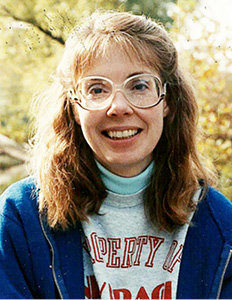
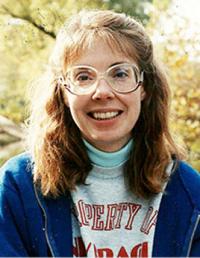
Even as the disease that would eventually take her life ravaged her brain, Patty Vreeland kept a sunny face to the world.
“She had the most amazing smile. It would knock your socks off,” said her husband of 24 years, Mike Vreeland of De Soto.
Mrs. Vreeland died April 5, following a 12-year battle with frontotemporal degeneration, a disease that results in progressive damage to lobes of the brain. Related to amyotrophic lateral sclerosis (Lou Gehrig’s Disease), FTD causes gradual, progressive decline in behavior and/or language, and is one of the most common causes of dementia in younger people.
The disease gradually turned Mrs. Vreeland from a healthy, articulate teacher, artist and general mischief-maker into a silent invalid.
But, her husband said, it could never completely quench the spark that was quintessentially Patty.
“Everyone who ever met her knew how kind she was,” Mike said. “She had a wicked sense of humor. We spent most of our 25 years together laughing.”
Patty Faulkner was an active teenager when Mike Vreeland first got to know her.
“She was a De Soto Dragon and I was a Hillsboro Hawk,” Mike said with a laugh. “She was part of the De Soto cheerleading squad. When I would bring the ball in standing on the sidelines, I tried not to get in front of those cheerleaders – they would pull the hair on your legs.”
Both the Vreelands were recently divorced and each was a single parent to a small daughter when they met up again some years later and were married in 1987.
Although she was quiet and demure to outsiders, Mike said he gradually came to understand what a live wire his wife actually was.
“Things were always going on in her mind,” he said. “She was quiet, but the depth that she had was just amazing. She had an understanding of life that I don’t have. She just knew what was important.
“I’ve always been a real principled guy, and I’ve never had any problem standing up for them, even if it meant making somebody mad. One time she said, ‘You know, you’re maybe the best man I’ve known except my dad – but you have the same problem he had. You’re almost always right, but how about kindness?’
“It was like somebody hit me with a sledge hammer. I started looking at how I’d lived my life, how I had hurt people for the sake of some principle. She made me see what was really important.”
Both the Vreelands taught at Hillsboro High School, Mike in the English department and his wife in English and art.
“She got the kids who liked to throw things at one another,” Mike said, laughing at the memory. “I don’t think they expected her to be able to do much with them. But the kids that another teacher might basically ignore, she managed to somehow help them. Kids would hang out in her room, since she was so accepting.
“But she had a LOOK – when a kid was over the line, she just had to give them that look and they would straighten up. I don’t think she ever raised her voice.”
The Vreelands enjoyed traveling, and they continued to do so after Patty was diagnosed.
“Our first trip, shortly after we met, we went to New York City to see her brother, Drew, who was rehabbing a big, 50-room historical mansion. We spent about two weeks, and we went walking just about everywhere around the city.
“But, it was a three-story house, and there were no stairs. To get to our bedroom on the third floor, we had to go up a ladder – and that’s when I learned she was deathly afraid of heights.”
Over the years, the Vreelands were active in the outdoors, and very involved with their two daughters’ dancing.
“Patty’s brother, Drew, belonged to a biking club in St. Louis, and Patty started riding with them,” Mike said. “They rode from Springfield to Portland, Ore., in the late 70s. She was in perfect shape – her legs were hard as a rock.”
But when she was about 50, Mrs. Vreeland began showing symptoms of a disease that is all too familiar to her family.
“Her Uncle Bob had it,” Mike said. “He was diagnosed at 58 or 59, and he died within a year. Her dad had it at about 70; and he died about six years later.”
“Around 2000, Patty started showing signs of personality difference; she wasn’t quite as nice as she used to be. She started buying things like crazy – she’d always been a good shopper, and it was almost like she went the other way.
“I recognized it with her father – he had done some of the same things.”
Mike said the course of his wife’s disease was slower than her father’s had been.
“It wasn’t as extreme as it was with her dad. I started noticing she would ask me about the lesson plans we had made, and she started having trouble entering the grades.”
The Vreelands both retired from teaching in 2003. They hooked their bass boat and fifth-wheel camper to the back of their pickup truck and hit the road.
“We’d be gone 11 months out of the year,” Mike recalled. “We’d go to Florida, then to Alabama. We’d come up and stay at Table Rock Lake for a month, then head up to upper Michigan for a few months. We made a few trips to California to see (daughter) Ali.
“We’d come home for the holidays, then start all over again. We just did whatever we wanted. I’ll bet we ate in about a thousand different restaurants.
“We just about ran the wheels off that truck.”
When the Vreelands came home for good in 2010, Mike said his wife’s weight was down to a frightening 103 pounds on her 5-foot-6-inch frame.
“Her doctor thought it was the end. Of course, he thought that a lot of times, and she just kept on. Patty lived a lot longer than he thought she would initially. She lost her speech about seven years ago. I could tell she understood things, but she couldn’t say them. She would write a little bit, but it frustrated her. She still recognized me till the end.”
Ultimately, the disease was too much for even the most determined optimism.
“She got an infection and just died,” Mike said. “I knew this was coming, but I still wasn’t ready.
“Patty always believed in me and was patient with me. She really liked some things about me, and she tolerated the things that I needed to change. She made me want to be better.
“Patty was the kindest person I’ll ever know.”