


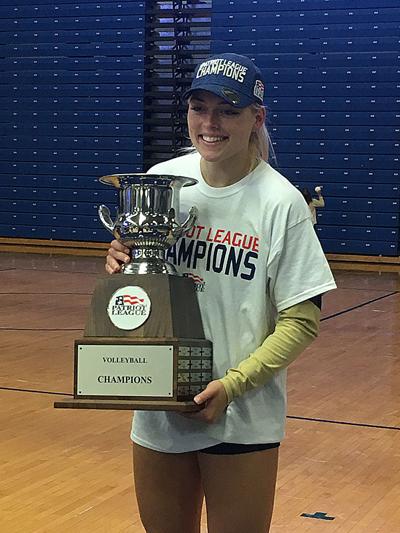
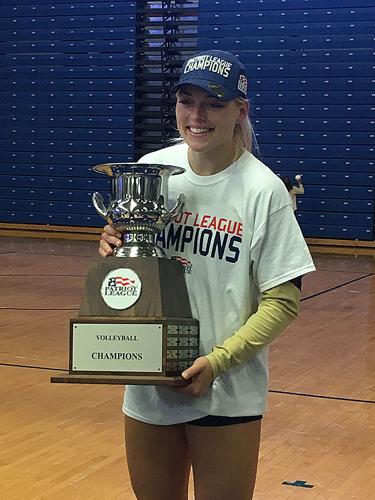
Kelsey Kingsland has been in an airplane by herself.
When it was in the air.
Kingsland, a 2015 De Soto graduate, flew a Piper Warrior solo last summer as part of her training at the U.S. Naval Academy. She spent 3 1/2 weeks preparing and nine hours in the air with an instructor before her first solo flight just before the midshipman entered her senior year at Annapolis, Md.
Starting as a plebe (the Navy’s term for freshman), the Navy gave Kingsland three years to figure out how she wanted to serve when she graduates next May. She wrote down pilot as her first choice. Based on her performance during a fast-paced flight program, her grades and overall class standing, the Navy granted her request.
After graduating from the Naval Academy, Kingsland will be commissioned an ensign. She’ll leave Maryland for flight training at the Naval Air Station in Pensacola, Fla., in late summer or early fall. If she’s able to pass the rigorous two-year program, she’ll receive her flight wings and be assigned to a squadron.
I asked Kingsland if she wanted to jockey a jet fighter, like the F-18 Hornet.
“I have no idea what I want to fly. I want to see what interests me,” she said.
Kingsland was studying for finals at Annapolis as she talked about her very bright future, the end of her volleyball career and decisions that led to her being accepted into the Naval Academy.
The Navy paid for Kingsland to attend its academy because of her prowess on the volleyball court. Now she could pay it back as a naval aviator.
And to think, a loss against Festus in the district basketball tournament in 2014 almost put an end to Kingsland attending any academy. The head basketball coach from the Nava lAcademy at the time was at the game Kingsland’s junior year to recruit her. The Dragons were heavily favored against the Tigers, but despite Kingsland’s 19 points, eight rebounds and five steals, Festus won handily. Kingsland was distraught. She didn’t want to talk to the coach from Navy.
Kelsey’s mom, Kim Kingsland, went to work and changed her daughter’s mind about the talk. Kim (Frischman) Kingsland played point guard her senior year for De Soto when the Dragons won their first title in 1988. Kingsland teaches physical education at De Soto Junior High and has been head coach and junior varsity coach of the Dragons. She’s in the school’s athletic hall of fame.
“But I talked to (the Navy coach) and told her I was leaving for a volleyball tournament the next day,” Kelsey said. “She asked if I wanted to play volleyball in college. I kept in contact with her. She sent my info to (Navy’s) volleyball coach and they contacted me. The Army volleyball coach was recruiting me.”
Kingsland toured the Army’s military academy at West Point, N.Y., and the Nava lAcademy.
“My whole life changed when I saw both academies. That was the ‘ah-ha’ moment,” Kingsland said.
“I went to the Navy because of the jobs after the academy. I really wanted to fly. The Navy gave me more opportunities. And Annapolis is so much nicer than West Point.”
Kingsland’s career on the court ended in Pittsburgh on Nov. 30 when Navy, playing in the NCAA Division I tournament for the first time since 1991, lost to No. 18-ranked Michigan in straight sets in the first round. Kingsland, an outside hitter, led the Midshipman with eight kills.
After lettering in volleyball and basketball all four years at De Soto and being on Navy’s team for three of her four years (Kingsland missed her junior year with an injury), it took a couple of days for Kingsland to realize competition for her now meant climbing the ladder as a naval officer.
“I think it hit me when I got back on (Dec. 3),” she said. “You do your daily routine and volleyball wasn’t part of it. I’ve talked to my teammates and some are ecstatic we can focus on bigger things. Then there are people like me where it was part of our identity.”
Life as a midshipman consists of daily routines. Seniors at the Naval Academy are called “firsties” and now that Kingsland is through with volleyball, she’s in line to be a squad leader next semester. A squad consists of 12 midshipmen. The squad is part of a company, and there are 30 companies in each brigade. As a squad leader, Kingsland would be responsible for the academic and athletic well being of the middies under her.
Kingsland’s routine consists of waking up at 0645 (that’s 6:45 a.m. for you civilians), donning a uniform and joining a formation. Her squad eats in King Hall before going to class at 7:55 a.m. Four classes and four hours later, Kingsland stands in formation, works out and then has lunch. After lunch, she attends two classes.
During volleyball season, practice was 3:45 to 6 p.m. each day.
During dinner, midshipman can sit anywhere and with anyone they choose. Finally, there’s a study period from 8 to 11 p.m.
With graduation fast approaching, Kingsland said the thought of flight school and leaving behind this chapter in her life isn’t overwhelming. It’s something she’s been training for.
“We’ve been preparing for this since we were plebes,” Kingsland said. “When you can’t leave the base, you get close. Now we’re going to be scattered across the world.”
I asked Kingsland what leadership meant. Not the kind that helps rally a team on a court or field. But what would it take for her to hand down orders that could place a person’s life in jeopardy?
While not on the forefront of national discourse these days, America is still at war.
“We’re asked that often,” she said. “Being an officer requires a sense of selflessness. If you’re in charge, you have to do things others aren’t willing to do or how do you lead them? I want to get to know the people.”